We had arrived in the night and didn’t get a good look around Casa Grimaldo, and we were delighted with what we found in the morning. For a very modest price, we had two rooms each with an en suite bathroom. Our rooms opened onto a covered terrace, where there were two tables for meals. We could see clues that Casa Grimaldo gets much busier in the high season, as the terrace also had a small bar.
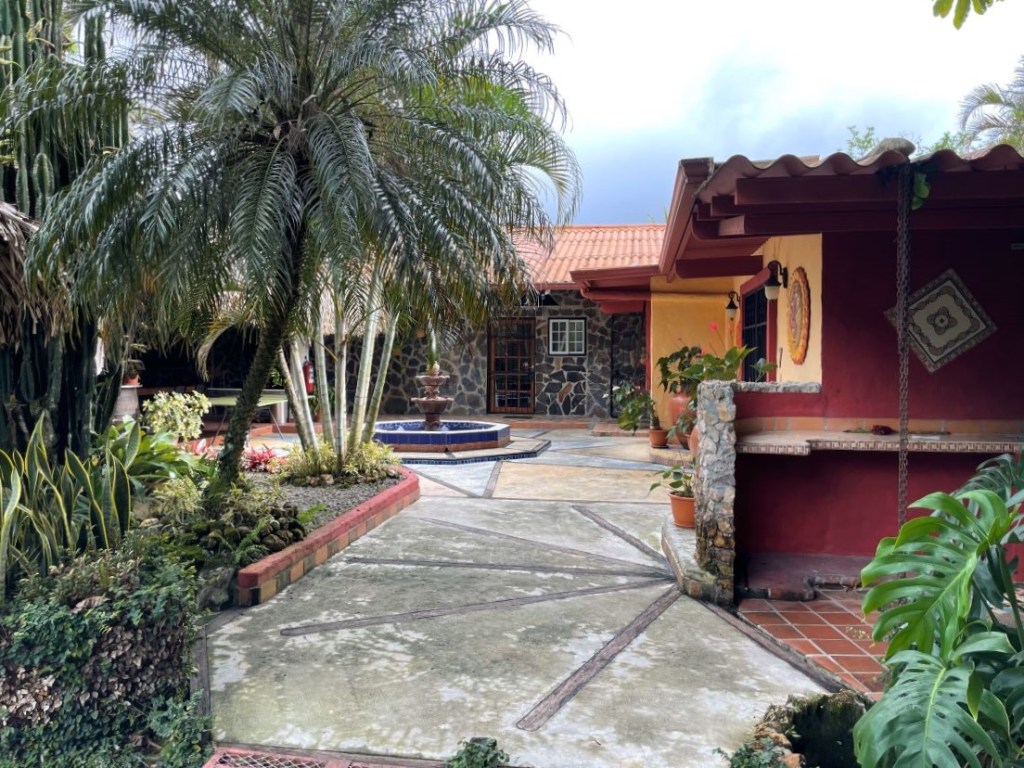
The door in the center of this photo was the room for Lydie and Cassie. The covered terrace is just to the left. Even better, Casa Grimaldo has a small but beautiful tropical garden. Once again, we felt lucky to be traveling in Panamá’s off season, as Julie and I had the garden entirely to ourselves while we enjoyed coffee surrounded by tropical plants.
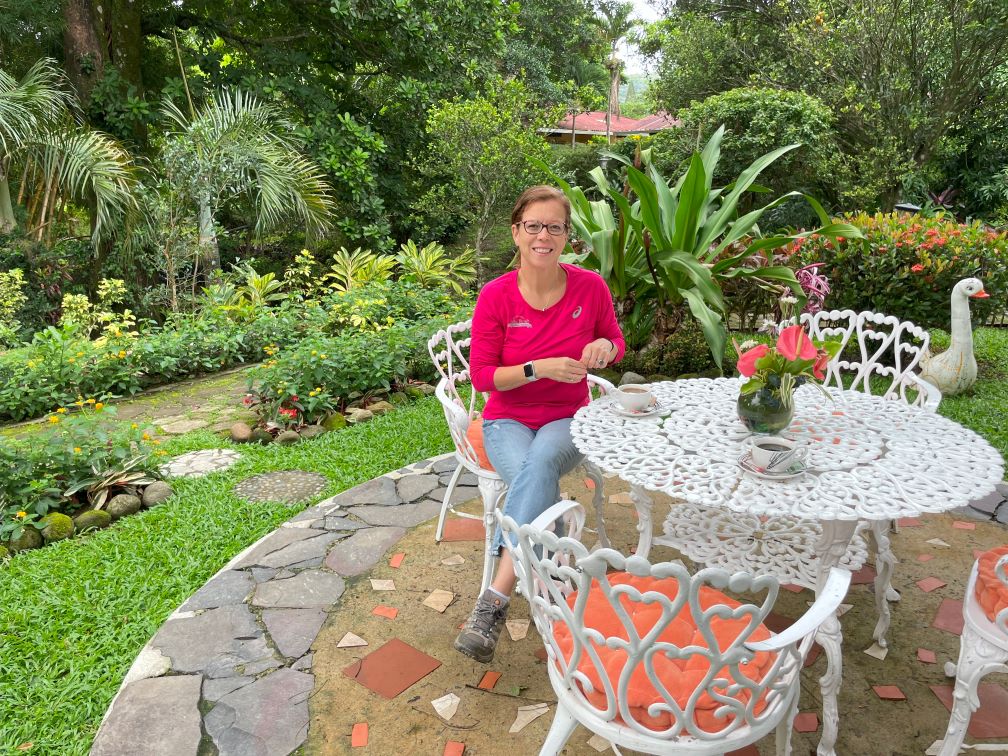
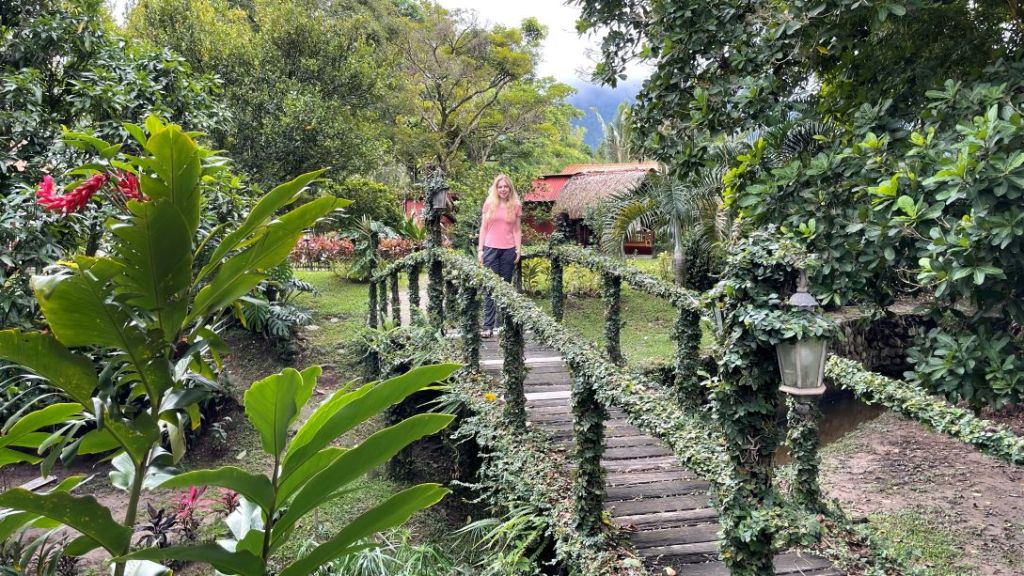
The girls soon woke, and we all enjoyed poking around the garden, searching for exotic plants.
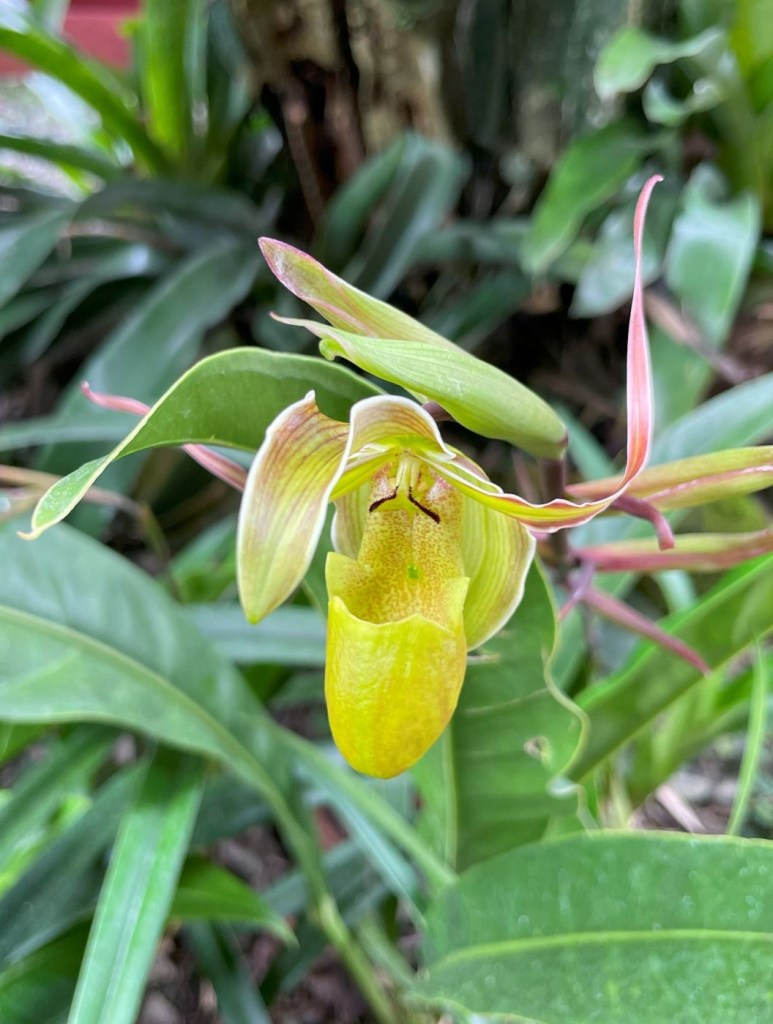
There were quite a few orchids in bloom. But I suspect that there are always orchids in bloom in Panamá.
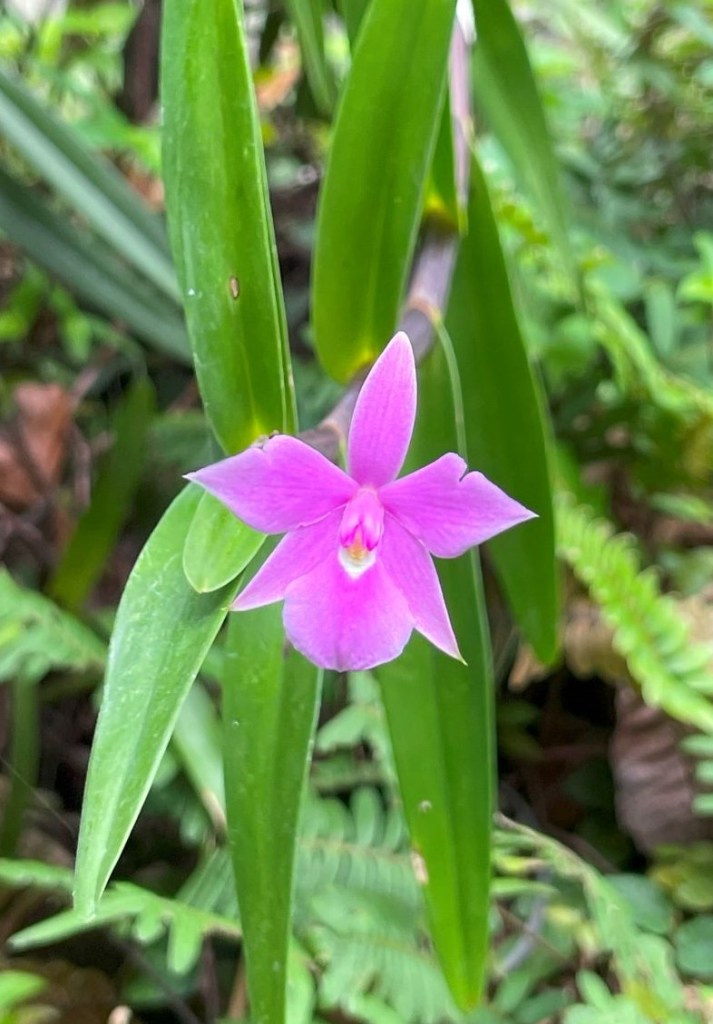
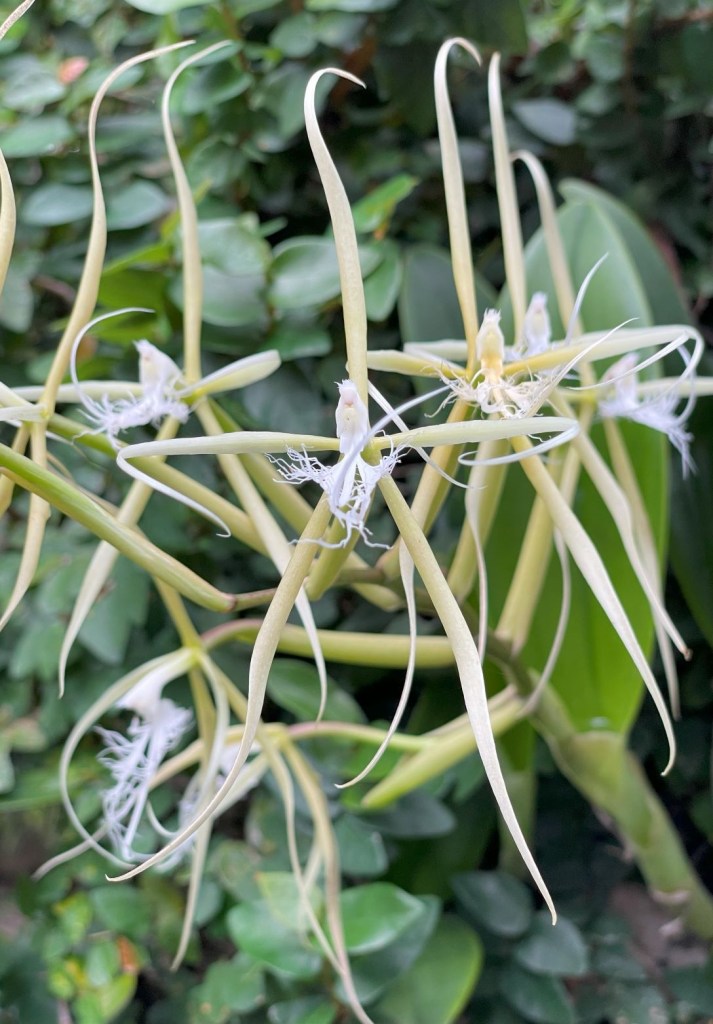
It started to rain/mist slightly, so we moved to the covered terrace next for breakfast.
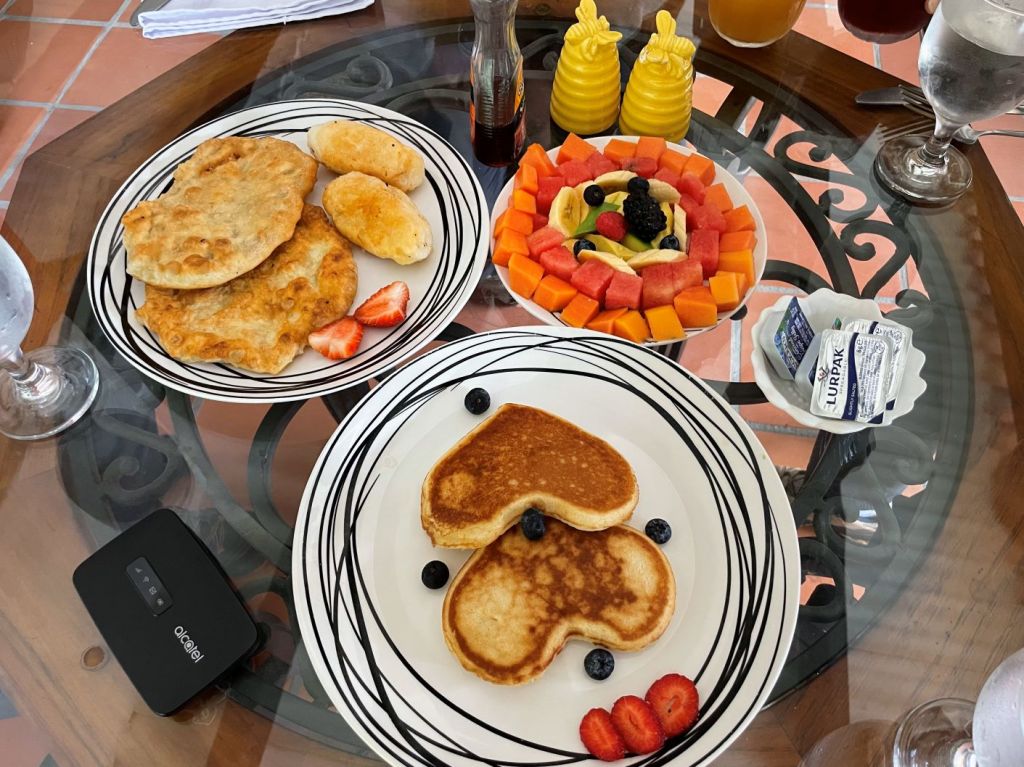
We had incredible fresh fruit – literally the best bananas we’ve ever tasted. And hojaldras! After breakfast, we geared up for our first activity of the day, which was to take a hike. Indeed, one of the reasons we came to El Valle is that it is known for its hiking. But Anton Valley is not your typical valley. Rather, it is a caldera from an ancient volcano with a tiny village nestled inside. Long ago, the caldera filled with water, and that water eventually wore passes through parts of the caldera walls. Much of the caldera remains, so that today you can hike parts of the ancient rim.
Our plan was to hike La India Dormida (“The Sleeping India”), which is probably the best-known hike in the area. The name of the hike comes from the profile of the ridge, which looks like a girl lying on her back. As we drove to trailhead, we could see the ridge above us, and the anthropomorphic shape was unmistakable.
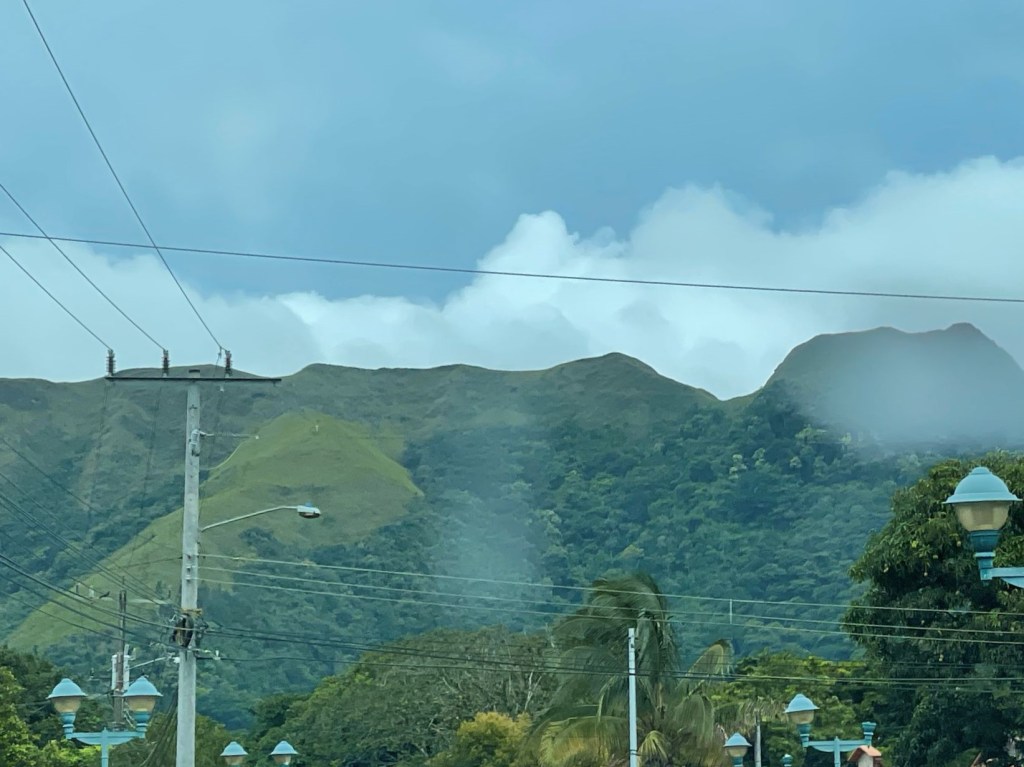
Note the sharp drop below the girls chin. That will show up later. We parked the car, paid a small fee at a booth near the entrance, and were off.

In researching hikes, La India Dormida was mentioned time after time, and I was a little worried that the trail would be too well worn to be interesting. From the very start it was clear that my concerns were unfounded. Almost immediately, we plunged into lush forests of trees filled with bromeliads, ferns, and orchids.

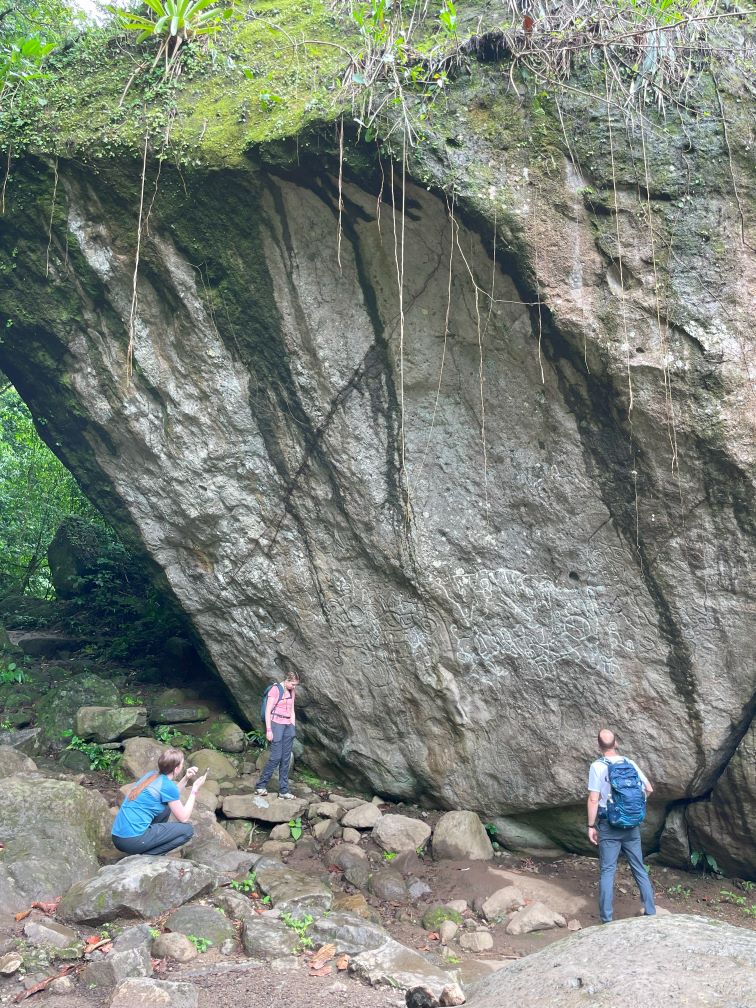
Early in the hike, the trail passes by La Piedra Pintada (“the painted rock”), a huge boulder with pre-Columbian carvings. Locals have filled in some of the carvings with chalk to make them easier to see, but the meanings of the carvings are unclear.
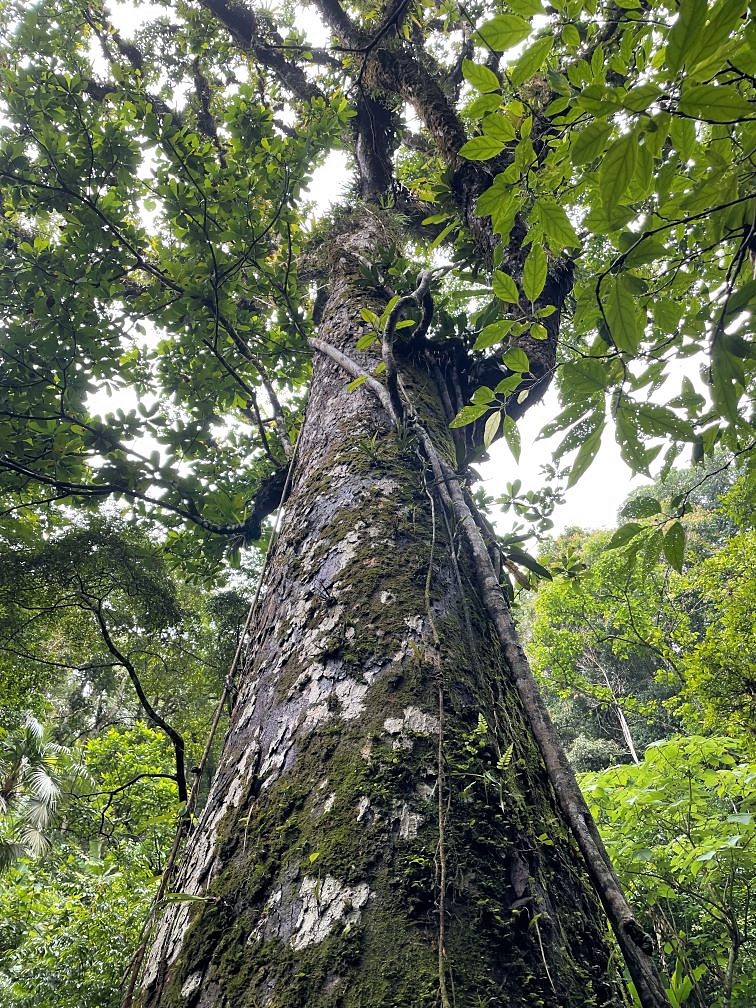
The trail then steeply climbs and the vegetation gets wilder. Some of the trees were massive.
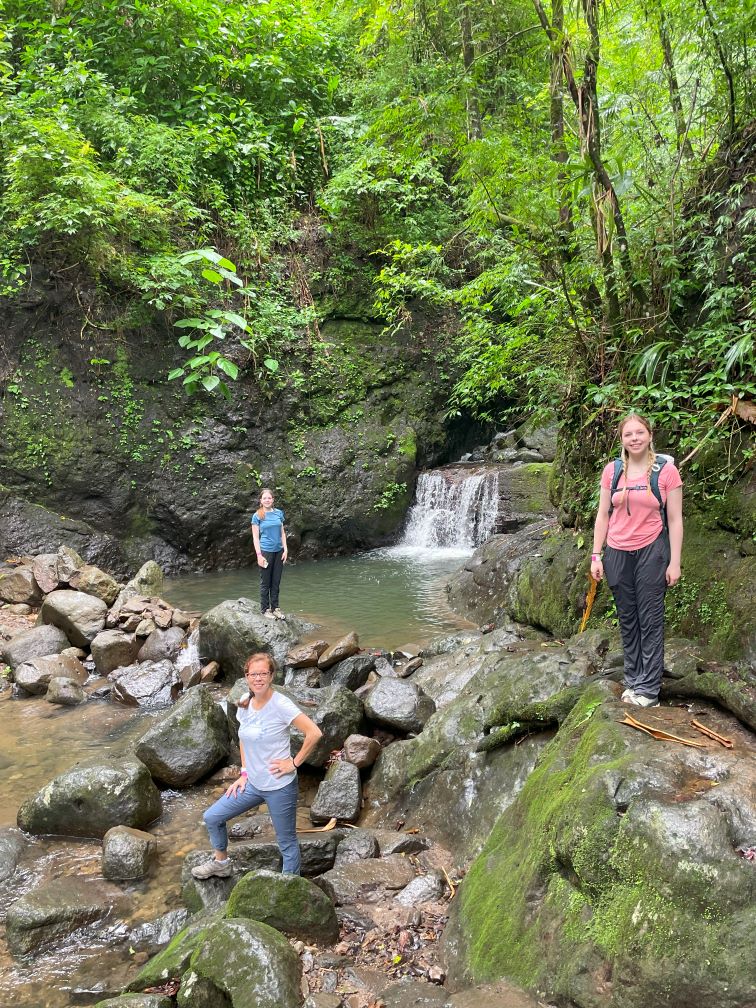
After a few minutes we reached a lovely waterfall.
We weren’t the only ones excited about the waterfall. So was this Brilliant Forest Frog.

We continued to climb, enjoying the views of majestic bromeliads.
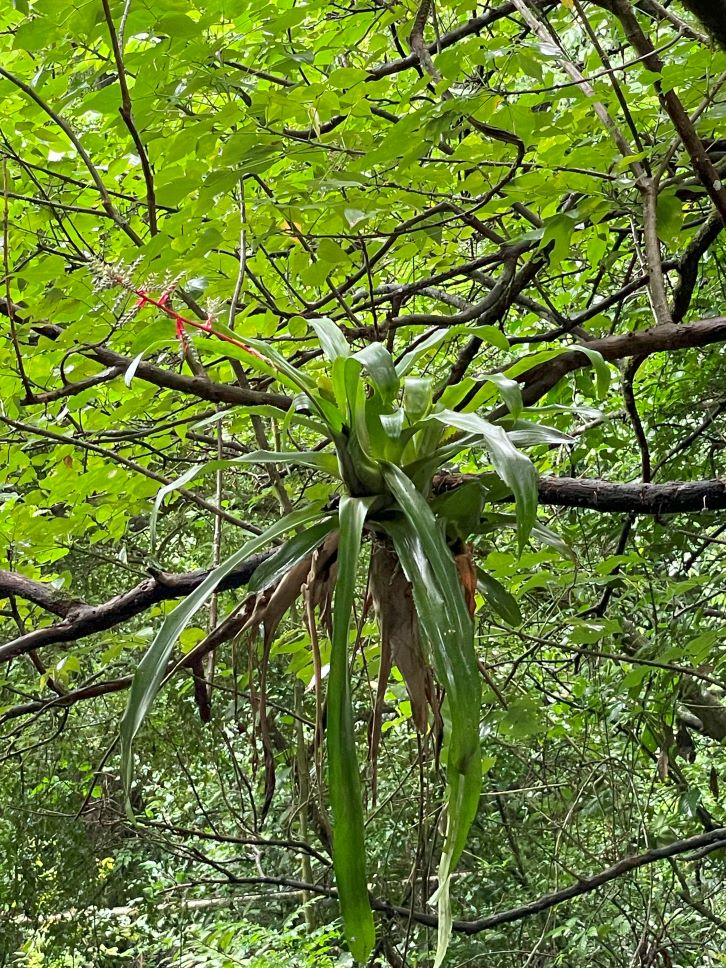
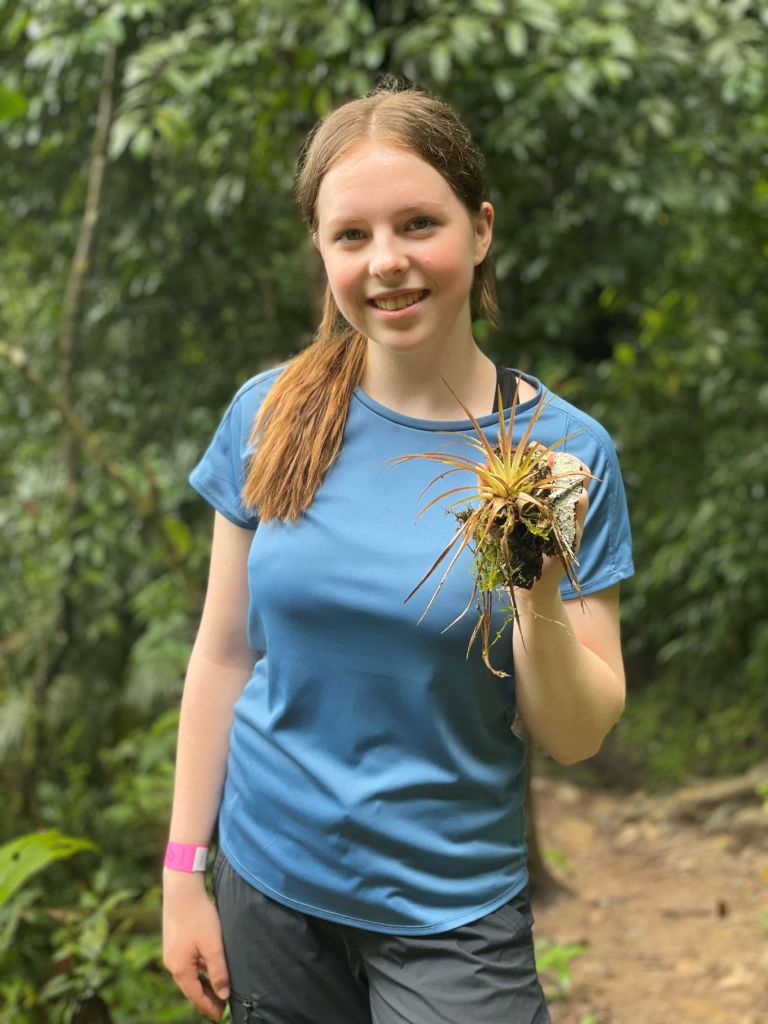
Although I grew up in Columbia, SC, I also grew up surrounded by bromeliads and orchids. My father is an avid gardener with a passion (or maybe obsession) for tropical plants. Seeing these huge specimens in their natural habitat was a treat for me. The trail soon passed by more waterfalls as we continued to climb. Along the way, Cassie found a recently downed bromeliad that she thought her grandfather would particularly like.
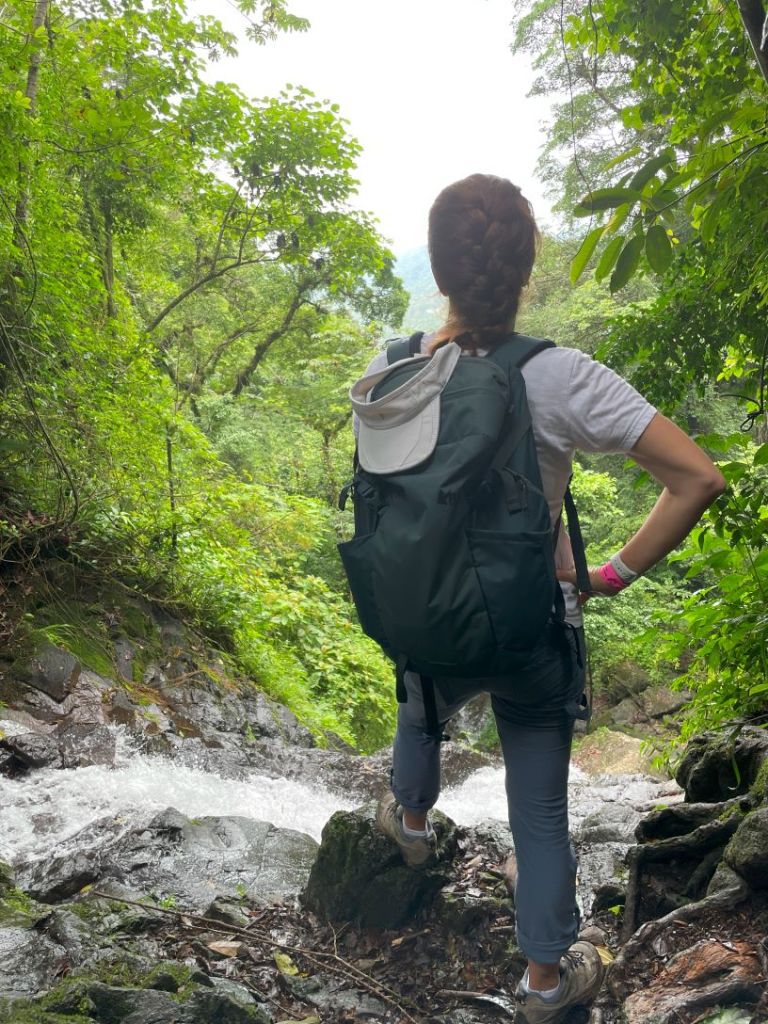
The trail circled around to the top of the waterfall, giving us some of the first views of the valley.
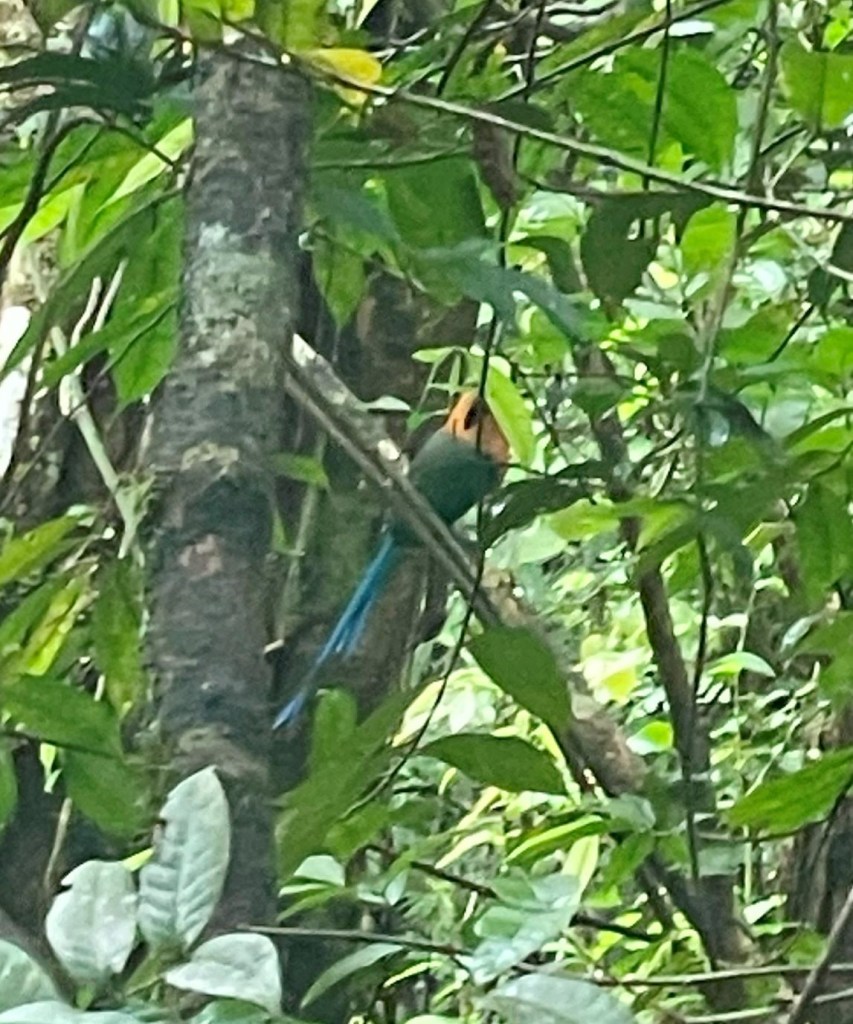
By this time, we were well away from the road, and we started seeing more wildlife, particularly tropical birds. We had been hearing birds throughout our hike, but they are hard to spot in the dense vegetation.

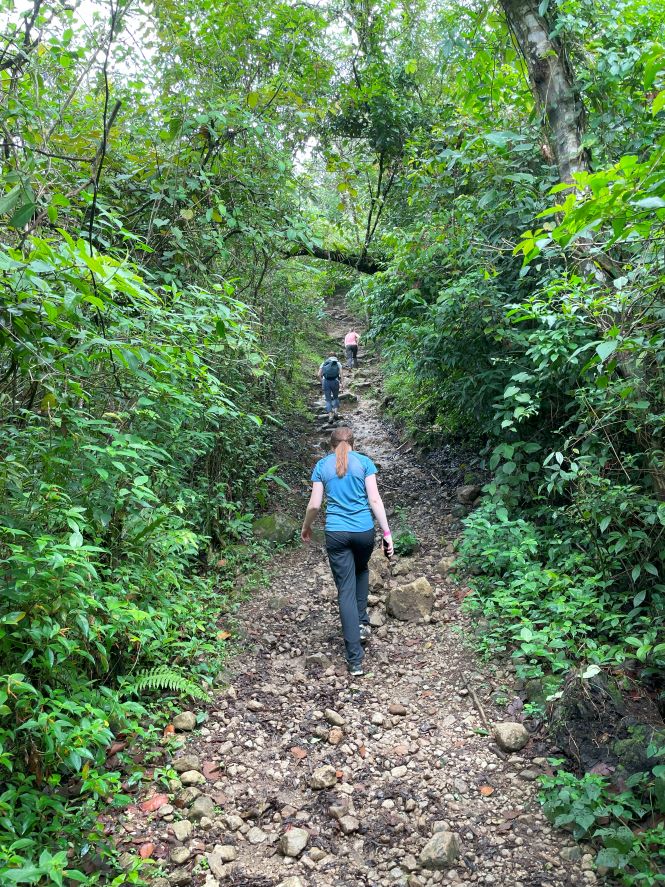
The trail went up, up, and up.
But the climbing paid off. We started getting better views of the valley. Then, we rounded a corner and passed out of the trees into the grass hilltops of the caldera rim, complete with some sharp precipices.
Cassie, Lydie, and I took a side trail to the top of the maiden’s “nose,” the tallest part of the hike.
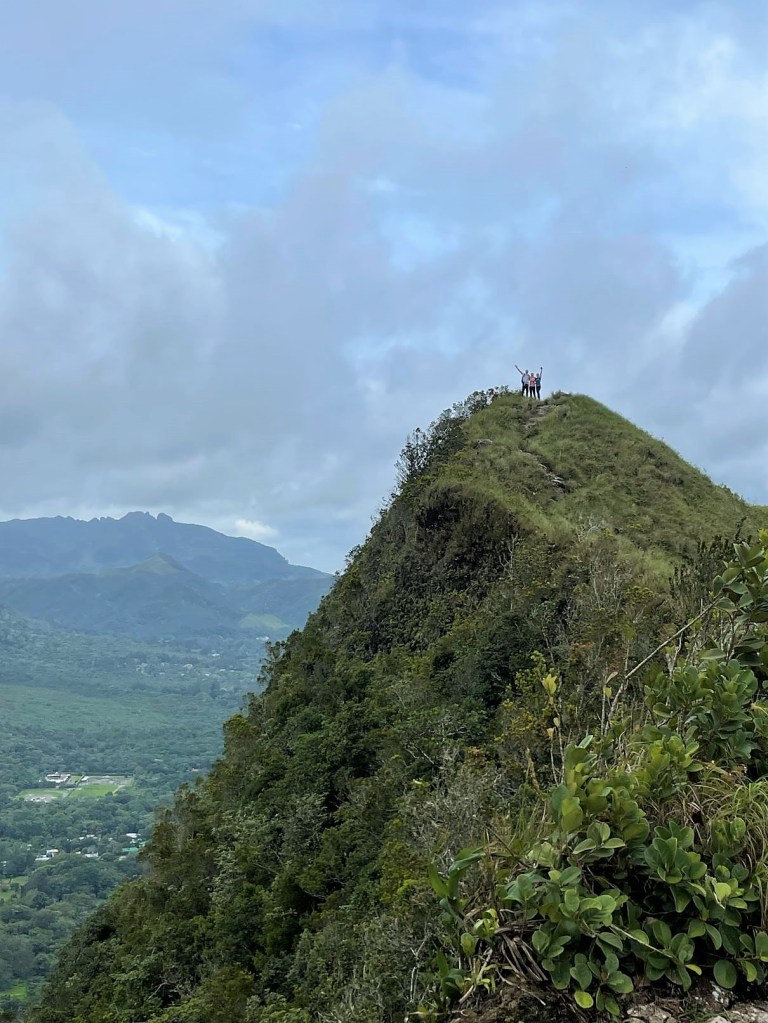
From there we started down her face, reaching her “lips.”
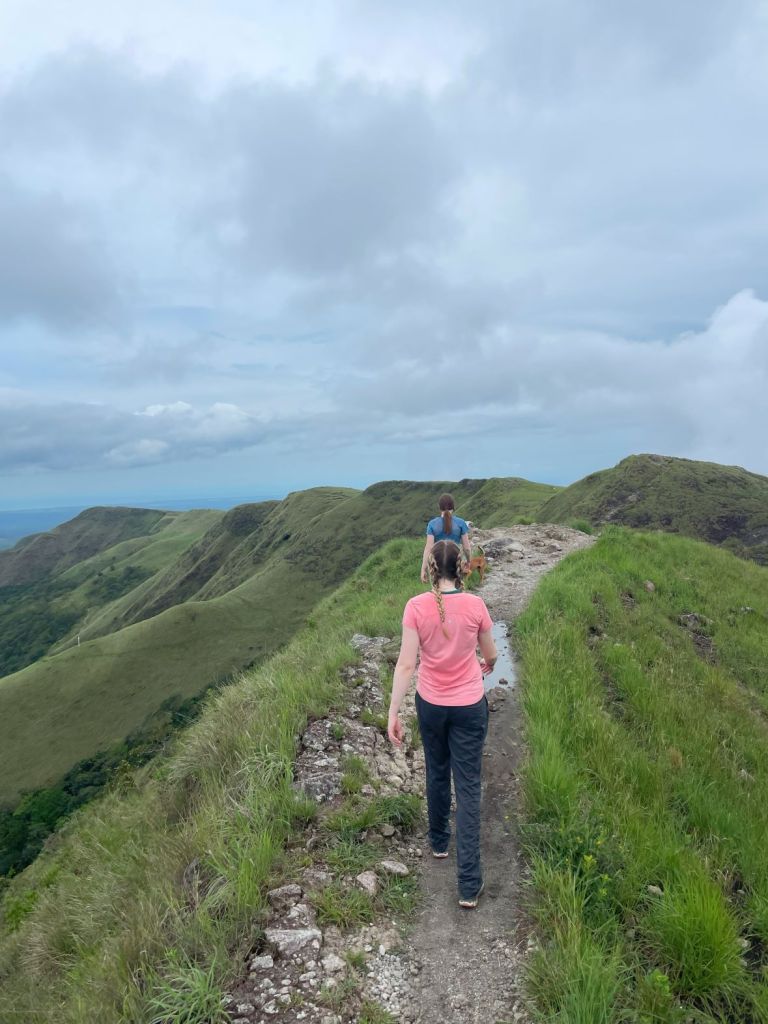
We could see the entire caldera and village stretching out below us. We could also see a cave into the side of the hill in the distance. Just before we began to descend her “neck,” we came across a dog amusingly barking at his own echo.
The dog ran off to find his echo, and we started to head down. The trail was seriously steep, requiring the use of hands in quite a few spots.

Along the way, we spotted some beautiful bugs that fortunately were not the stinging or blood sucking kind.
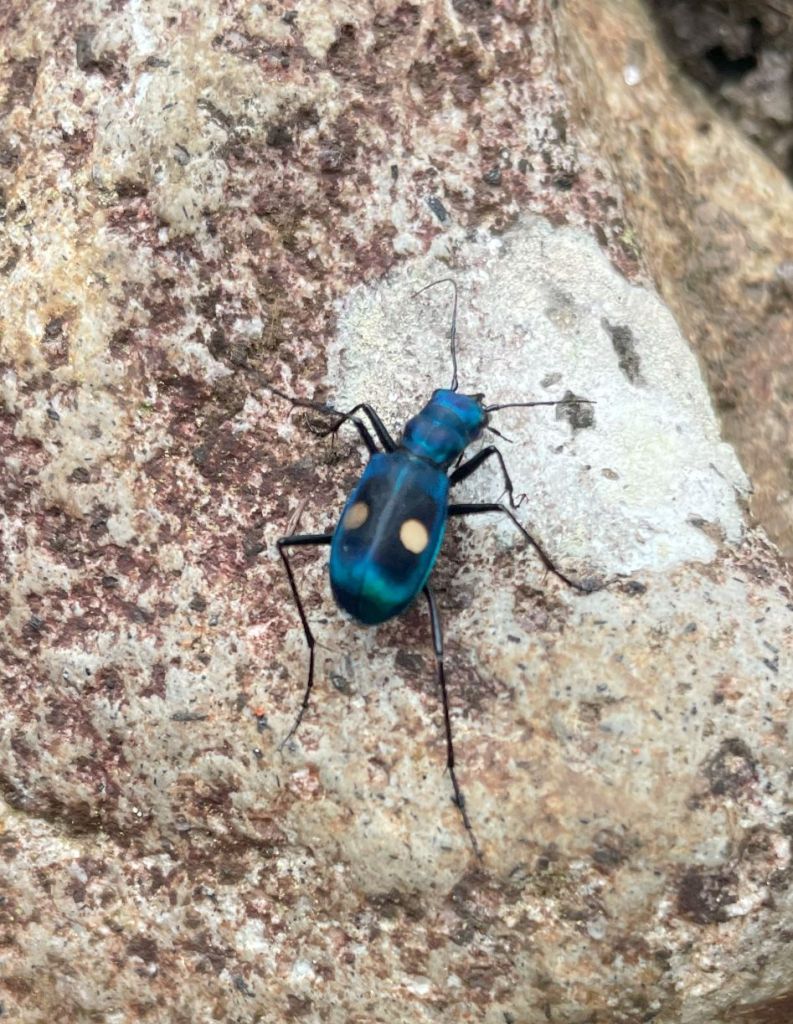
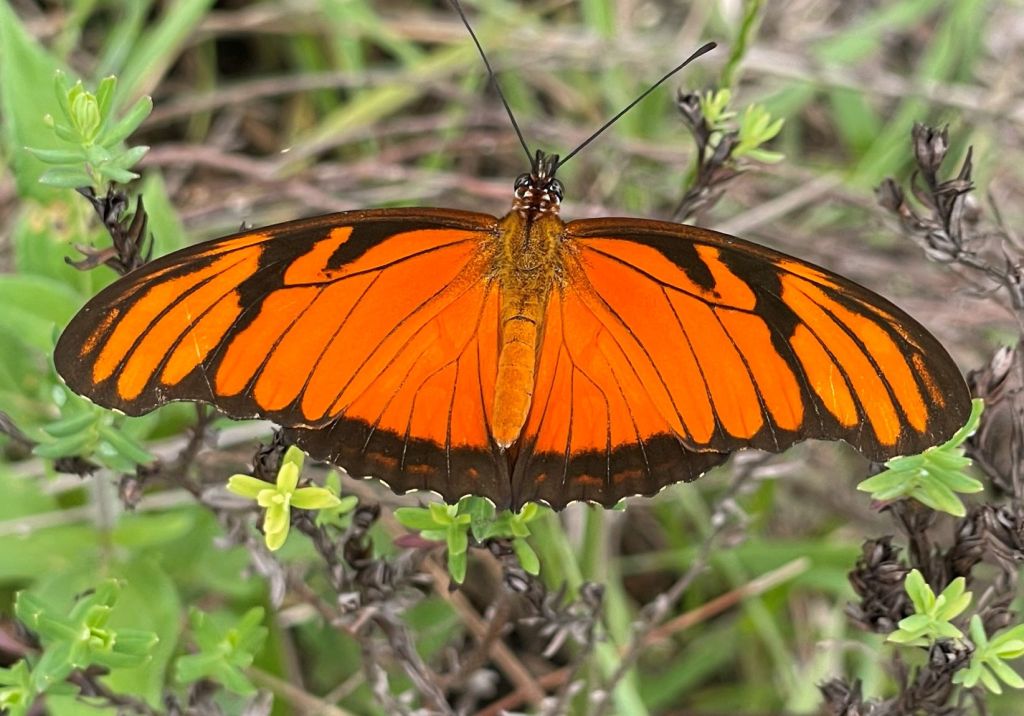
Once back up the maiden’s “chest,” the path leveled out, providing wonderful views all the way to the pacific.

Soon we reached our turnoff to head back down. We actually walked right by the turnoff, but we were using an app to follow the trail, which helped get us back on track. It’s worth noting that this was not a trail for which you need a guide. An app or a map would be enough. (Later in the week we did a hike for which a guide was super important.) The trail heading off the ridge was of course steep.
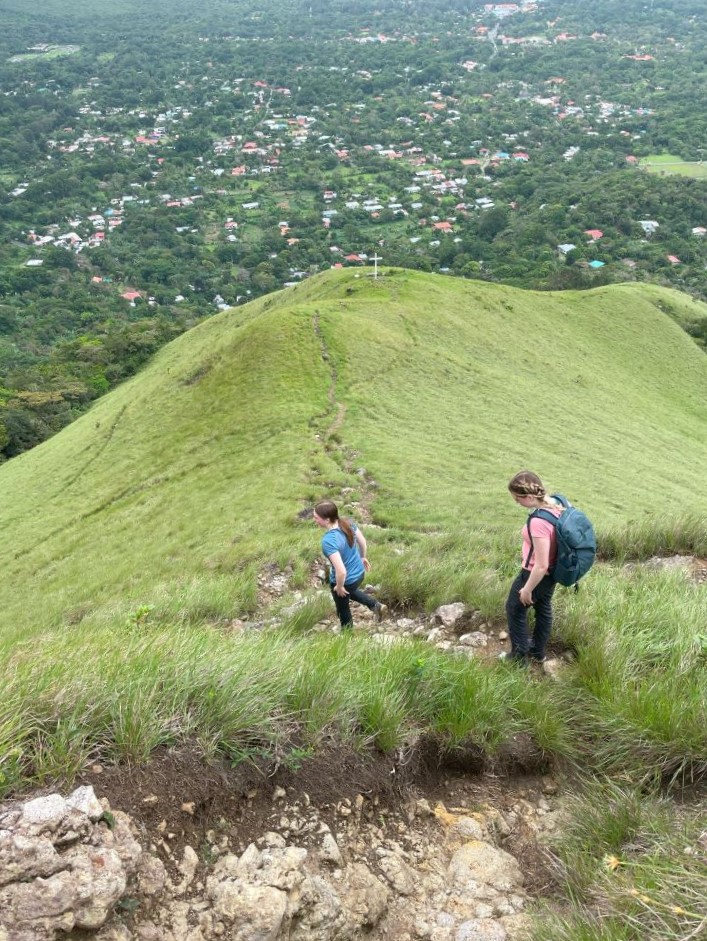
Lucky for us the path down passed near the cave we had seen earlier. Side trip!
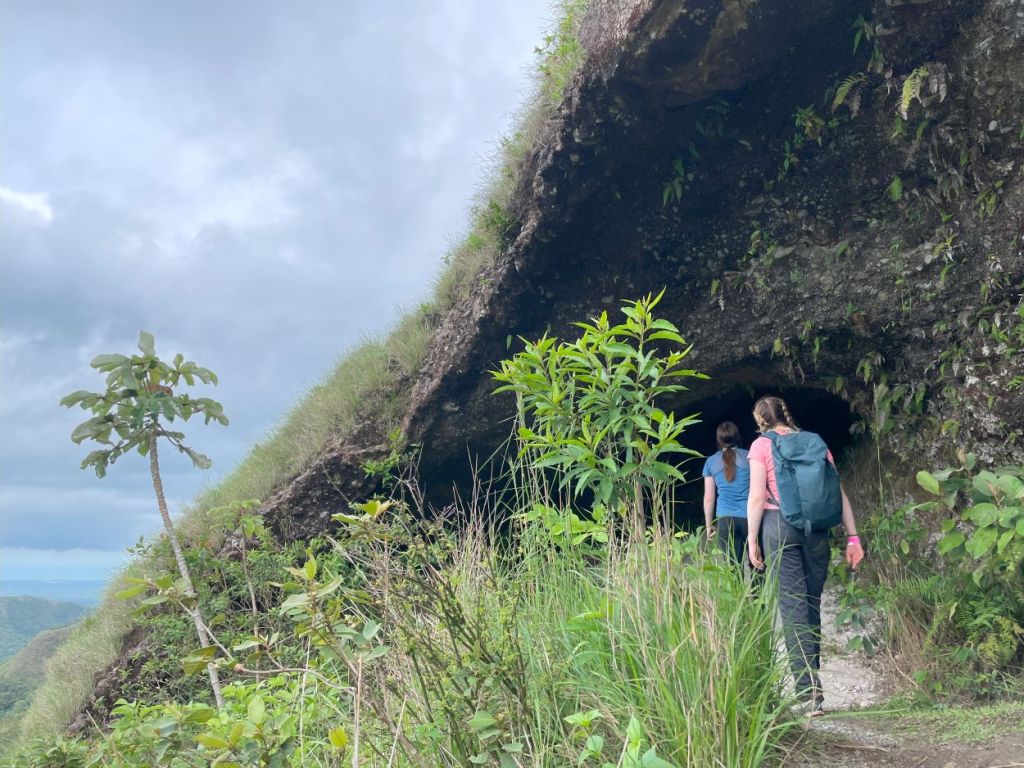
The cave reminded me of the shallow volcanic cave we saw in 2022 in Fuerteventura, which I suppose makes sense given that both caves are volcanic.
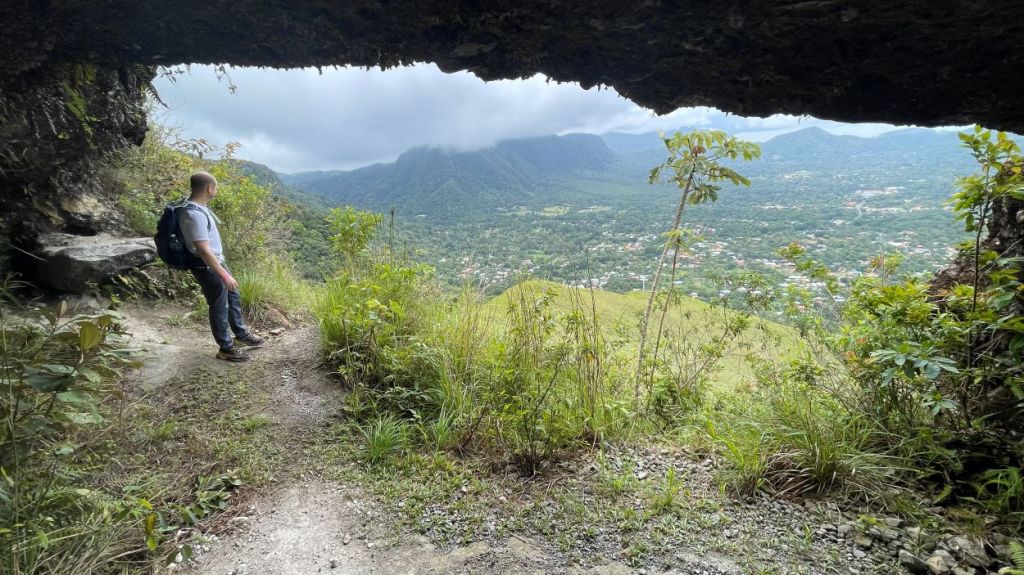
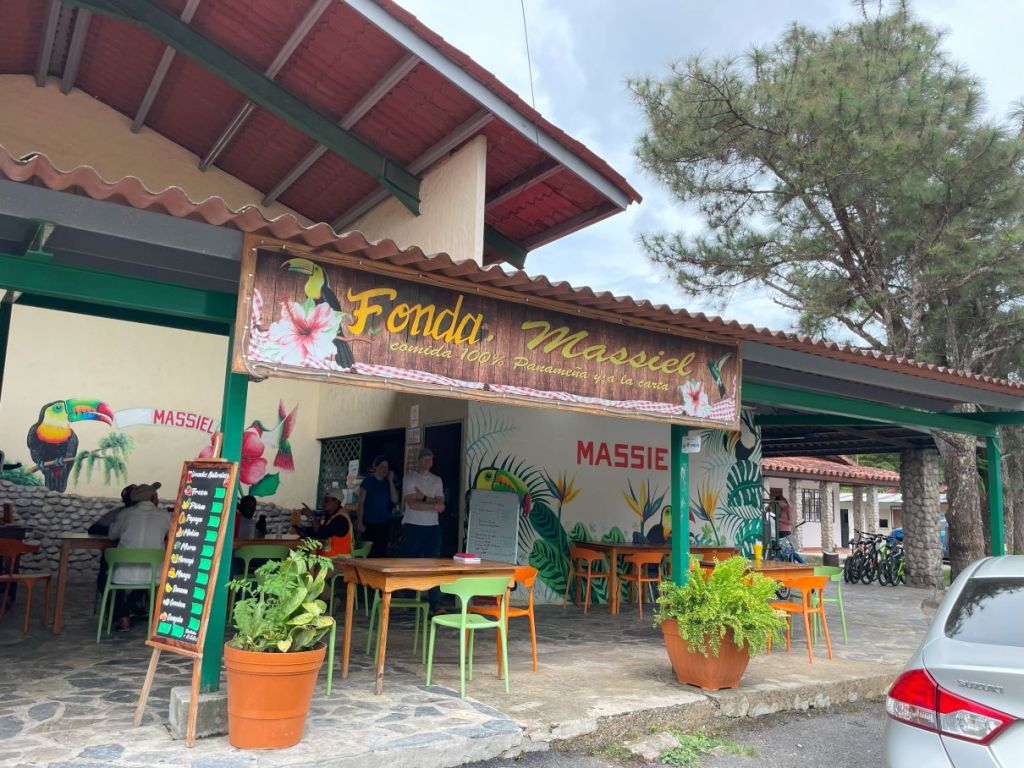
The cave was filled with ferns, even in the sheltered back of the cave. I expect those ferns get their water from the clouds that sometimes blanket the caldera. After visiting the cave, we continued down the trail, eventually passing into dense forest before reaching a road, which we took back to the car. The hike had taken us about 4 hours. We cleaned our shoes in some puddles, hopped in the car, and headed back to town to find some lunch. We found a great place with outdoor seating that served local food — things like roast chicken, rice, and plantains. We got fruit smoothies with crushed ice to cool us off, too — strawberry for Lydie and Cassie and guava for me. The table next to us was filled with construction workers, suggesting that the food was truly Panamanian.
After lunch we had to decide what to do next. Initially, we had thought about doing two hikes, one before lunch and one after lunch. But La India Dormida had already been quite a challenge and had provided us with wonderful experiences. A second hike would be somewhat redundant. Instead, we decided to head to Pozo Azul — a series of waterfalls and pools in the jungle. The problem is that Pozo Azul wasn’t described in our guidebook.
Indeed, I had a little trouble getting guidebooks for our trip. Only one, The Lonely Planet, was recently updated, with the current edition published in 2022. Frommers and Fodors both dated to 2016, National Geographic to 2015, and Moon to 2013. Given the impact of covid, I was doubtful that the information in those older guidebooks would be useful. In contrast, for Costa Rica, all five guidebooks have been updated since 2021. Even for Lonely Planet, the Costa Rica guide is 544 pages, while the Panamá guide is 320 pages. This discrepancy mystifies me. Both countries have so much offer, from rainforests to mountains to beaches. Both countries are easy to reach from the US. And both countries are extremely safe. The Institute for Economics and Peace produces the Global Peace Index, which is the world’s leading measure of global peacefulness. In the 2023 Index, Costa Rica ranked a blissful 39th, while Panamá ranked 68th. This might sound bad, but the United States ranked 131st. Indeed, Panamá’s relatively safety is one of the reasons we decided to visit. And Americans routinely visit Trinidad (69), Jamaica (77), the Dominican Republic (83). Moreover, it’s not like there are no tourists going to Panamá. There are heaps. In 2019, the last full year before covid, 2.5 million tourists visited the country. It’s just that many of the tourists tend to come from South America and Europe. I expect that tourist amenities in Costa Rica are more developed, but given our experience, I can’t help but wonder if Panamá may be at an inflection point for American tourists.
In any event, let’s get back to Day 3. Because of the lack of up-to-date guidebooks for Panamá, I had been researching our trip online, looking at blogs and videos on YouTube. A couple of these had mentioned Pozo Azul as a cool place to visit. In planning the trip, I had dropped a pin on Google Maps just in case, but I didn’t remember all of the details. I knew we would have to drive to where I dropped a pin and that we would have to find someone to take us the rest of the way in a 4×4. How to make that all happen was a little up in the air. And we didn’t know how things would be different in the off season. Nevertheless, we geared up, and headed out.
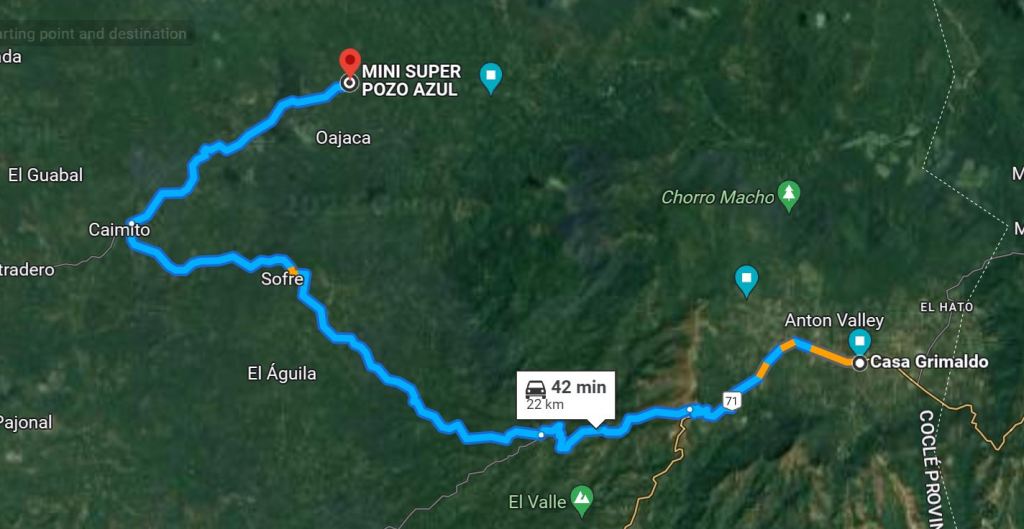
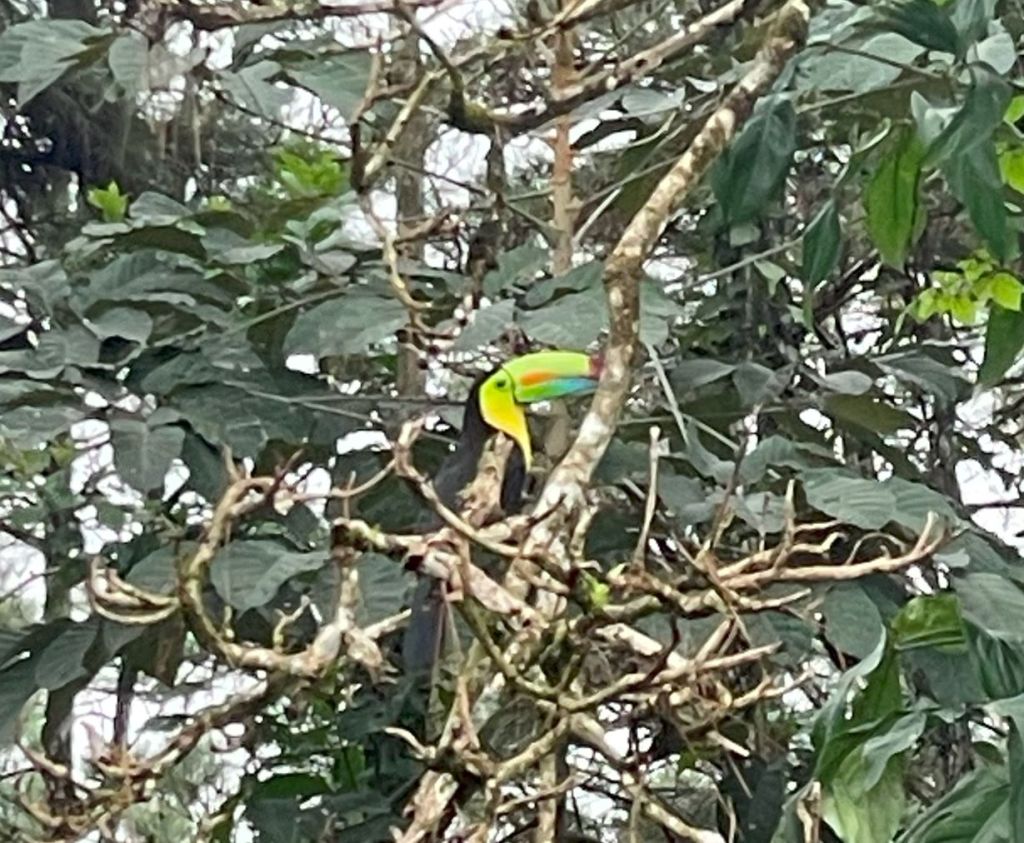
The roads were paved but small, steep, and twisty. When we passed through small villages, there were frequently dogs sunning themselves on the road. We often passed through dense jungle. As we neared Pozo Azul we were excited to spot a toucan sitting on nearby tree.
We soon reached the pin on the Google Map, where a dirt road intersected the paved road. I recognized the place from one of the videos I’d seen, but there was nobody in sight with a 4×4. There also weren’t any cars parked nearby indicating that other tourists had come this way. Next to the road there was a woman on a covered porch, and Julie asked her if this was the road to Pozo Azul. She replied that it was, but also said that we wouldn’t make it in our car. Keep in mind that we had rented an SUV. The woman then looked up and yelled across the intersection, “Roberto!” a few times. A man soon strolled out of a nearby yard surrounded by a fence. He exchanged a few words with the woman, and then turned to another man in the yard. Soon, the car in Roberto’s covered driveway was being moved, and Roberto was waving for us to park there. We weren’t sure what was happening but went with the flow. We hopped out of the car, hoping that Roberto was going to take us to Poco Azul.
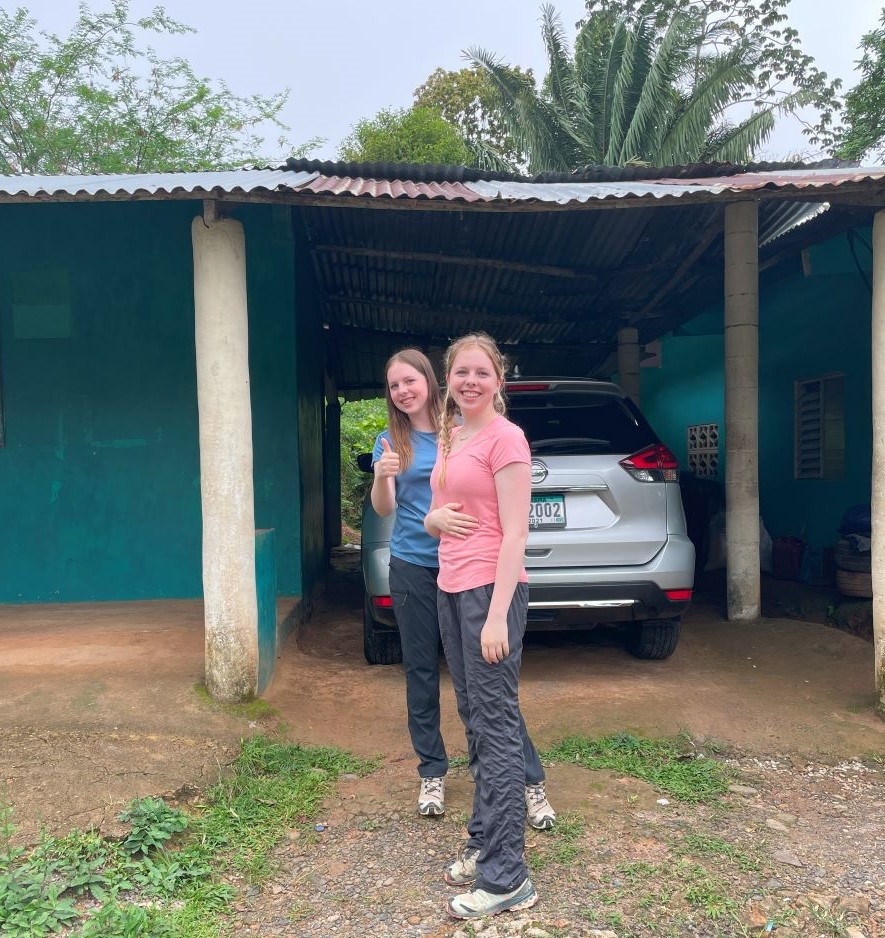
Unfortunately, Roberto couldn’t help. Even worse, Roberto didn’t speak any English, and we were barely able to communicate in Spanish due to his unfamiliar, thick accent. We were pretty sure that he told us that we needed to find Richard, who could drive us. But our phones weren’t working, so Roberto called Richard. We were fairly certain that Roberto told us to walk back to the intersection to wait, but not much of this was making sense to us. Why did we park at Roberto’s house? Why did he insist that we park under the carport? Were we really in the right place?
Choosing optimism, we headed back to the intersection to wait for Richard. I want to emphasize that at no point did the unnamed woman or Roberto ask us for money. That might have been kindness on their part, but that also might indicate that we were not in the right place, as surely people would ask for money for providing services in a tourist destination. Before long, someone arrived in a 4×4, and said his name was Richard. We were comforted to see that there was bench seating in the back, perhaps indicating that we were on the right track after all. For $1 per person, Richard agreed to take us, so we climbed in.
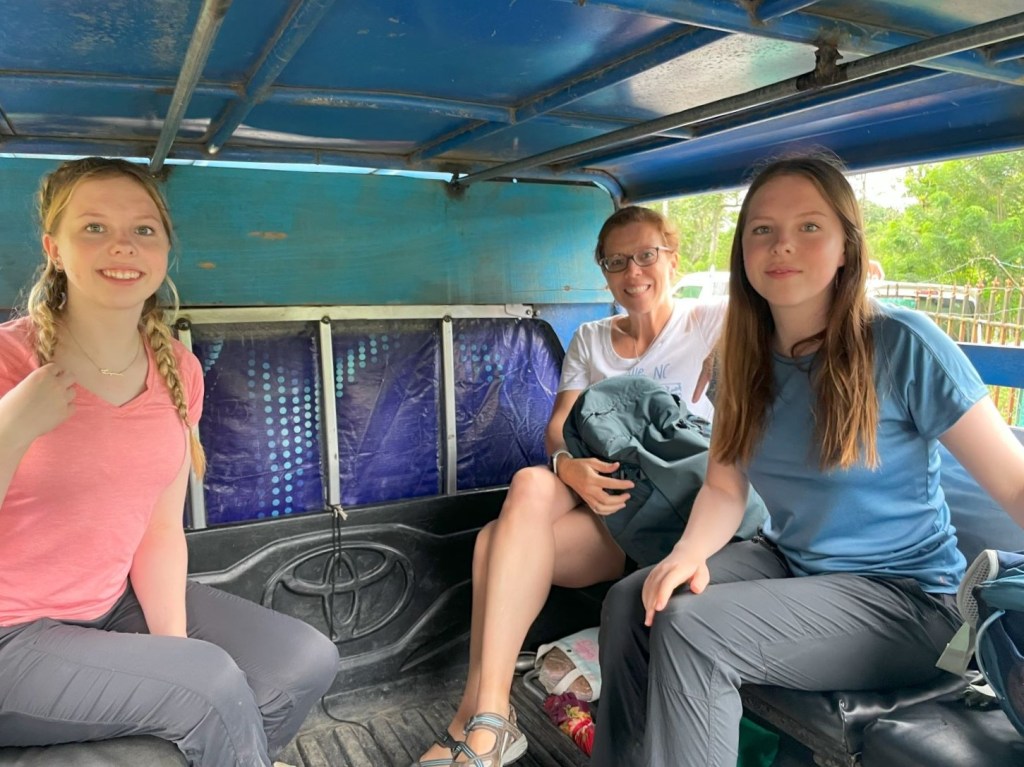
From the start, it was clear that we never would have made it down the road. It was steep and rough, clearly requiring four-wheel drive. Along the way, the road passed by houses and areas of wilderness.
At a couple of places local people hopped into the truck and then later got out. We thought that perhaps Richard drove the equivalent of the local bus. Or again, perhaps we were in the wrong place. Soon, it was just us, and the road became even rougher, passing through wild areas of jungle.

We were bouncing around in the back, laughing while holding on to keep from smashing into each other. I was suddenly struck by the absurdity of the situation. We drove to an intersection, parked our car in somebody’s yard, and hopped in the first 4×4 heading off into the wilderness. We were either on our way to finding a wonderful hidden gem or digging ourselves into a hole that was going to be awkward (if not dangerous) to get out of. We all got a little hysterical.
After about 30 minutes, we stopped, and it was clear that our concerns were unnecessary. This was the place we were looking for, and it was, in fact, a hidden gem. With the sounds of waterfalls in the distance, we paid a few dollars to a gentleman standing by a gate and headed down a steep staircase to the river.
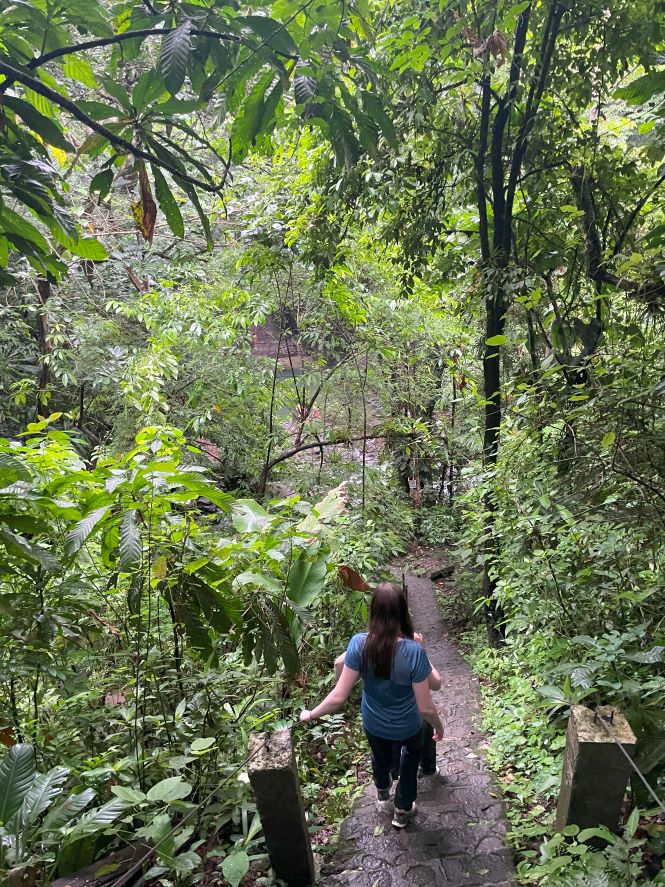
When we reached the water, we found beautiful waterfalls cascading into blue-tinged pools. There was a group of locals jumping off the first waterfall into a natural pool. We used wooden ladders and steel cables to climb upstream past the first waterfall to the second pool, which was empty.
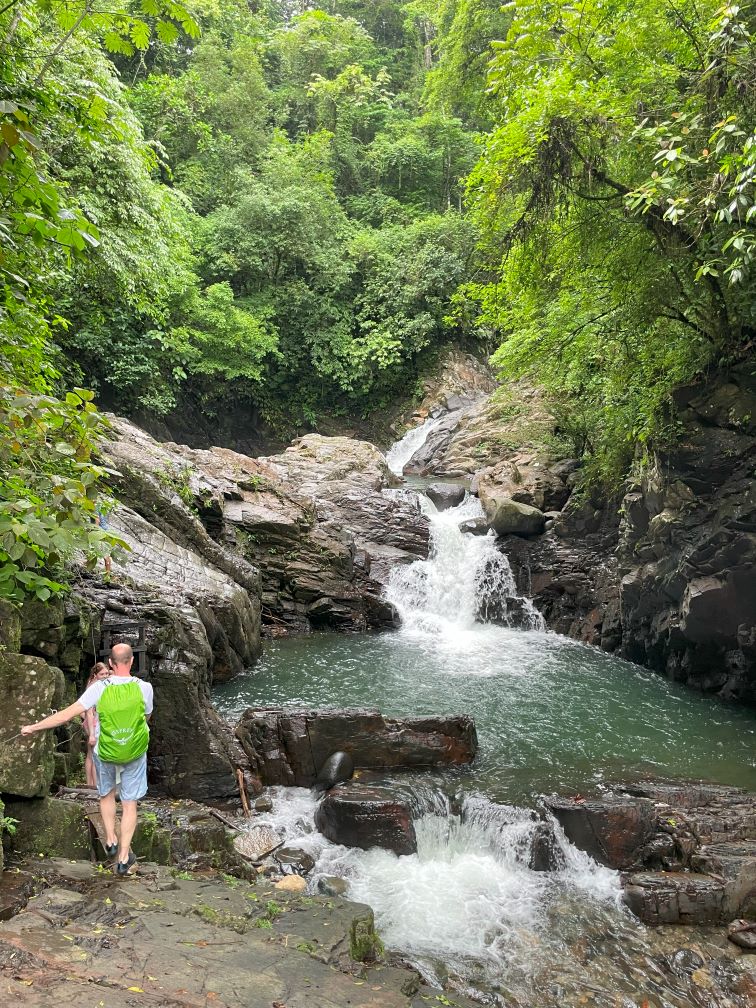
Each pool was prettier than the one before, so we kept climbing past the second waterfall to a third pool, which was also empty. Team Hubbard loves to jump off things into water (e.g., Greece and Spain), but we were a little unsure where to start. We weren’t exactly close to medical facilities if something went wrong.

Fortunately, a guide of sorts joined us briefly to point out where we could jump into the water. (He insisted that it was safe to dive, but that was a hard no for us.)
We picked a relatively low spot, and Lydie got us started.
I went second, bracing myself for the cold shock of a mountain stream. But this is Panamá. The streams aren’t cold. They feel fantastic!
Cassie was hot on my heels.
Now that our feet were wet, we switched to a higher jump.
The girls jumped without any hesitation. Starting with Cassie…
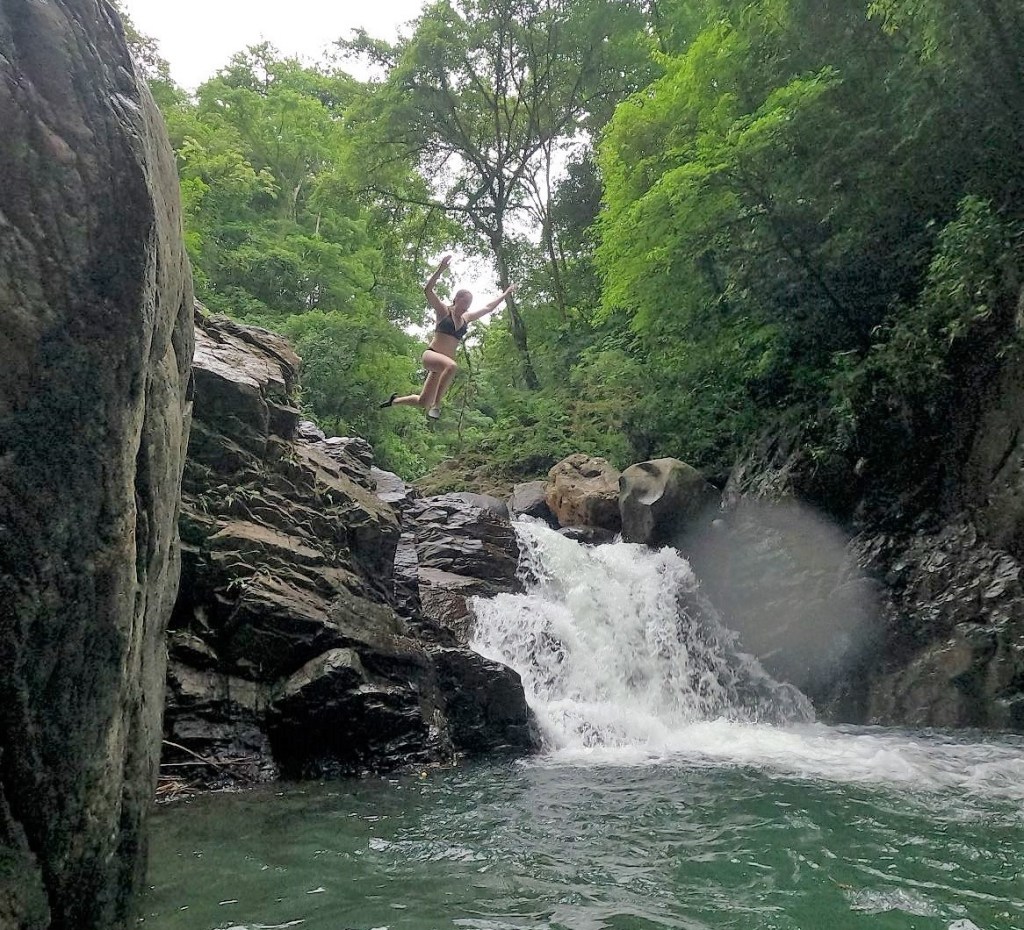
… and then Lydie.
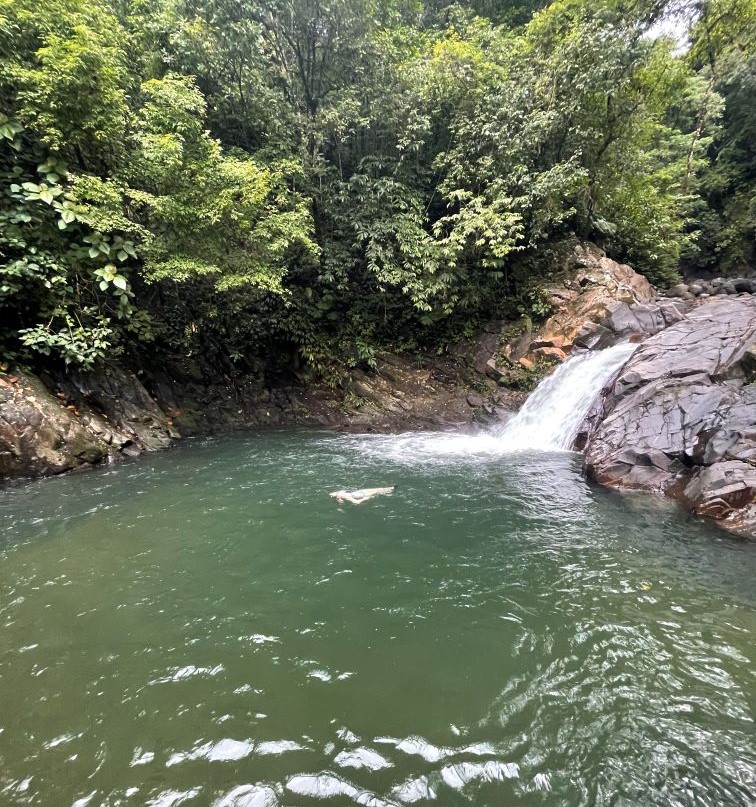
We also enjoyed swimming in the large pool. We skirted the waterfall and then pushed off into the current. Lydie enjoyed floating in the jungle pool.
The girls and I were curious about the next pool up, so we swam across and climbed up.

We soon reached the fourth pool. Lydie couldn’t take it all in.
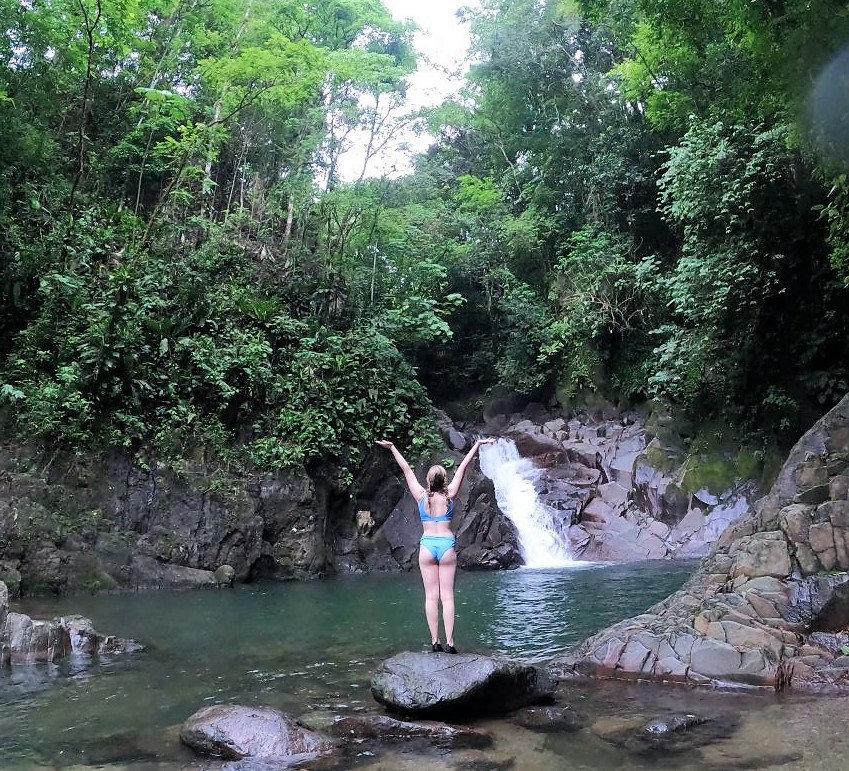
The waterfalls and pools were certainly the focus of our time, but the setting was unbelievable. We’d stop from time to time to look up at the massive tropical trees covered with bromeliads, ferns, and orchids. The fourth pool was beautiful, but the jumping was better where we were, so we headed back.
By this time, we’d worked up our confidence in the depth of the pools and switched to a third, higher jump spot. This spot was a boulder wedged into the cliff next to the waterfall. I jumped clear across the waterfall.
Showing no fear, Lydie jumped straight into the wash from the waterfall.
Cassie likewise didn’t hesitate.
This was our favorite jump spot, mostly because it was so high. We climbed back around and jumped a few times. It was time to head back. It was starting to get dark, and I didn’t love the idea of driving into El Valle in the dark again. I took a time-lapsed video of our return drive with Richard, but the image-stabilized video doesn’t do justice to just how bouncy the drive was.
We walked back to Roberto’s house to get the car. I thanked him for his help. He still didn’t ask for any money, and I was again impressed by the people of Panamá. One good turn deserves another, and I gave him a small tip anyway. Our drive back to El Valle passed without incident. I’m no Richard, but our trips with him made the paved road back felt somehow less steep and less twisty. And maybe we had been blessed a bit by the waters of Pozo Azul.
By the time we were showered, most of the restaurants in town were closed, so we ate at Zapote Restaurant, which claimed to have the best pizza in El Valle. It was, in fact, great pizza. As we waited for our pizza, we played cards and drank Balboa. Our night ended with our legs tired, our bellies full, and our spirits soaring.
-Will
 The Hubbards' Travel Blog