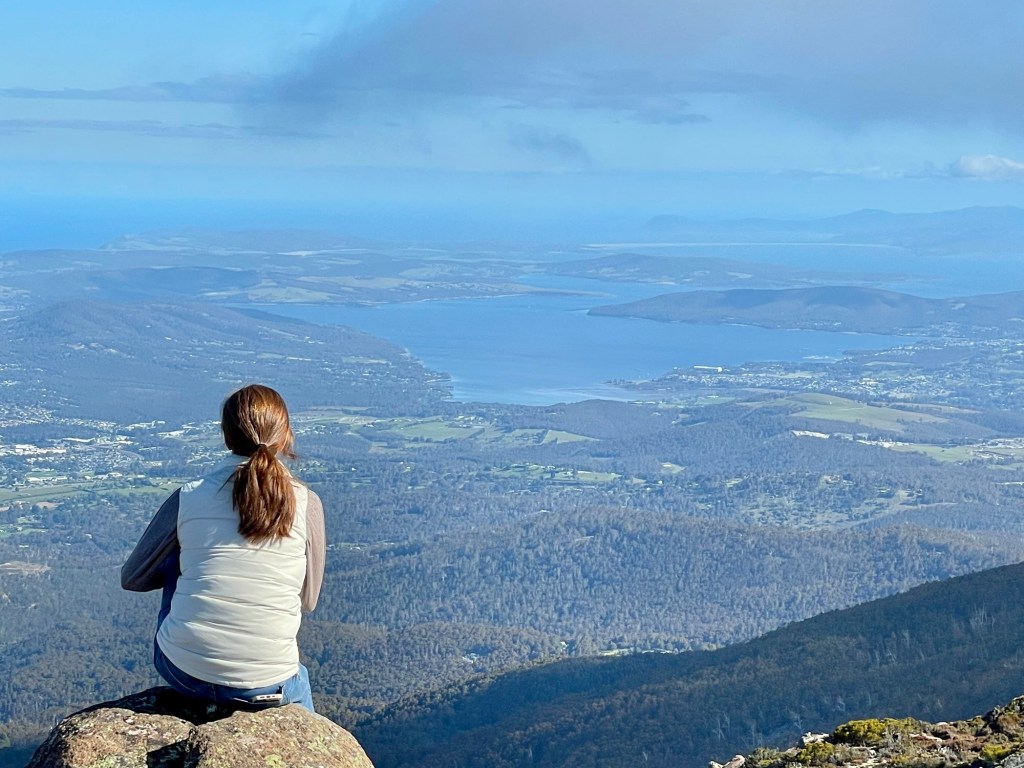
We spent our last couple of days in Tasmania exploring Hobart. For most of November 21 we caught up on work, but by the end of the day we decided to drive up to the top of Mount Wellington, the 4,000-foot peak that overlooks Hobart. It was a clear, sunny day, giving us great views of Hobart’s harbor to the east.
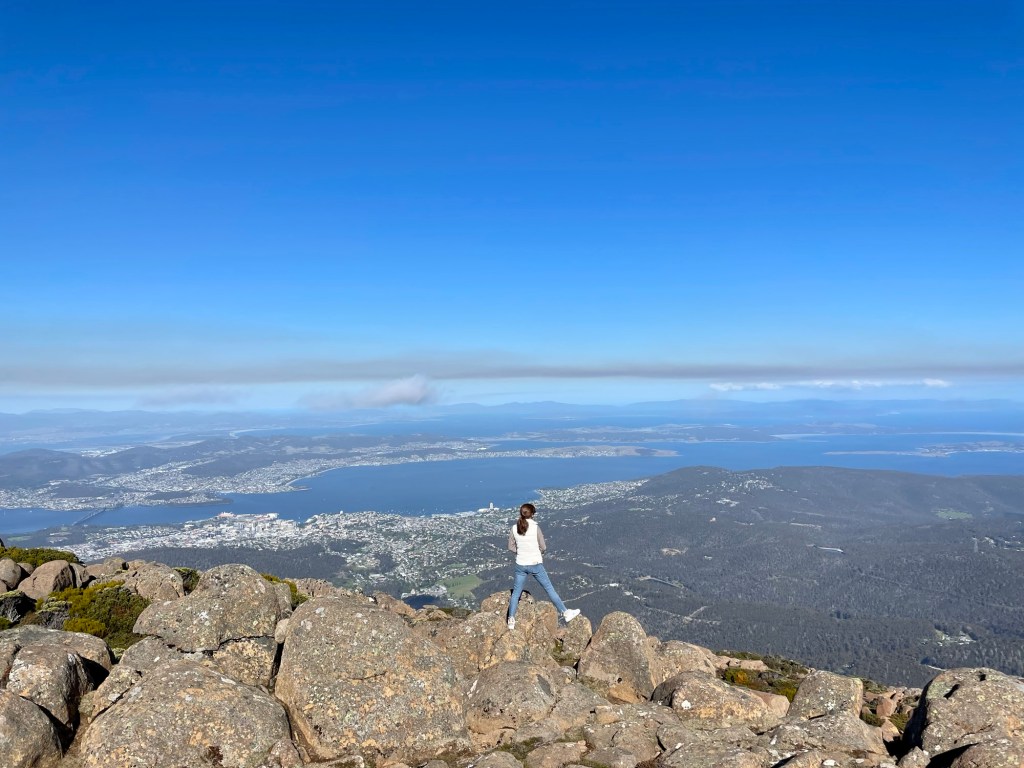
Far in the distance to the south, we could see Bruny Island, including the Fluted Cape where we’d been hiking the day before.
The next morning we headed downtown to the Salamanca Market, an outdoor market held every Saturday. We enjoyed poking through stalls for local crafts and picked up a couple of presents for friends, family, and our dog. For lunch, we got some Tasmanian paella (a funny riff on the Salamanca market) from a food truck and ate outside, enjoying the warm weather.
After lunch, we drove to MONA — the Museum of Old and New Art. The museum displays a private collection of art assembled by David Walsh, a billionaire who has made much of his money through gambling. From what I’d read, visiting MONA is a surreal, mind-bending experience, and we were excited to see for ourselves.
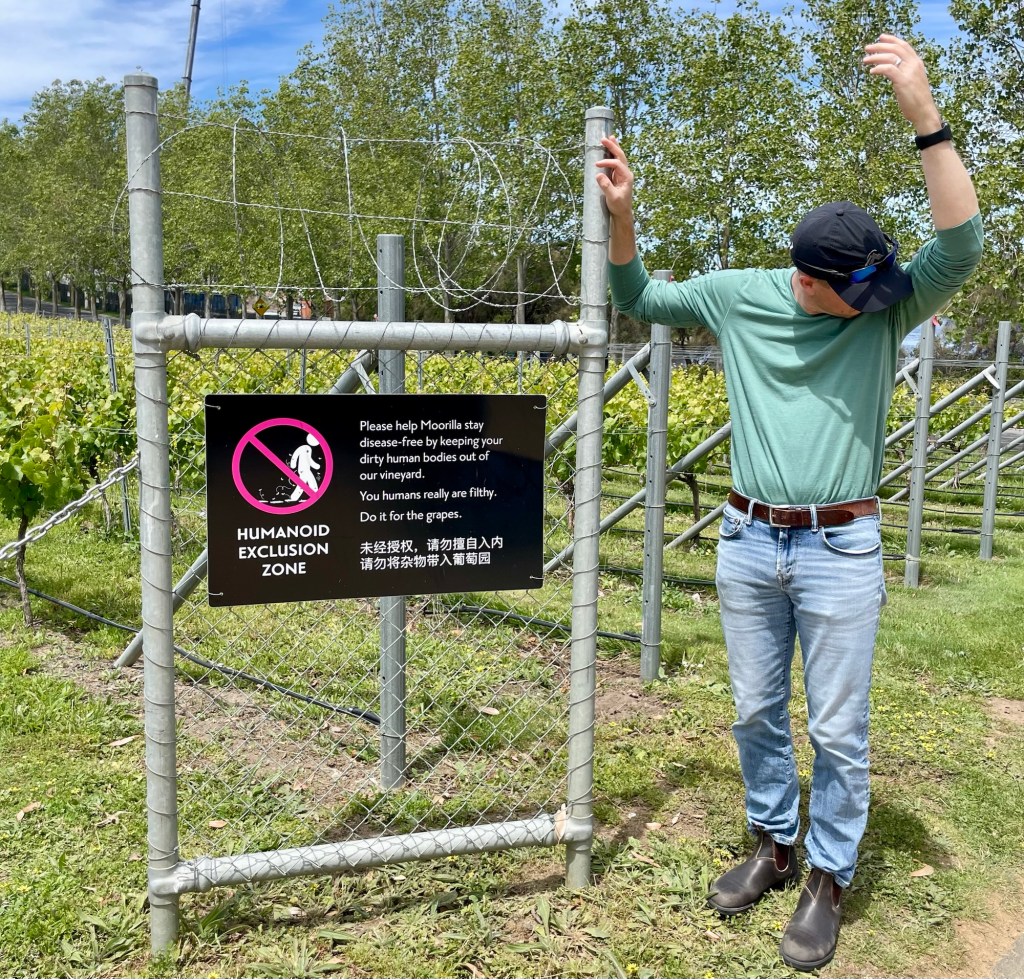
And MONA came out swinging! After parking, we walked through the grounds towards the museum, passing grape vines for the small vineyard associated with MONA. A sign on a comically small and useless fence instructed people to stay out because “humans really are filthy.” Tough but fair.
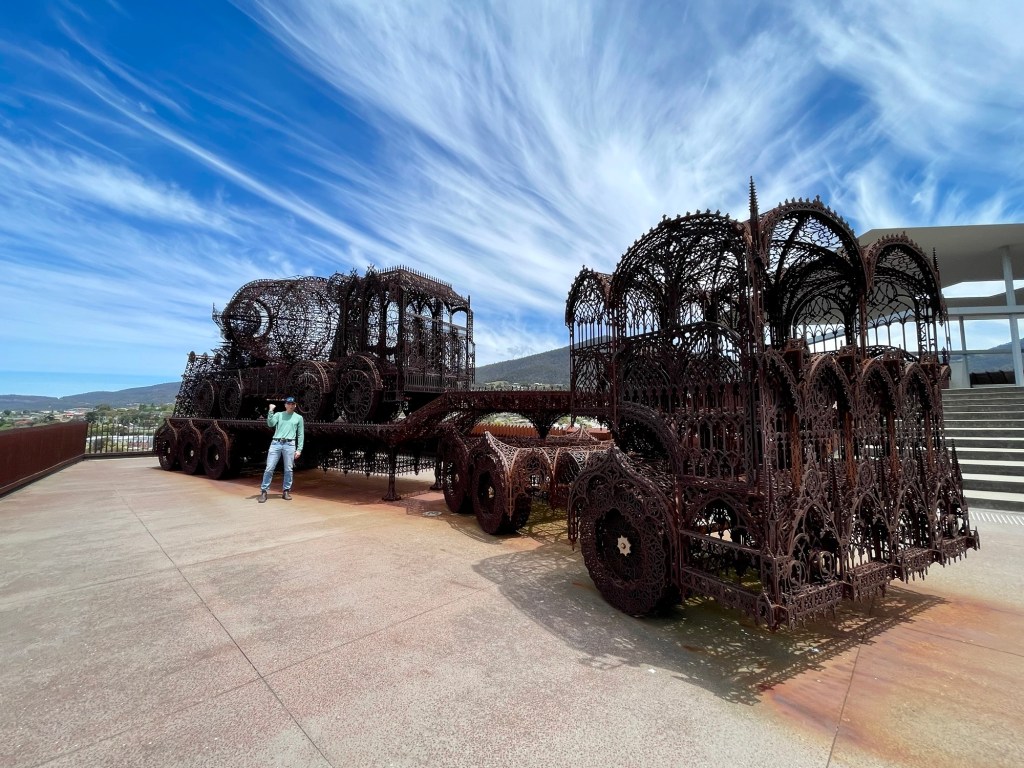
We walked through a small courtyard on our way to the entrance, passing by a full-sized gothic truck made from lace-cut rusted metal. Woo woo!
We still weren’t quite to the entrance. And there was a trampoline. With bells on it. This filthy human couldn’t resist.
We finally entered the museum and discovered that most of the exhibits are underground in three basement floors cut into the bedrock. On the recommendation of the doscent we descended to the bottom to work our way back up.
To say that there was no rhyme or reason to the art is an understatement. Bear with me as I run through some of the highlights.
One of the first rooms we entered felt like a jazz lounge, and there was a woman playing the harp and singing. She stopped, started, and looped recorded tracks, suggesting that she was trying to record her music. (There is in fact a fully equipped recording studio on the property.)
Her stage looked like a bedroom — because it was her bedroom. Evidently, she’s part of an exhibit that is part performance and part sleeping disorder.
One of the next exhibits involved a long row of water nozzles that were electronically controlled to spell words pulled from online new sources.
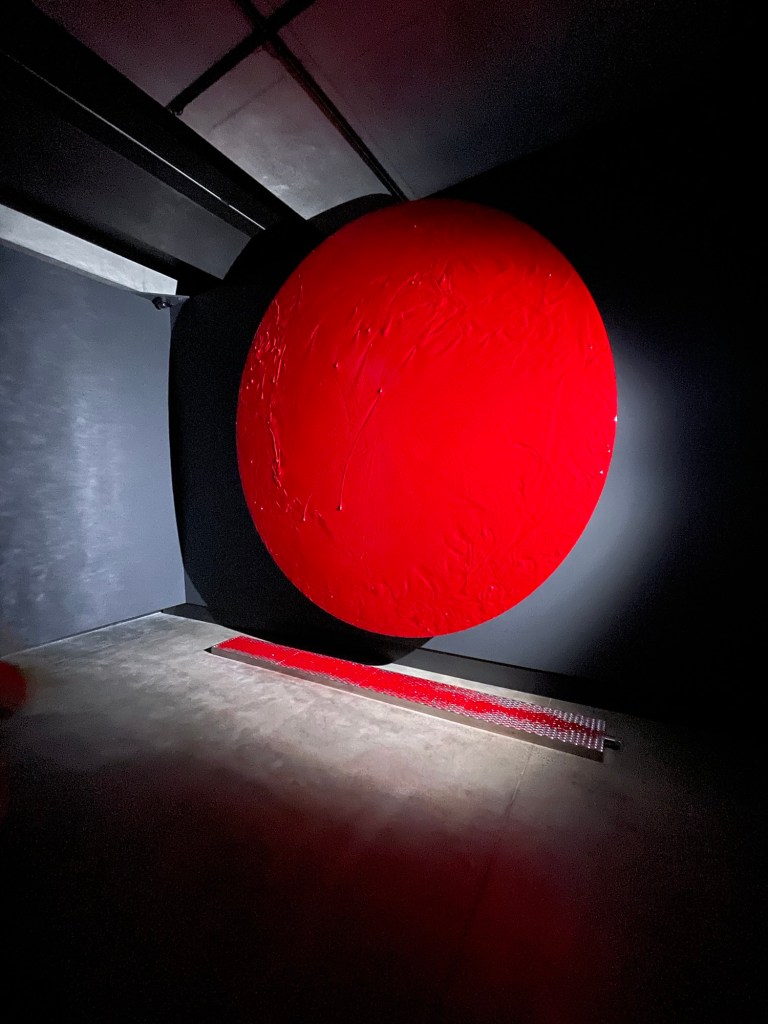
We then saw a serious of exhibits involving dynamic, contradictory sculptures. One involved two huge discs covered in viscous paint — one red and one blue. The discs rotated slowly so that the paint barely dripped off. By the time a globule reached the bottom edge, the disc rotated so that the drop was headed back at the top to drop toward the center. The paint was constantly moving but in a way ended up largely staying still.
The next piece was my favorite in the whole museum. It displayed a massive stone suspended on a curved glass sheet that was supported by a metal frame. Everything was static but threatened to move rapidly at any moment. I kept my distance so as not to be blamed.
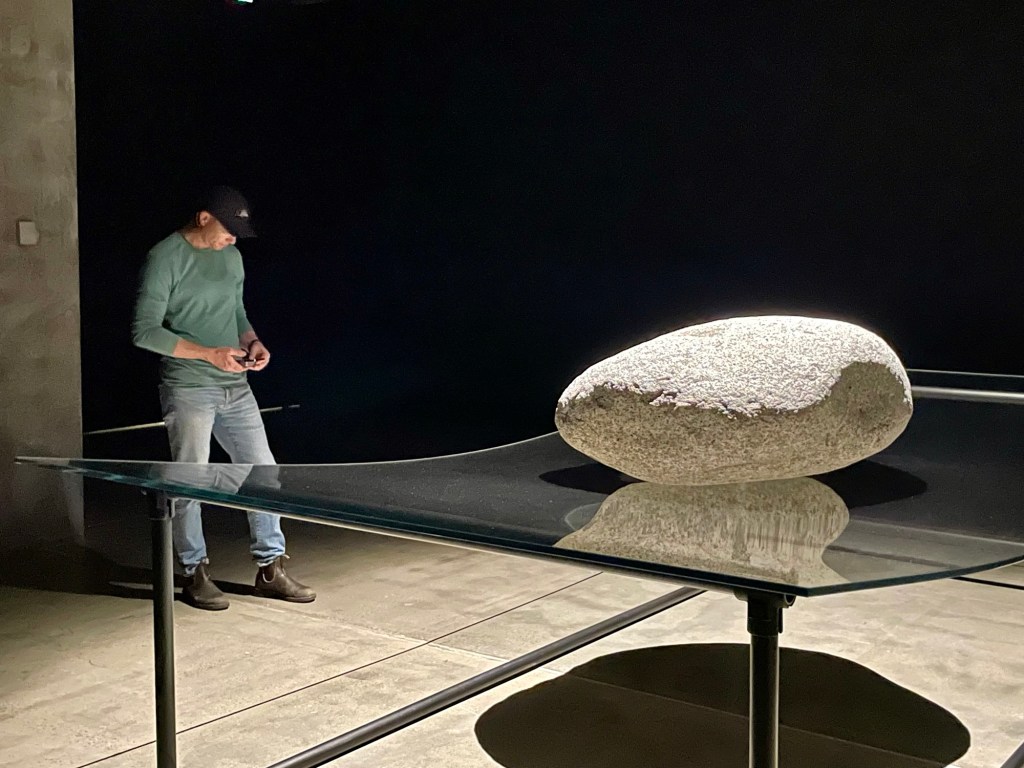
It’s a deceptively simple piece. Only the glass supports the rock, and amazingly, the sheet was not manufactured to be curved. The rock was slowly lowered onto the glass, causing it to flex near to it’s breaking point. The artist apparently broke more than 200 sheets trying to figure out a rock/glass combination that worked. I also loved the title of the sculpture — The Weight Never Sleeps.
We heard the next room before we reached it. It sounded like someone got too close to an exhibit and broke it. It turned out the breakage was by design.
The combination of cables and pneumatics slowly broke massive timbers, though we didn’t stick around long enough to see one split. I found myself wanting to hear the cracking of the wood failing under pressure, but the sound was simultaneously stress inducing — a fascinating contrast.
The last of the dynamic sculptures likewise involved contrasts, this time of light and dark. Through some unseen process, steel was melted into tiny blobs and dropped into a liquid, making huge sparks.
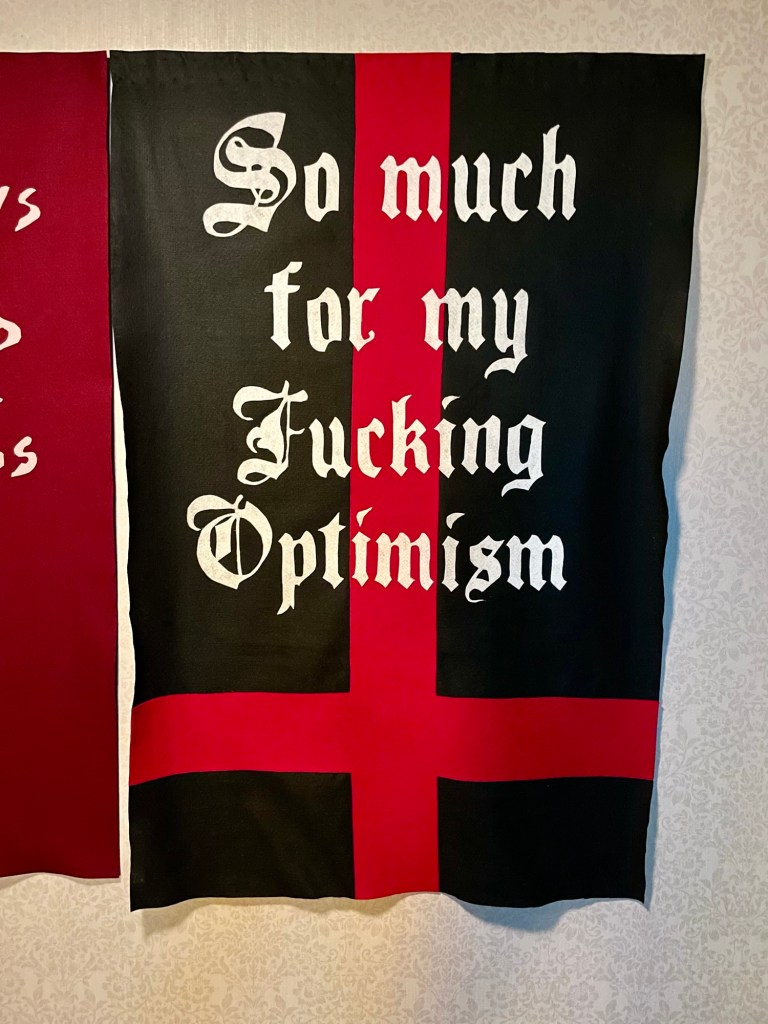
We continued to wind our way through the museum, enjoying variously exhibits. The meaning behind some of the artwork was cryptic if not absent altogether. Other pieces had messages that were a little more straightforward.
Other exhibits were more about the experience than any particular meaning, like the box of rubber bands that asked visitors to pass their entire bodies through the rubber bands before returning them to the box, which of course I did. Another room housed about 50 television sets each showing a single person singing the entire collection of Madonna’s greatest hits. Julie expressed herself and sang along.
We continued to explore the museum through no set path, sometimes looping back to visit things we missed. In one room we found a small-but-still-full-sized white temple held off the floor by huge glass balls that refracted the image of the entire room.
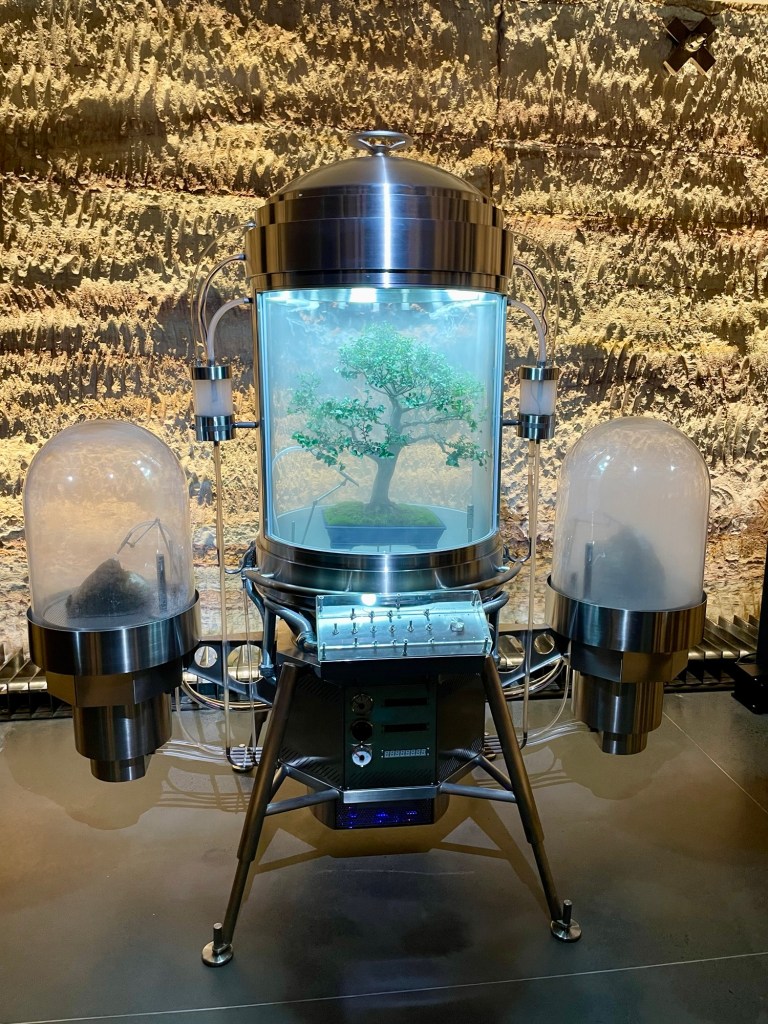
Julie and I both loved the sci-fi attitude of an exhibit that housed a live bonsai tree, with lichen to the sides, all constantly being fed small amounts of moisture through a technological landing pod.
Some of the exhibits were self-contained and only admitted two people at a time. For one, we entered a dark room, walking on square stepping stones surrounded by black water to reach a platform, where there was an ancient Egyptian sarcophagus on one side and a same-sized digital display on the other showing progressive MRI scans of the sarcophagus. The scans revealed interesting details. For instance, on the painted cover of the sarcophagus, the man’s arms were crossed in a classic mummy pose, but the scan showed that his arms were actually by his side. In another 2-person exhibit, we walked though a dark, tightening spiral with walls covered in felt to reach a cochlear center where we were asked to confess our secrets. The reflected sounds from the center were channeled one story up to the entrance plaza where they could be heard by new visitors. Fortunately, we’d been warned, so we didn’t share the really juicy secrets.
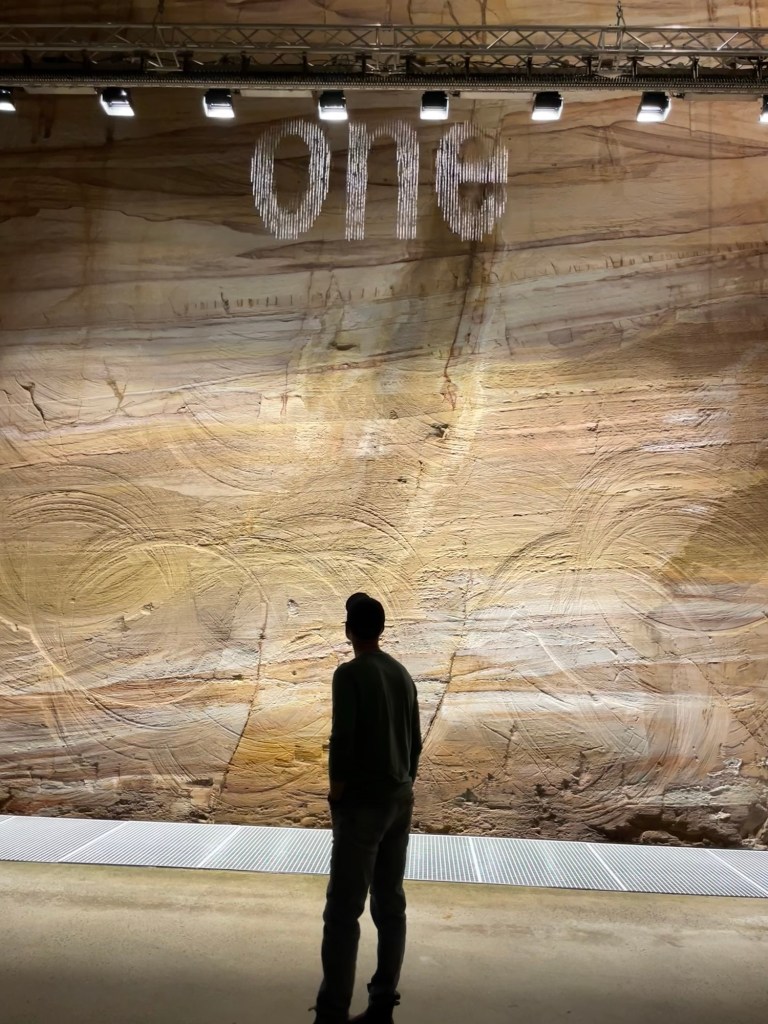
The building itself was as much a part of the experience as the exhibits. It felt like the lair of an evil genius had been turned into a museum. For example, this tunnel was filled with a constantly rising wall of sound that never quite crested.
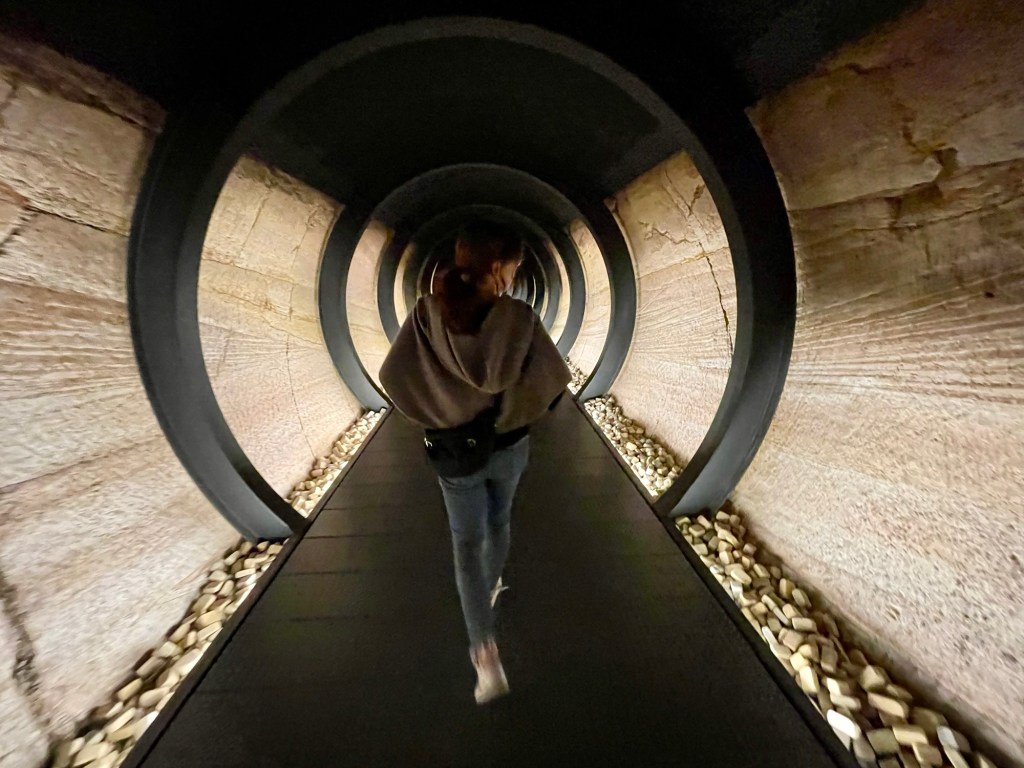
Other tunnels were more understated but only by comparison..
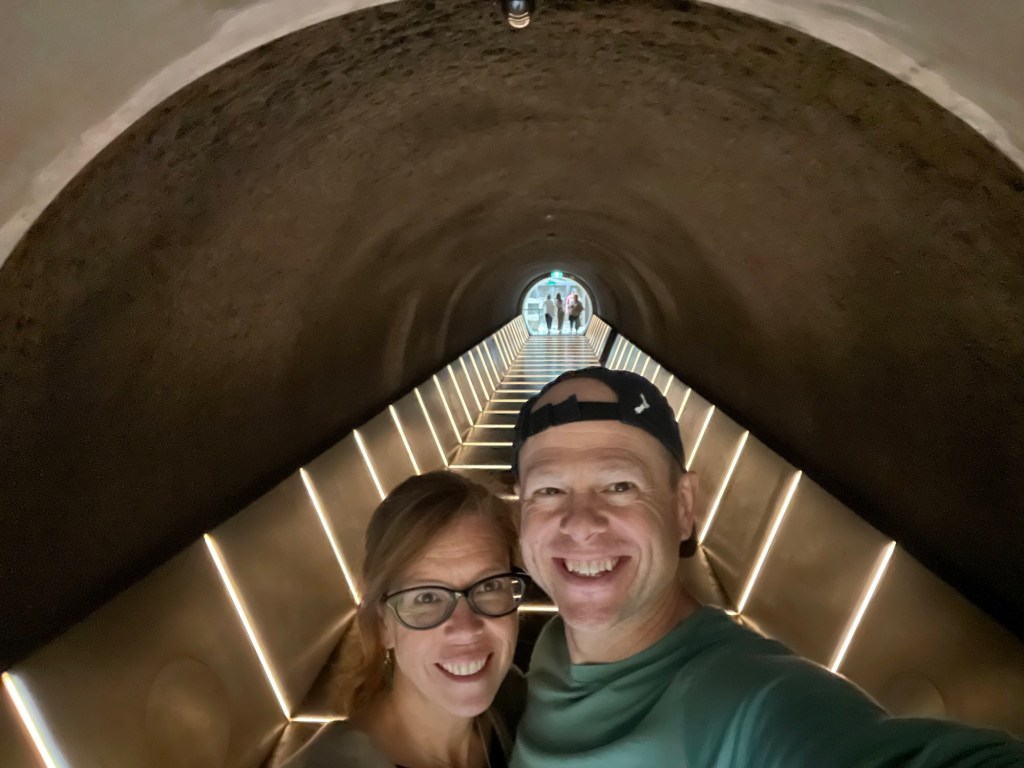
This one also had a “grotto” along the way, perhaps in the spirit of an English garden but more in the aesthetic of a B-grade movie from the 1960s.
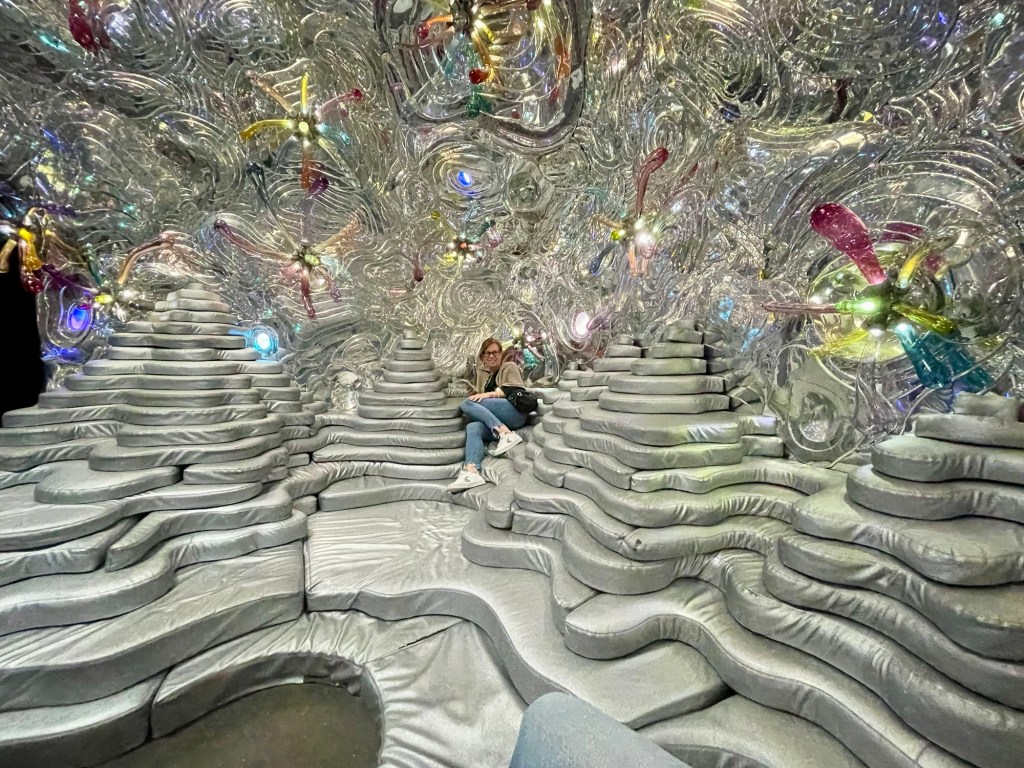
The museum used light and space in cool ways, too. For instance, at the end of this tunnel, the underground chamber opened into two floors, with a lit floor that mirrored the walls.

Another hall was filled with vibrantly colored strut-inducing lights.
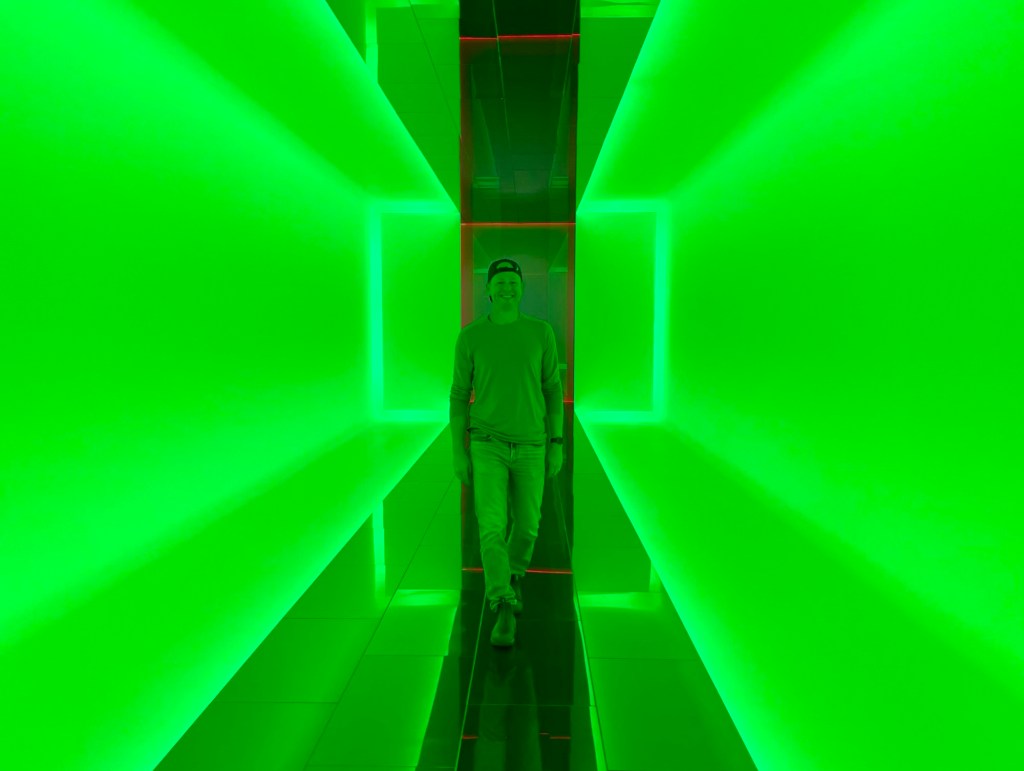
The last exhibit we saw was filled with light, sound, and hidden meaning.
I know I’ve run through quite a few exhibits in this post, but I’ve actually left heaps out. To me, some modern art museums promise a lot but don’t deliver. MONA nailed it. It was of the most enjoyable art museums I have ever visited. It had art with meaning that made me think. It had art with no meaning that made me think meaning is overrated. It had sense, nonsense, and no sense.
When Julie and I went outside, we followed the sound of live music to reach MONA’s outdoor performance space, complete with a bar. The place was filled with people of all ages and types, enjoying the music, the weather, and the company.
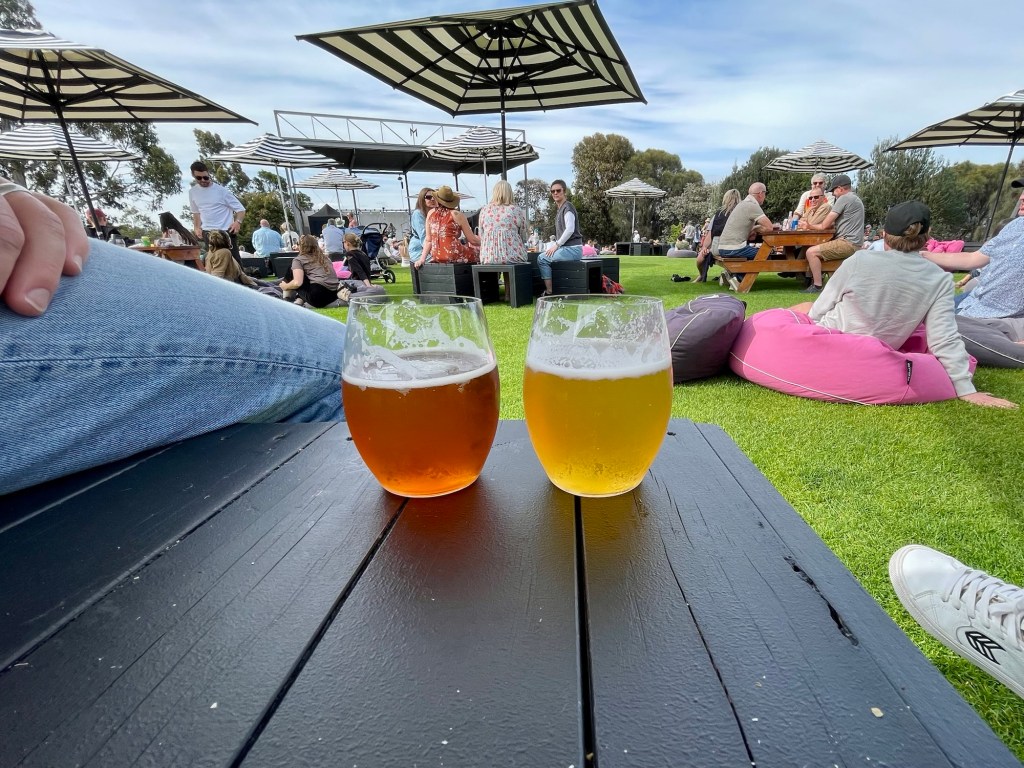
We had a final beer to toast our amazing time in Tasmania.
The next morning we packed up and flew to Melbourne, where we had a fantastic dinner at my friend Chris’s house. To catch an early flight, we stayed in a Holiday Inn by the airport, an anticlimactically generic place to spend our last night having stayed in so many unique and charming places in Australia.
This morning our incredible time in Australia came to a close. My only quibble is that we didn’t encounter any snakes, despite Australia’s reputation for being full of them. (Despite Julie’s eye rolling, I’ve been referring to it as “a reptile dysfunction.”)
Fortunately, we’re not done with our adventures just yet. We’re headed back to New Zealand for a couple of final weeks. Goodbye, wombats, wallabies, kangaroos, and cockatoos! Hello, kiwis!
-Will
 The Hubbards' Travel Blog