Today we picked up a rental car and left Cairns headed north. By the evening, we would be in Cape Tribulation, deep in the Daintree Rainforest.

We drove for a little more than an hour through sugarcane fields to reach the Mossman Gorge, where we had booked a guided walk with a local aborigine. Our guide, Santo, is from the Yulanji tribe. His people have been on these lands for thousands of years. He also had a hilarious deadpan wit, telling us that if something chased us in the forest we each had to find our own tree. Our tour started with a traditional welcoming during which our small group walked around a fire stoked with bark from the paper bark tree.
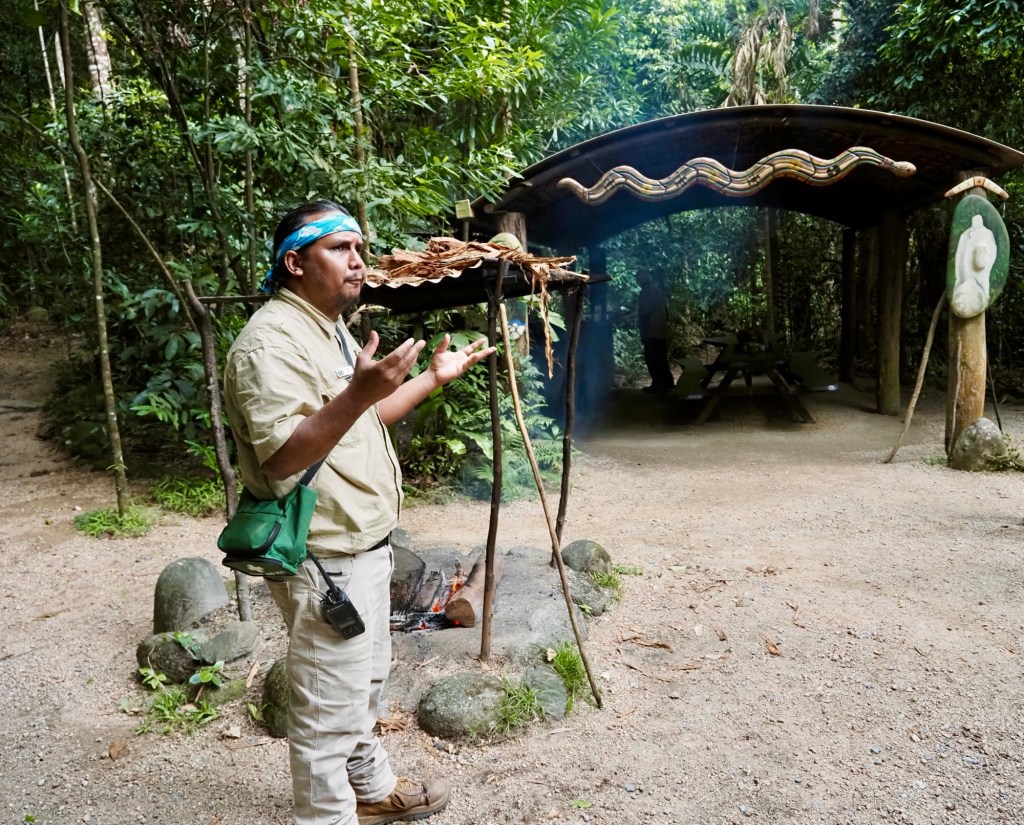
From here, we headed into the forest. The first thing Santo showed us was possibly the most terrifying thing we’ve seen to date.
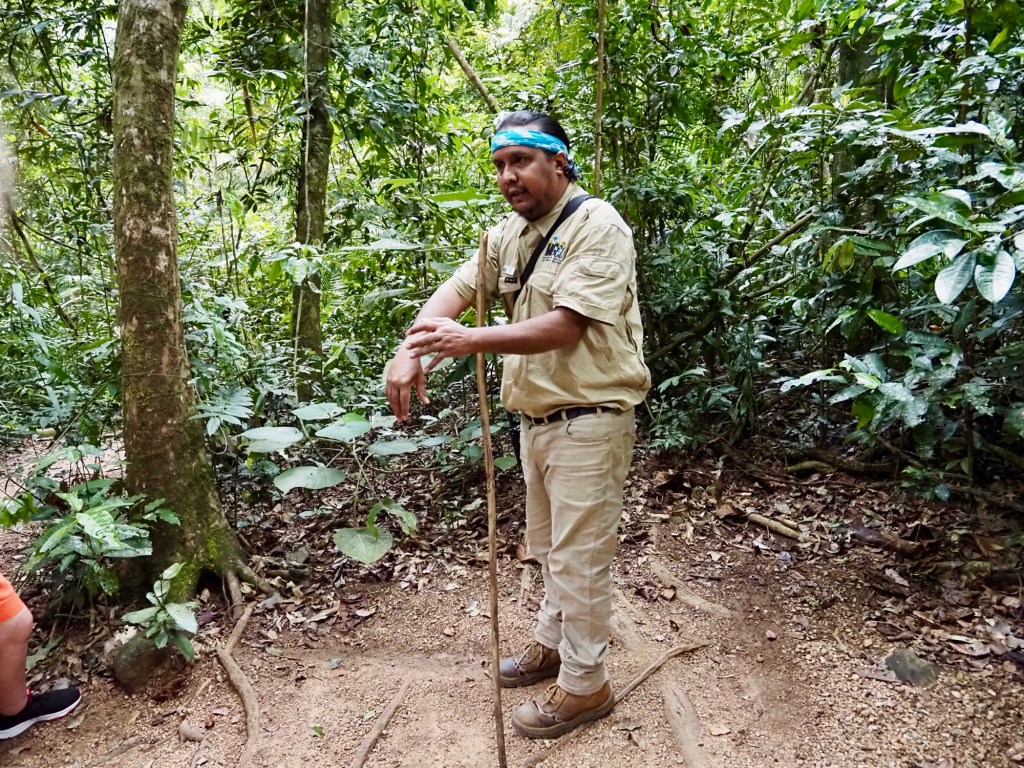
The broad, leafy plant to Santos’s right is the Australian stinging bush, a type of nettle. The leaves are coated in microscopic, hollow silica hairs filled with toxic compounds. If touched, the delicate hairs embed in your skin and cause excruciating pain, and if left untreated can remain in the skin for as long as two years. The tiny hairs can even become airborne and be inhaled. The hairs remain dangerous even when the leaves die. People have literally gone mad from the pain. If plants had morals, this one would be evil.
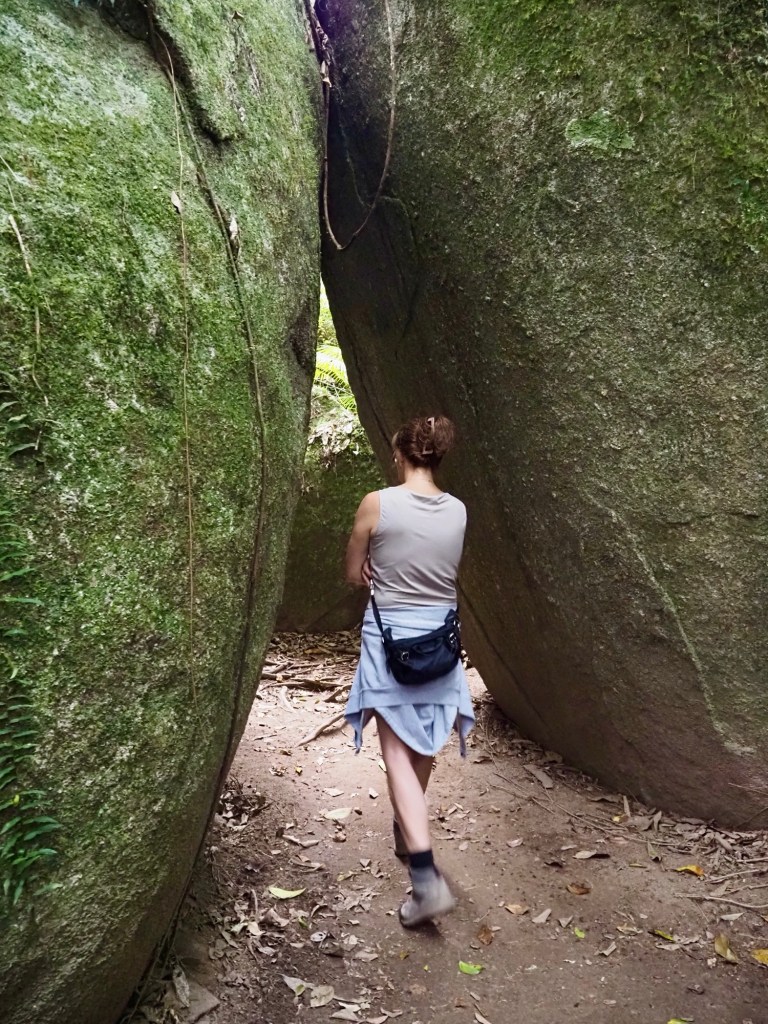
We stayed well away from the stinging bush and headed further down the path. Our next stop was two huge boulders that lean into one another to form a small alcove. Santo explained that this was a place where arranged marriages took place both within the Yulanji people and when someone from another aboriginal community married into the Yulanji. For reasons I still can’t fathom, Julie practically ran into the space between the stones.
The path then wound towards a beautiful nearby stream that fed into the Mossman River.

The next thing Santo showed us was some local bushcraft, including some plants with medicinal properties that could be used as soapy cleaners. He also showed us how the Yulanji made paints from ochre and charcoal.
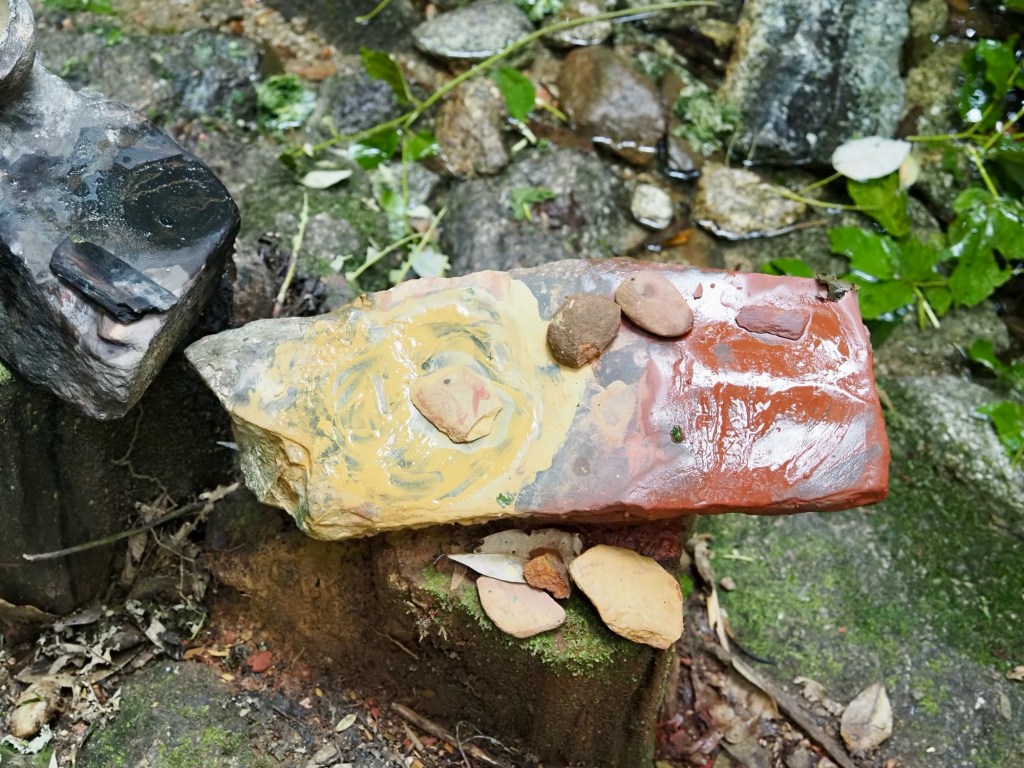
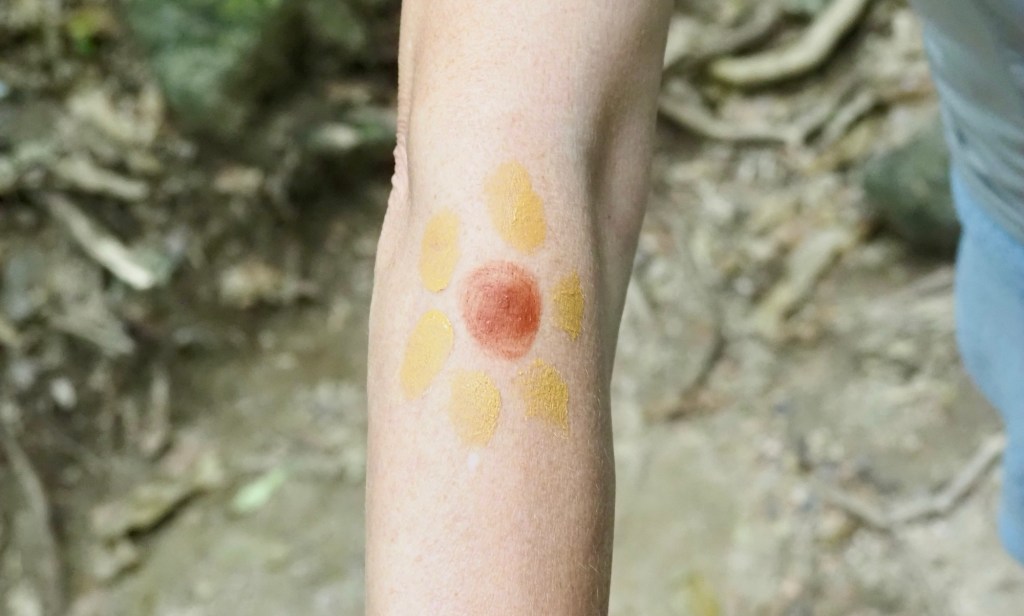
Santo explained that these paints were sometimes used to paint “passports” of sorts on the bodies of Yulanji hunters to indicate permissions to hunt on certain lands. Julie tried her hand at a little body painting.
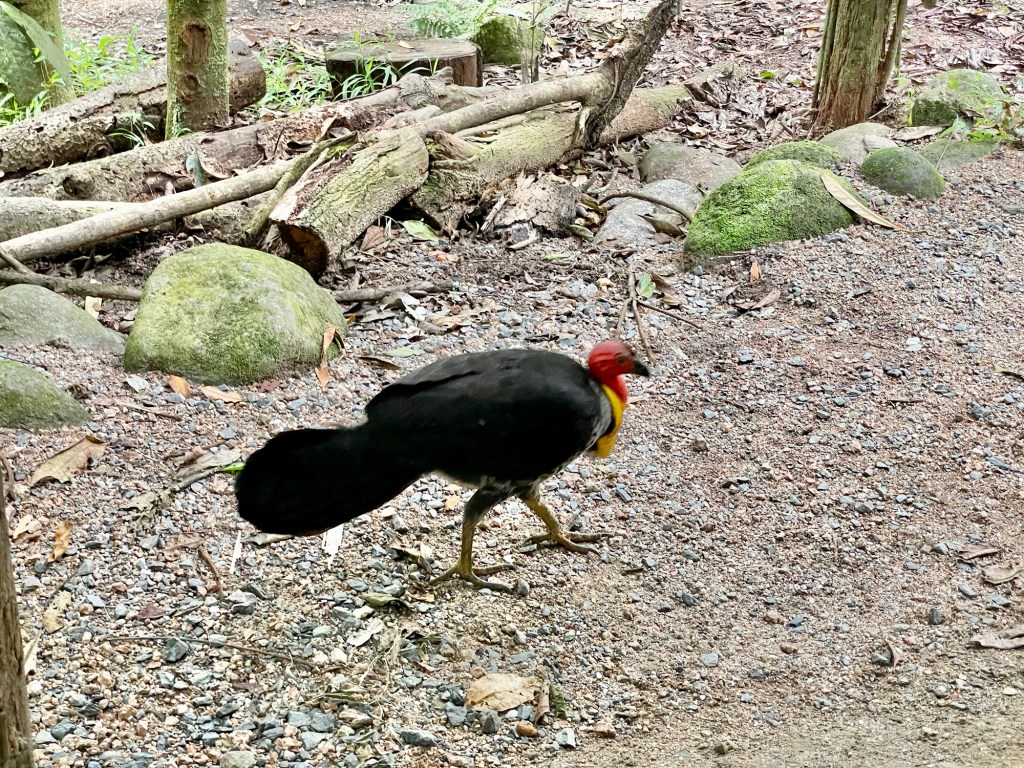
The tour ended with tea and dampers, which are bready snacks a bit like scones. The tea is a variety grown in the Daintree and the jam for our dampers came from local tropical fruits. A lurking brushturkey circled in the hopes of snatching any dropped morsels.
After our tour, we hopped back in our car to head further into the Daintree Rainforest. Mossman Gorge is in the southern part of the rainforest. We were headed to the wilder, northern section. To get there we had to take a short ferry across the Daintree River. The ferry is basically a flat barge that shuttles back and forth across the river. When we arrived the ferry was on the far side, so we parked and waited for a few minutes.

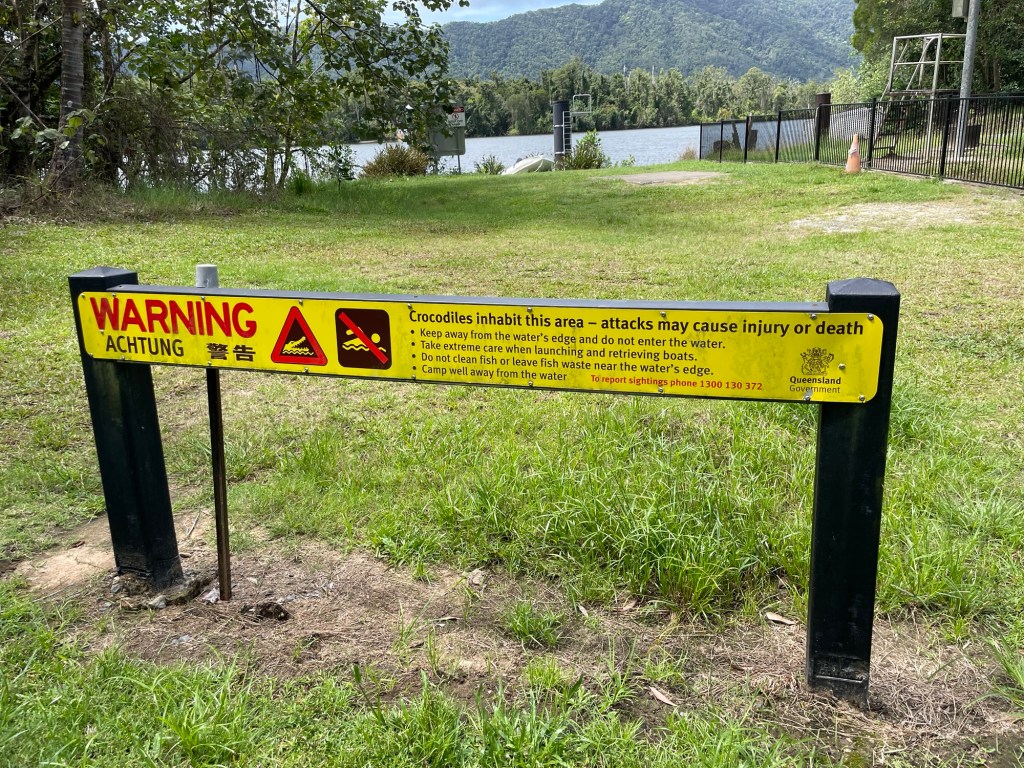
While we waited we noticed some signs warning of the dangers posed by local crocodiles. It turns out that crocodile “attacks may cause injury or death.” Good to know.
We crossed without incident. We kept our eyes pealed for crocs but sadly didn’t see any. The jungle on the other side of the river was noticeably wilder. We drove on a winding road for another 30 minutes to reach the Daintree Discovery Center, which is a natural botanical garden of sorts, with paths, elevated walkways, and an observation tower. The Center provides a booklet and audio tour with detailed information about the plants and animals of the rainforest.
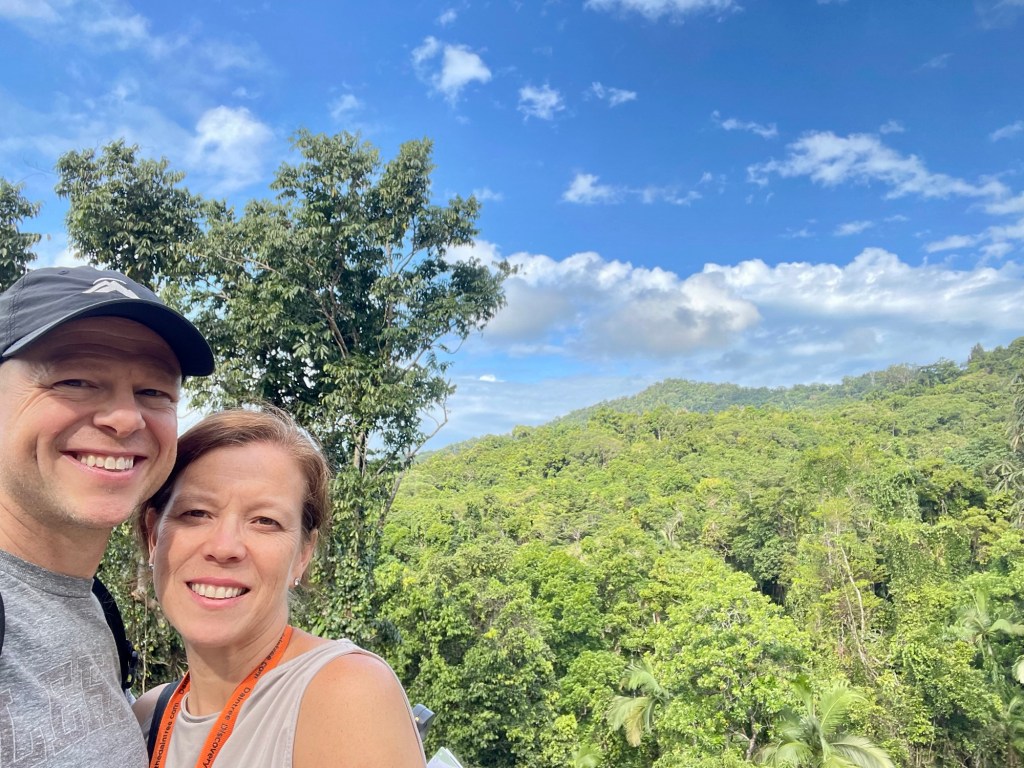
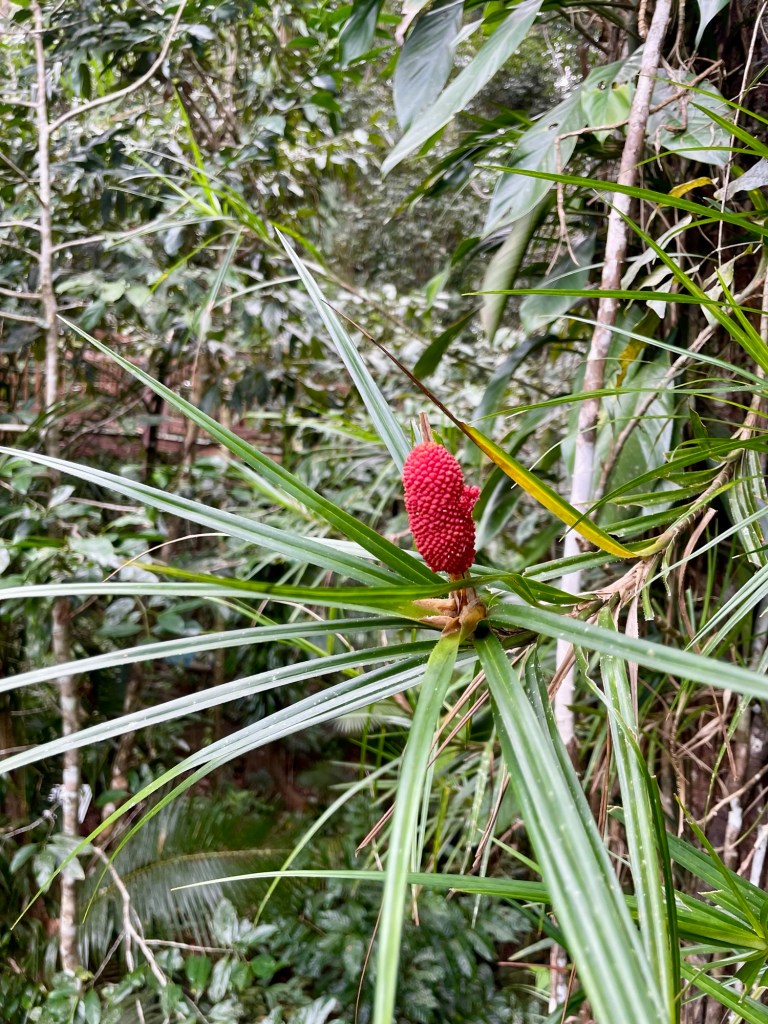
The astounding biodiversity of the Daintree is one of the reasons it is a UNESCO World Heritage Site. There are more than 3,000 different types of plants, including more than 400 different types of trees. Part of what makes the Daintree special is its age. This area has been rainforest continuously for more than 120 million years, making far older than most dinosaurs. Indeed, the Daintree was rainforest since the time of the supercontinent Gondwana (when Australia, South America, Antarctica, Africa, and India were joined). The Amazon Rainforest is comparatively young — “only” about 65 million years old. Because the Daintree is so old, it has quite a few bizarre plants that were unfamiliar to us, including ancient plant species like huge tree ferns and cycads.
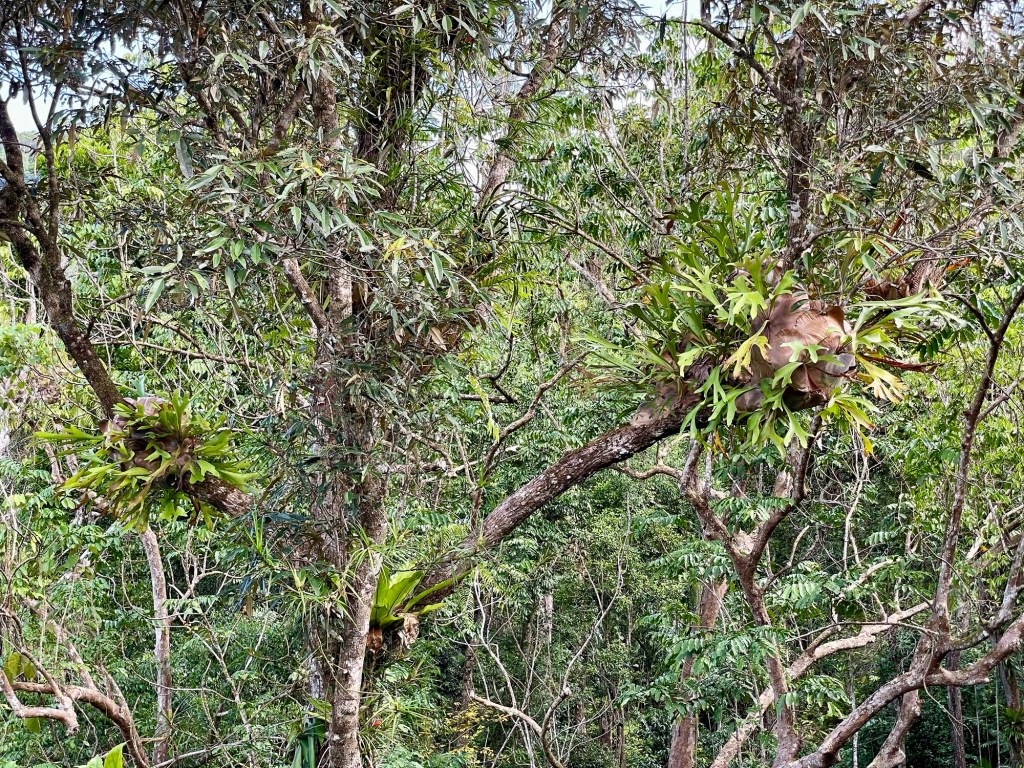
We once again loved seeing the huge ferns high in the trees.
The Daintree is also packed with animals, including more than 400 bird species. One of the stars of the Daintree is the cassowary. Growing to almost 7 feet, it’s the third tallest bird in the world (after the ostrich and the emu). Cassowaries are also critical to the health of the rainforest. It’s the only animal that can eat and disperse the seeds of more than 70 plants. For some plants in the forest, the seeds have a near 0% chance of germination on their own. After passing through the gut of a cassowary, the germination rates skyrocket to more than 90%. But cassowaries can also be dangerous. Their powerful legs have 5-inch talons. In rare instances, they’ve killed people. But they are endangered and shy, so it’s not really a concern unless you corner them.
Many people come to the Daintree never see any. There are only about 4,500 left in the wild. We got lucky leaving the Discovery Center and saw one silently walking through the forest.
We were in our car, and the cassowary wasn’t threatened, so nobody got stabbed. Woohoo! After watching the cassowary disappear into the woods, we drove to Cape Tribulation, a small settlement deep in the Daintree. Captain Cook’s ship, the Endeavour, struck a coral reef here, hence tribulation. This is one of the few places in the world where two UNESCO sites come together — the Daintree and the Great Barrier Reef. I guess Captain Cook found the reef to be literally a barrier.
We stayed at the Cape Trib Beach House, a sprawling jungle compound at the end of the park’s paved road. The road continuing north requires 4WD, which we unfortunately don’t have. We parked our car and used a small cart to carry our luggage to our small cabin. We narrowly avoided getting caught in a heavy downpour. The Daintree’s reputation as a rainforest is well earned.
Our day was not quite over. We’d booked a rain-or-shine nighttime walk in the jungle. The tour left from a lodge a short drive away. Walking up the path to our car, the path was covered in huge cane toads brought out by the rain. Cane toads are not native to Australia. They were brought in an effort to protect sugarcane (also not native) from an Australian beetle with a sweet tooth. The toads had little effects on the beetle, but the toad population has exploded. They now number in the 100s of millions if not billions. That’s a lot of mouths to feed, and the effect on native insect populations has been devastating. Part of the problem is that cane toads are highly poisonous, so few animals eat them. Those that do, often die, including crocodiles and turtles.
We continued on to our night walk. We saw some neat things, including a glowing tree in the middle of the jungle that is covered in bioluminescent fungi. We also saw and smelled peppermint stick insects, named for the minty smelling spray they emit when threatened.
The Daintree Rainforest was already incredible, and we went to bed excited that we had two more days here!
-Will
 The Hubbards' Travel Blog