Today was another busy day for Team Hubbard. Our plan for the morning was to do some horseback riding, then in the afternoon we planned to visit a nearby primary school.
After another great breakfast looking out at the lagoon, we were picked up by Megan, the woman who runs Santo Horse Adventures. As we drove in her truck, she told us that we needed to pick up another passenger, a woman from the Solomon Islands. Megan explained that the woman had been stuck in Vila due to “problems” with Air Vanuatu, so that the woman’s 4-night trip to Santo unfortunately had been shortened to just 1. Indeed, the woman had just landed in Santo and was on her way from the airport. With so much disappointment already, the Solomon Islander asked if we could wait for her so she could join the horse ride. Team Hubbard didn’t mind at all, particularly since we knew how many wonderful things on Santo this woman wouldn’t get to experience.
And our ears perked up at the mention of “problems” with Air Vanuatu. We asked Megan for more details, and she explained that, just a couple of days after we flew to Santo, the 72-seat ATR plane we took was grounded due to mechanical problems. With our departure just a couple of days away, the plane wouldn’t be fixed in time for us. Even worse, Air Vanuatu only has 4 planes, with the ATR being the “big” one. The other three combined can only hold 47 people. Air Vanuatu was scrambling trying to service all of the islands with its capacity to move people more than cut in half.
This could be a big problem for us. I’d read in guidebooks that in more remote island areas it’s prudent to leave an extra day between domestic flights and international flights. That way, if something glitches with the internal flights, you might still be able to make your international flights. We’d taken that approach with our flights, initially scheduling a single night in Vila on either end of our time in Santo. But in July Air Vanuatu changed their flight schedule by a day, so that we had two nights in Vila on the front end and none on the back end. Instead, on our last day we’d fly from Santo to Vila in the morning and then catch our flight to Fiji in the afternoon. That meant that even a delay of a few hours in our flight from Santo to Vila could derail our plans.
It’s worth noting that the problems with Air Vanuatu run deep. The airline entered voluntary liquidation in May 2024. They were deeply in debt and couldn’t buy replacement parts, leading to cancelled flights and stranded tourists. The airline became a government entity towards the end of 2024 with plans of restarting regular services. Then the earthquake hit Vila, and the government’s scarce funds were diverted from the airline to disaster relief. The result is that Air Vanuatu has been a key part of travel in Vanuatu but is unreliable. We booked our flights with Air Vanuatu in February 2025. By May 2025, more reliable airlines from New Zealand, Fiji, and Australia had moved into the market. Now, on certain days you can fly direct to Santo from Auckland and Brisbane. But that option didn’t exist at the time we made our plans. I add these details in an effort to encourage you, dear reader, to consider going to Santo. Just not on Air Vanuatu if you can help it.
All of this worried us somewhat, but it was a problem for later. We had horses to ride. Our Solomon Islander soon arrived, and we headed off to Megan’s ranch. I should note that Megan was delightful. She’s a Kiwi transplant to Vanuatu married to a man from Vanuatu but of French descent. Megan has more than 30 horses, but only about a dozen are used for riding. The rest are part of Megan’s animal rescue efforts. More on this in a bit.
Once we arrived, Megan sized us up for helmets and horses. Lydie would be riding Madam Missy, who was second in command in the herd, just behind Megan’s horse, Velvet. That meant that Lydie would be riding second on our adventure. Cassie would be riding Skyler, who was definitely the best looking stallion in the bunch (other than me). Julie’s horse was Diego, Madam Missy’s boyfriend. She must have liked his accent. I would be bringing up the rear on Arizona, an old mare with a bit of a skin condition. Rizzo was a bit headstrong and liked to eat, like the other girls in my life. I could work with that.
As we prepared to mount up, we asked Megan what footwear to use. We’d brought a couple of options, including water shoes. Megan told us just to go barefoot. Island style.
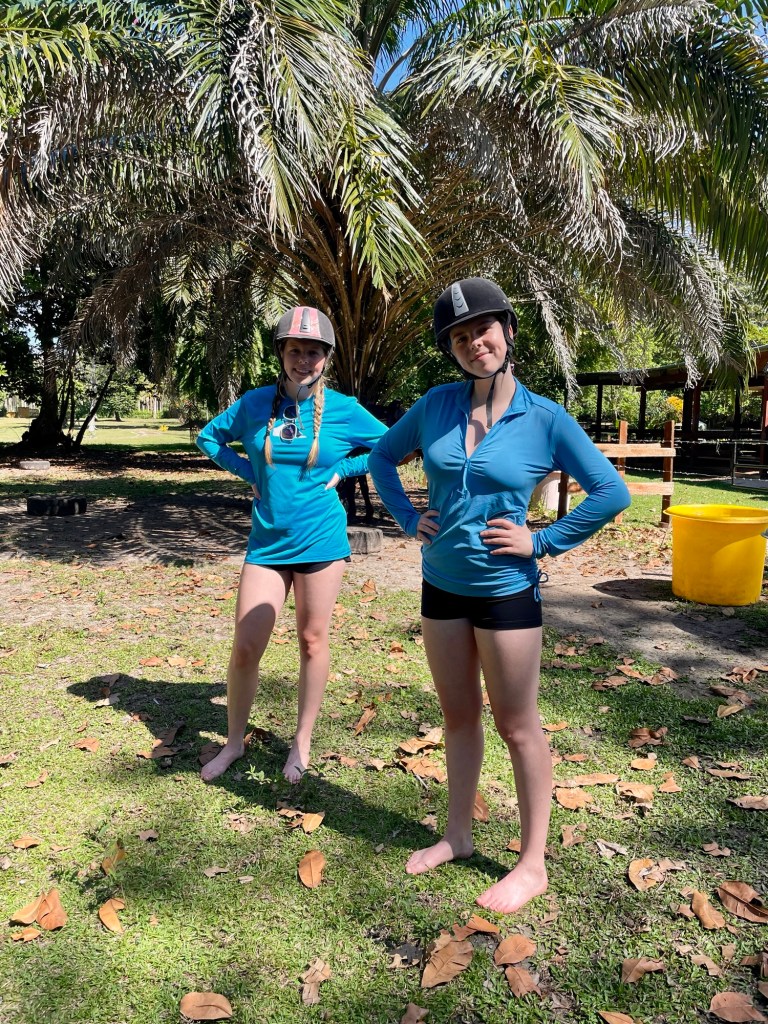
With a little help, Team Hubbard mounted up!
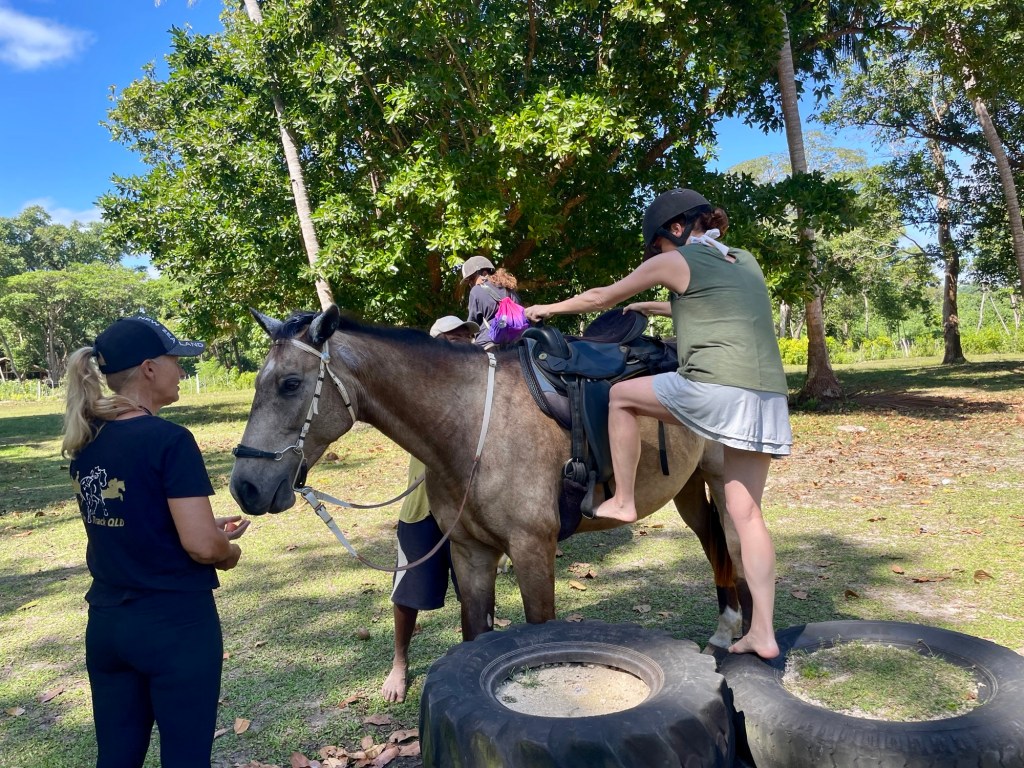
The first part of the ride wound through Megan’s extensive ranch. The jungle was cleared back to provide some island pasture for the horses.
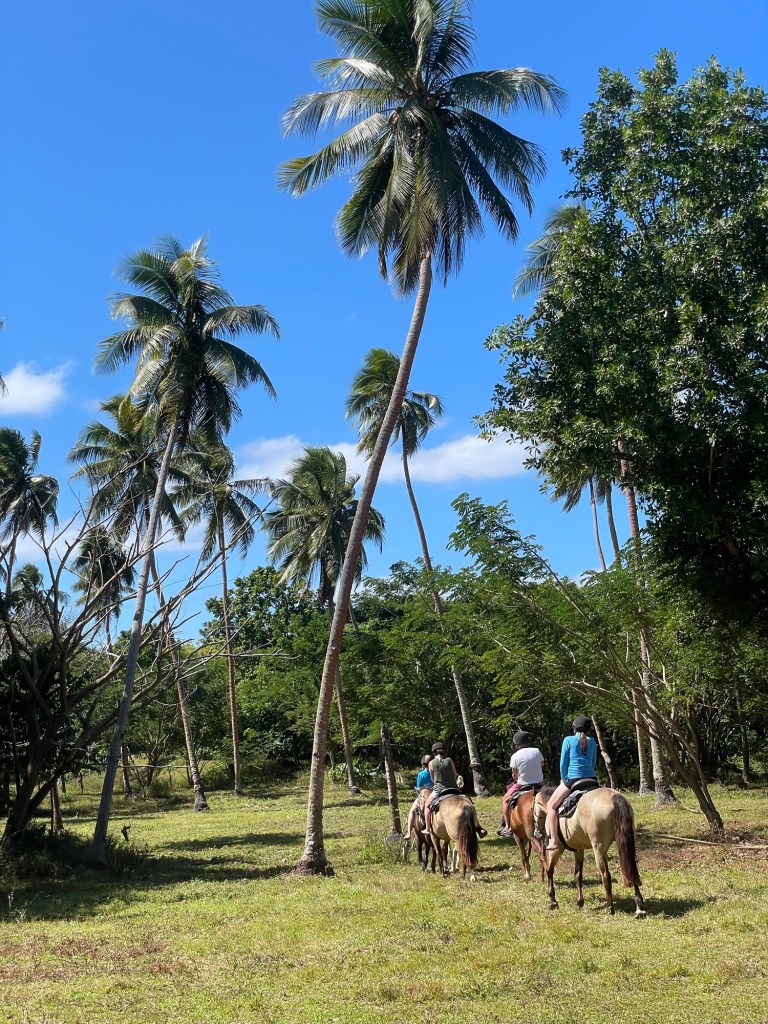
It was sunny, but not hot, with wind blowing through the palm trees. Everyone enjoyed getting comfortable in the saddle and bonding with their horses.

From here, we headed toward the coast, passing through sandy forests with huge tropical trees. We then took our horses down a sandy bank into a freshwater stream flowing to the ocean. The mangroves arched over our heads creating a tunnel.
After a few minutes, the tunnel ended as the stream reached the ocean, where we turned our horses towards a stretch of sandy shore.
We continued on to the beach. By this point, Cassie and Skyler were friends.

Since it was low tide, there was enough beach for us to extend the ride a bit. Out in the water, I could see two men fishing with a net in an outrigger canoe.
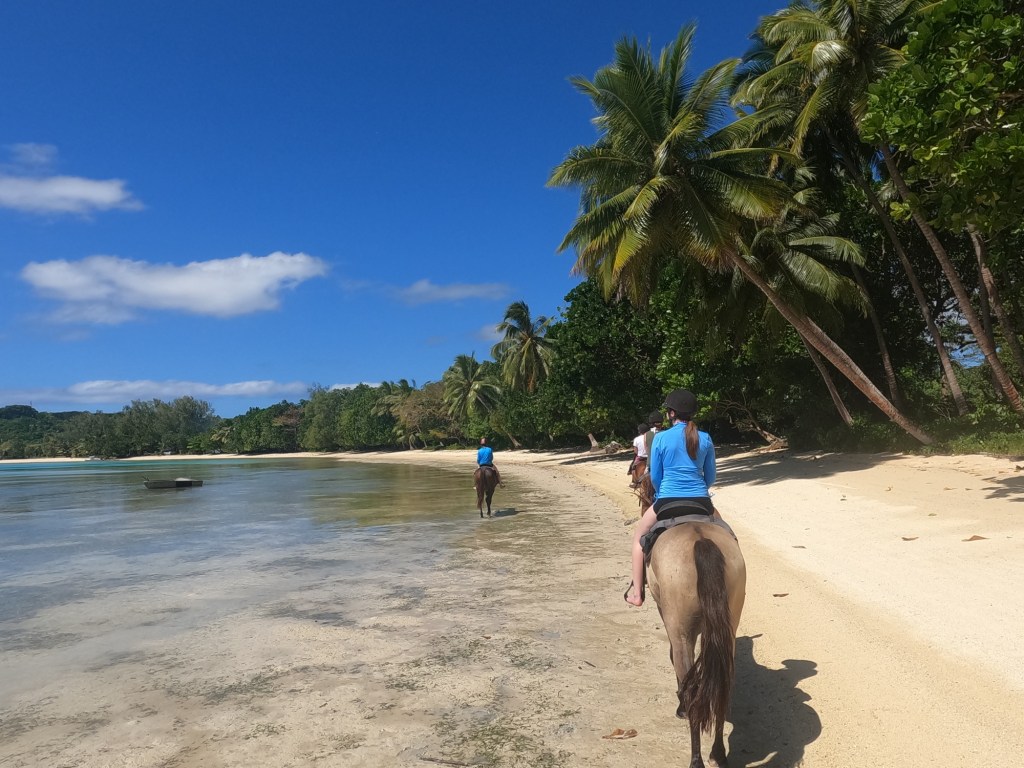
The beach stretched in the distance, but we eventually had to turn back. We looped out into the lagoon, and headed back up the beach.

We retraced our steps, and were soon back in the mangrove tunnel, with Megan and Lydie leading the group.
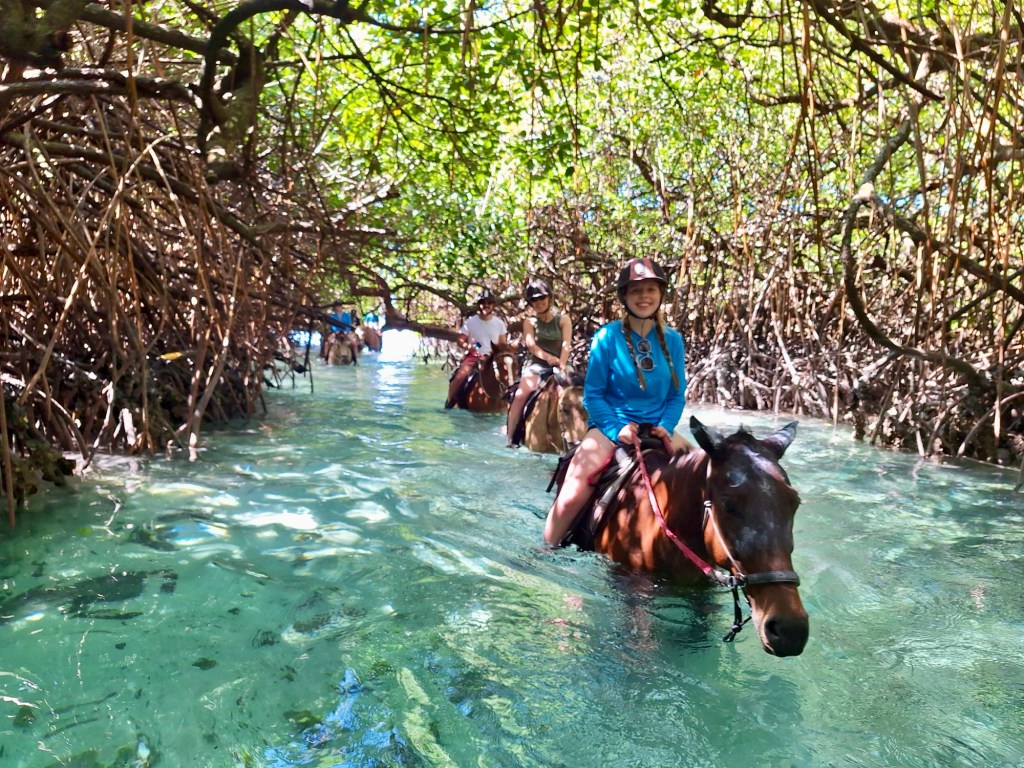
I was sill in the back, which meant that the water was somewhat cloudy for me and Rizzo. This didn’t bother the surefooted horses overmuch.
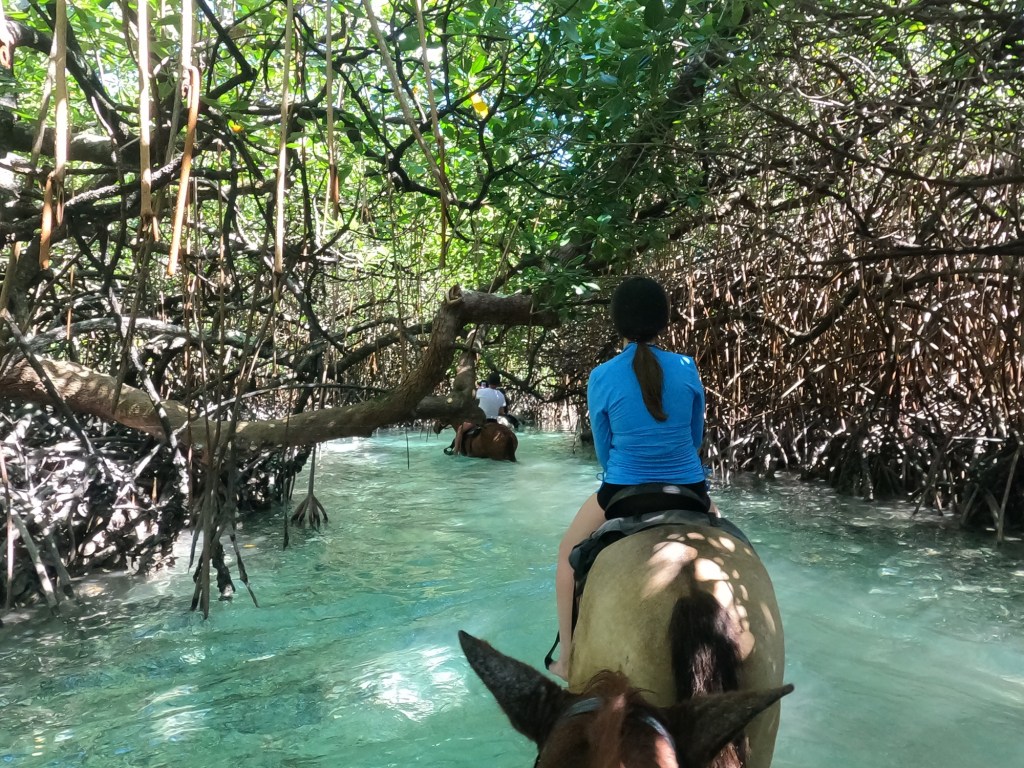
We climbed back out of the water and picked our way down the tropical path.

We were soon back at the ranch. It was time to say goodbye to our horses. We’ll miss you, Madam Missy!
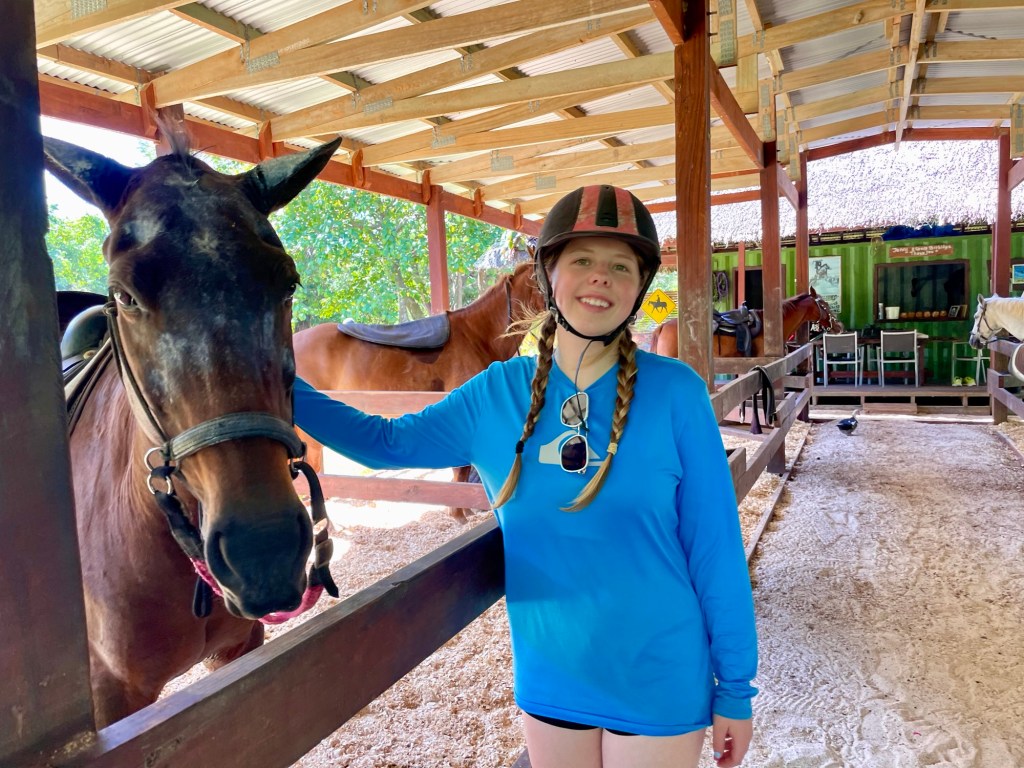
See you later, Skyler, you handsome boy!
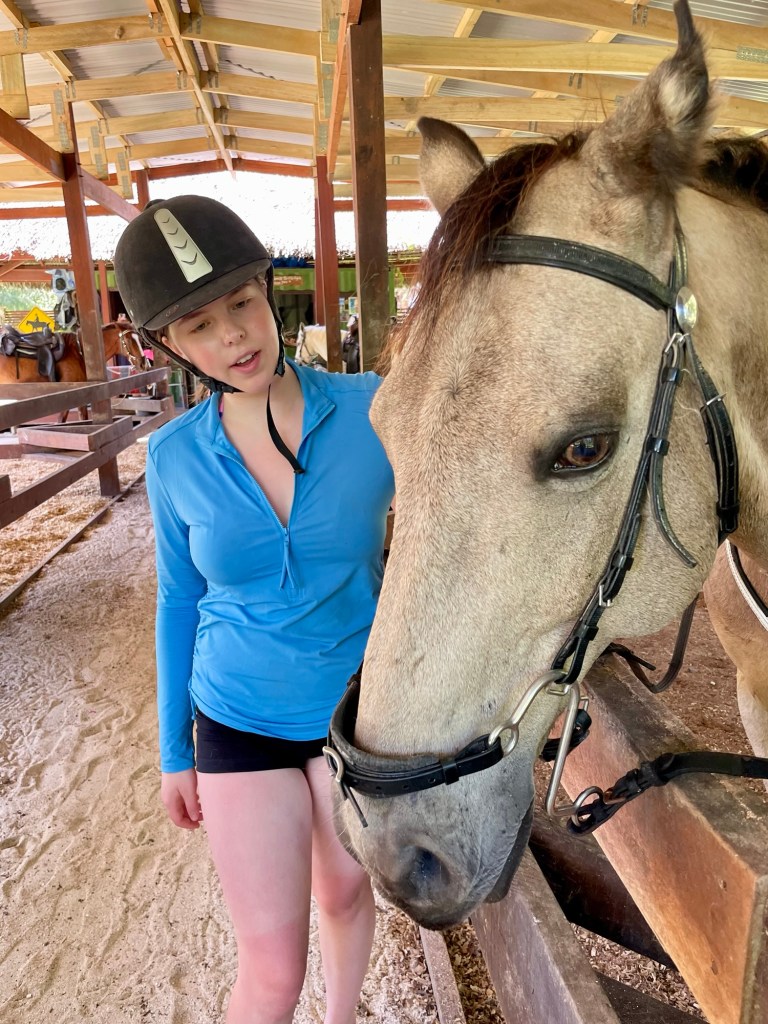
At this point, Megan offered to show us some of the other animals she’d rescued. She had a couple of very friendly flying foxes (i.e., fruit bats). We’d seen hundreds of these flying in the distance from the Turtlebay, and we were excited to see them up close. They were basically puppies with wings. As we approached their enclosures, they climbed down the sides upside-down to greet us. They wanted to nibble our fingers. Megan lets them out at night to fly and feed, but they are still recovering from some injuries, so they’re not yet ready to head off on their own.
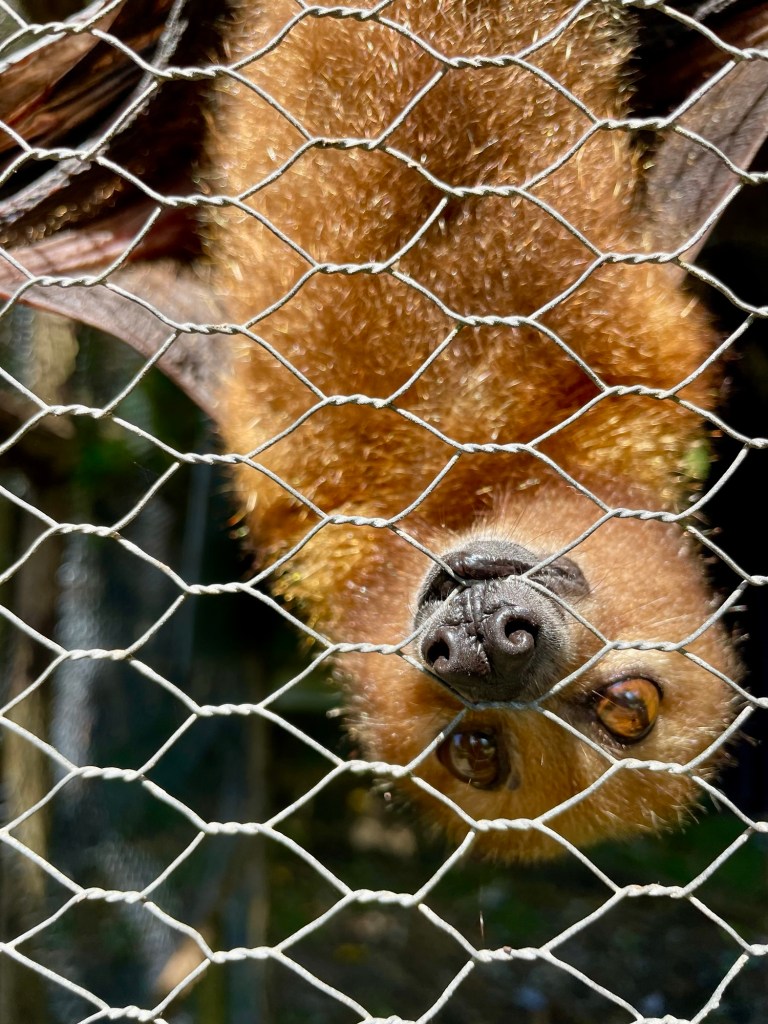
Megan also showed us her ducks, a talking parrot she rescued from a bar, and a goat who serves as a bit of a service animal for orphaned foals. We then walked down to the water in front of Megan’s house. Julie was full-on fan-girling at this point, hearing about Megan’s life on a tropical island rescuing animals. I was more impressed by Megan’s unassuming bungalow.
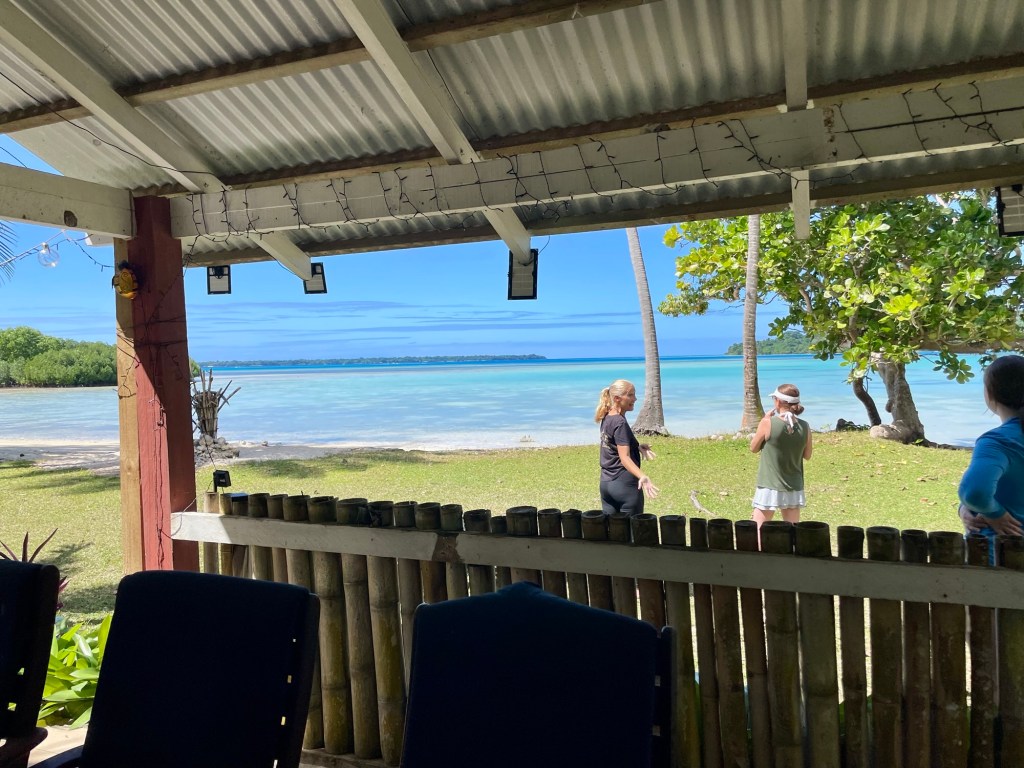
You see, the bungalow is built on the foundation of another building that blew down in a cyclone. That building was where James Michener wrote Tales of the South Pacific (details in a previous post in case you missed it).
As we walked back to Megan’s trucks, the parrot started yelling, which got Megan’s dogs howling. Apparently, this is one of the parrot’s go-to moves when he doesn’t want to be alone. We got back in Megan’s truck and headed back to the Turtlebay for lunch.
While we waited for our food, my thoughts turned to our potential flight problems. At the recommendation of some guidebooks and Turtlebay, I’d purchased travel insurance for our time in Vanuatu. I called the insurance company and verified that, if we encountered problems, we‘d be able to cover the costs. I also talked with Angie, one of the managers at Turtlebay about our problems. Megan had recommended that we go into Luganville to the Air Vanuatu office to try to secure some of the limited space on the smaller planes. Megan told us to get there early and to plead our case with passion. Angie said she’d might be able to save us the trip. She’d make some calls and get back to us.
We finished our light lunch and headed out to meet the truck to take us to the Turtlebay Village School. A German family with two younger kids joined us on the excursion.
The school is privately funded and has a religious component. As a result, the students greeted us with a christian song that I suspect was also an English lesson for the kids.
A group of young girls then gave us some flower necklaces and greeted us in English. Clearly a bit uncomfortable with English, the girls were simultaneously shy, embarrassed, and giggly.
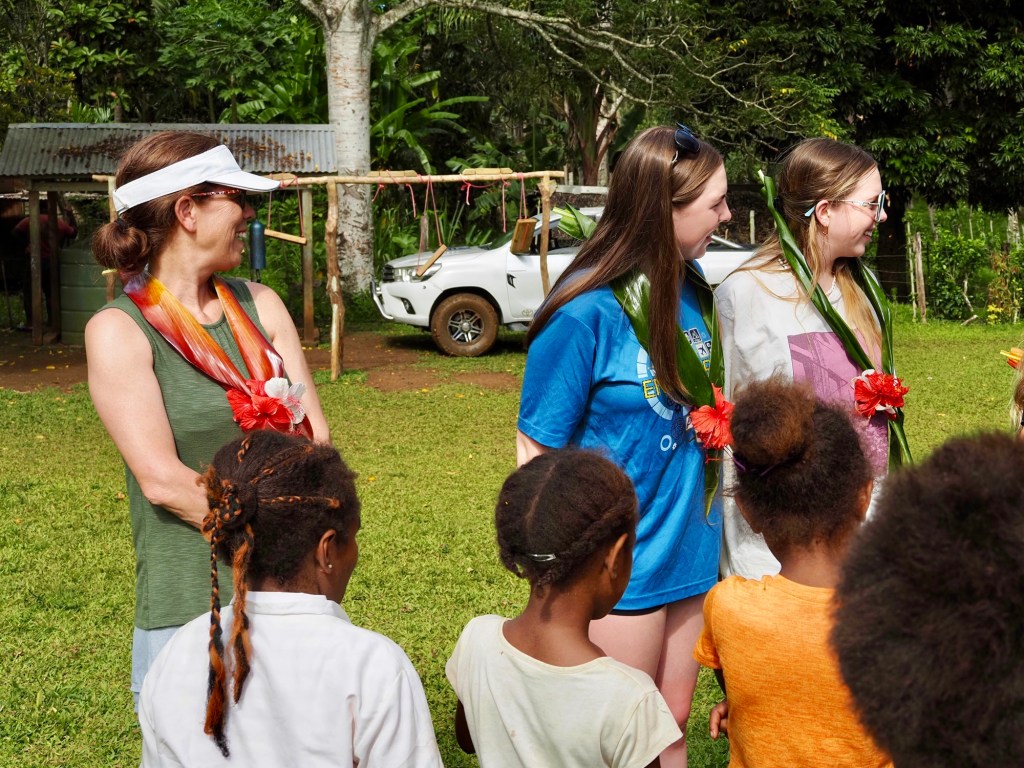
After the lovely greeting, the kids were turned loose to play, and we had a chance to walk around, explore the classrooms, and talk with the students. We went into one classroom and chatted with a group of three boys.
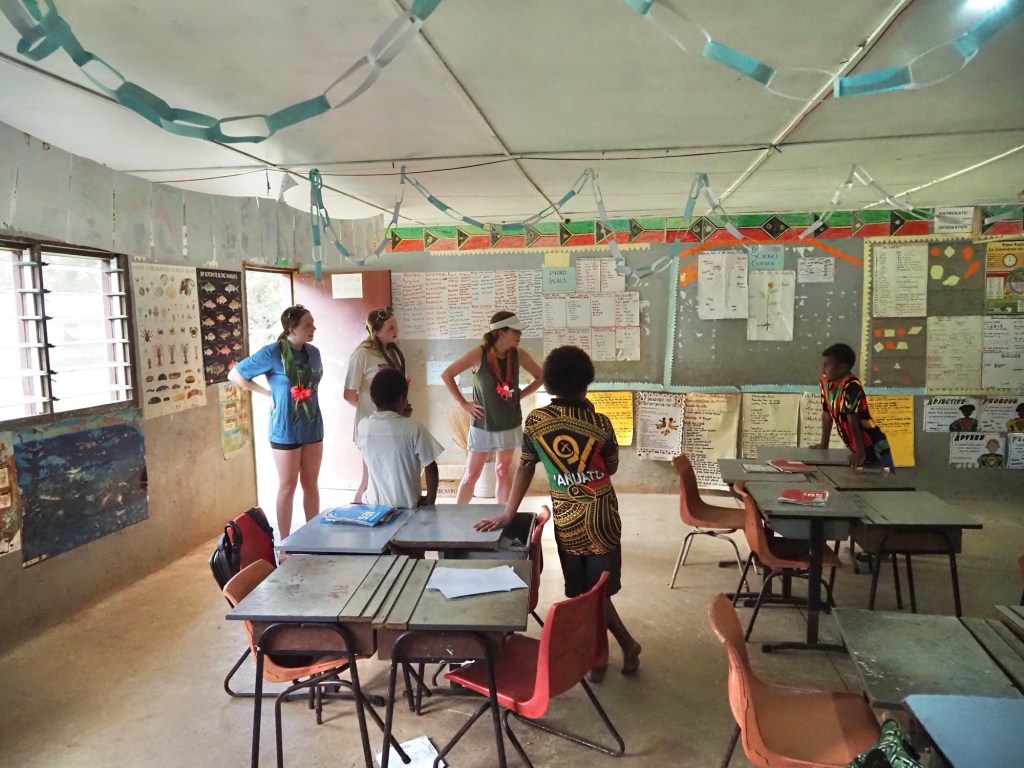
I asked them if they liked math. They hemmed. I asked them if they liked science. They hawed. I asked them if they liked sports. They immediately said, “Yes!” I asked, “What sport is your favorite?” One boy searched for the English word, smiling when he found it: “Play!” A kid after my own heart.
We also enjoyed talking with the teachers, who always had their eyes on the kids while they told us about their teaching, the students, and the school.
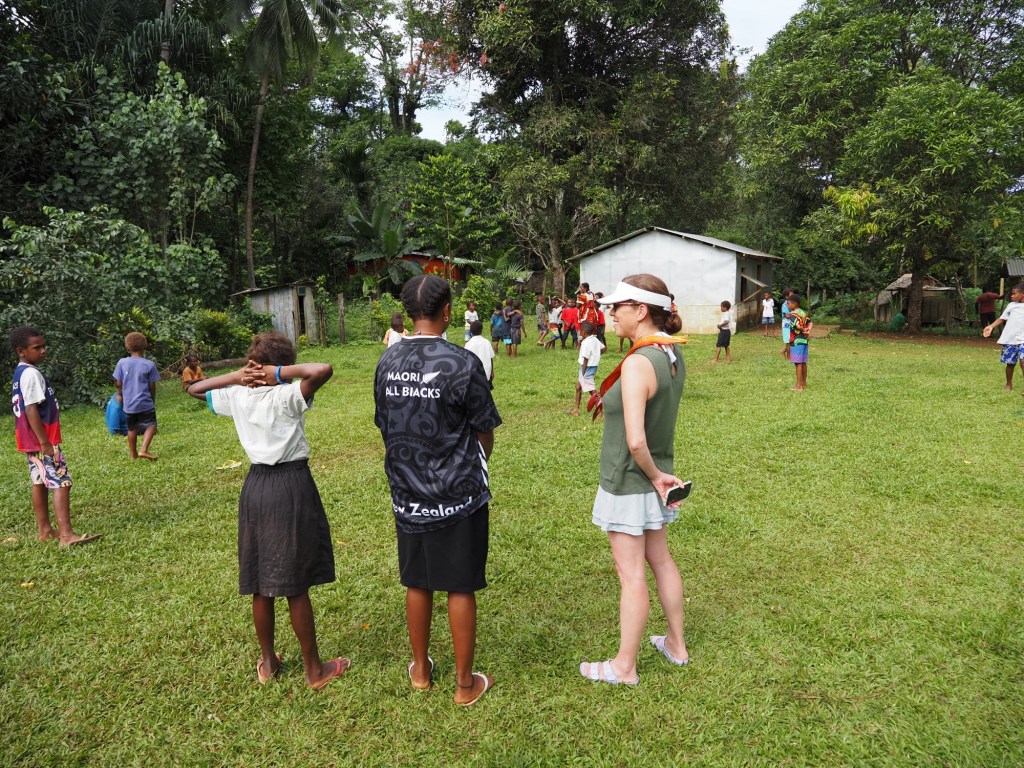
The German family with us brought a soccer ball to give to the students.
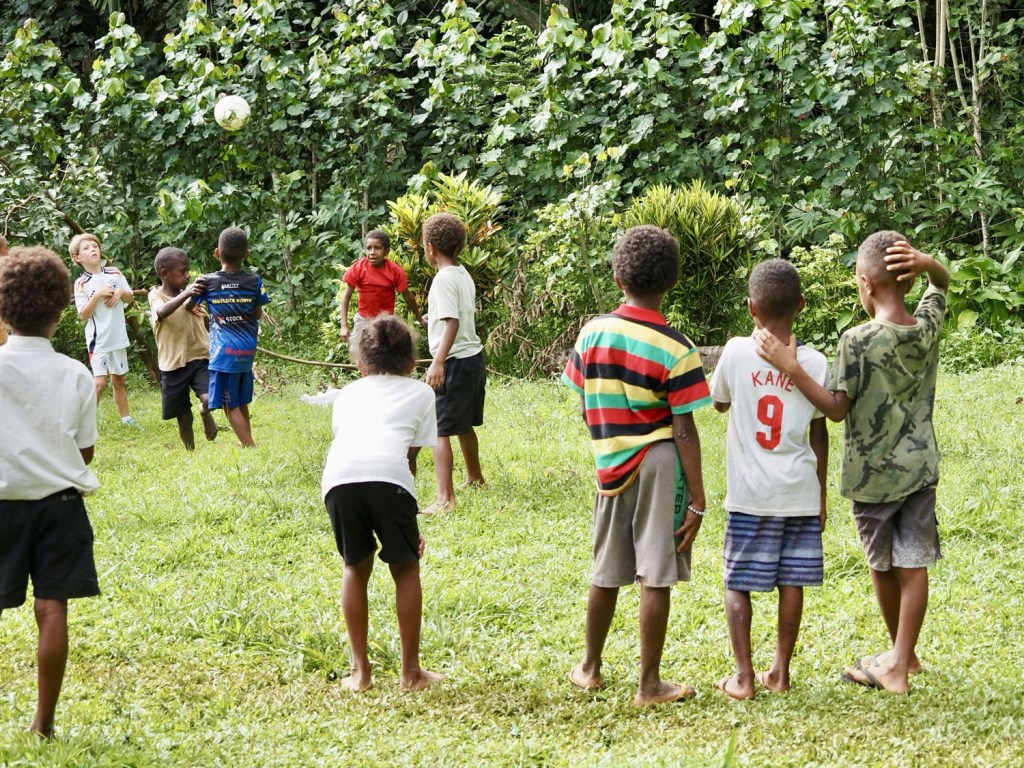
The young German son, decked out in a pristine new German National Team jersey, joined in the game. There too many players, so the kids were eventually split into two games. Our friends whose favorite sport was “play” were actually some of the best soccer players there. I was amused to see that, as we’d find back home, the worst kid on the field got stuck in goal.
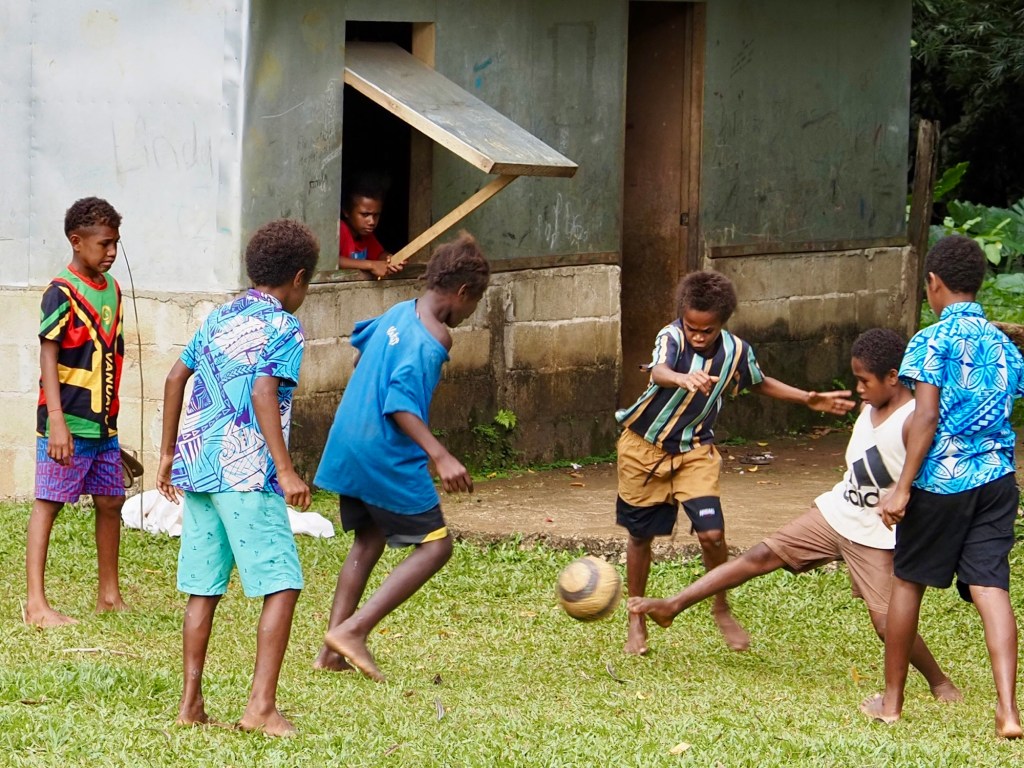
Overall, I loved seeing how typically “kid” it all was and how the teachers minded them. There’s something universal about the dynamics amongst kids and between kids and their teachers. But I was also struck by the gulf between the educational resources plowed into my kids and those at this small school.
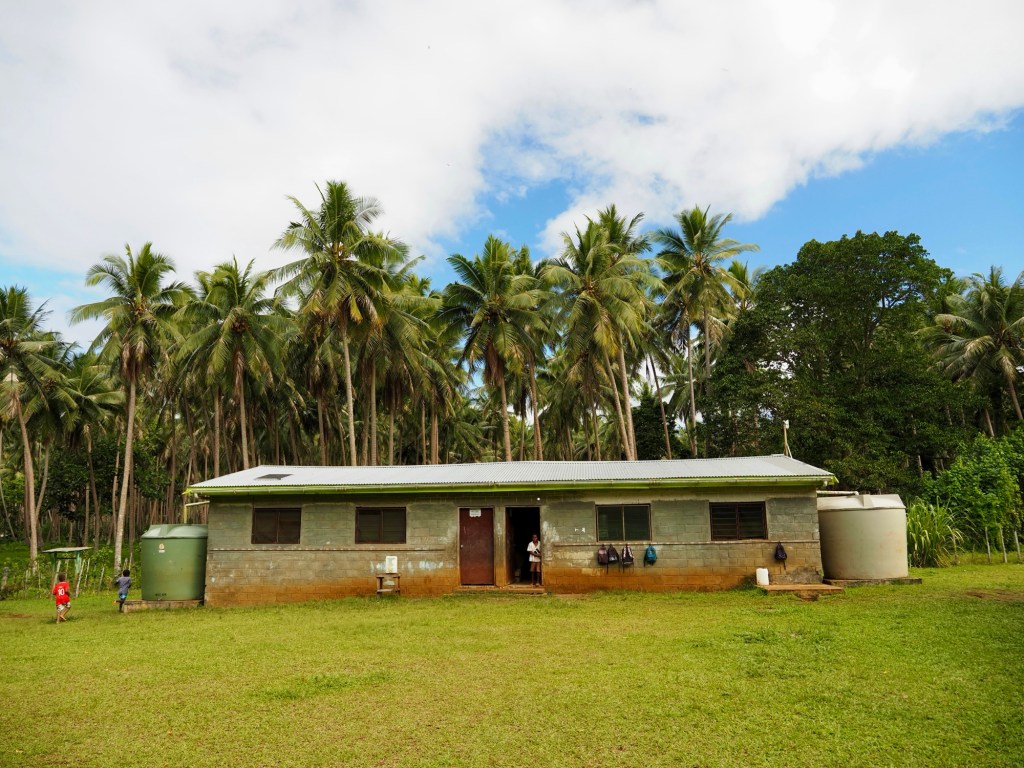
Later that night I was chatting with another guest at the Turtlebay (Anthony). He’d lived on Santo for more than a decade. Evidently, he used to own a good-sized island, and was now back for a visit. Years ago he’d donated some some solar panels to some schools in the area. He asked what I’d thought of the school visit, and I told him that it was bittersweet. The kids were wonderful, but it was a little hard to see the lack of resources. He pointed that there are resources and then there are resources. Some lead down a path of greater prosperity for students but others can change a place, ultimately leaving people less happy and fulfilled than they started. From his years of experience in Santo, he suggested that western-style development might leave some ni-Vanuatu worse off. This stuck with me, as I thought it raised a hard question. By many measures, the ni-Vanuatu are happy. By many measures, they are also poor. I’m still not sure what all this means, but I do wish I’d brought the kids a couple of soccer balls. That clearly made them happy.
We returned to the Turtlebay and had yet another great dinner. We decided to get mostly appetizers to enjoy sharing different dishes. Angie tracked us down, too, and told us she’d sorted everything out with Air Vanuatu with just a few phone calls. Given Megan’s concern and instance that we needed to go in person to the Air Vanuatu office, we were a little surprised. Mick later shared with us that he suspects that Angie is part of some sort of ni-Van mafia. Apparently, when Angie makes calls, things happen. We once again thanked our lucky stars that we’d landed at Turtlebay.
-Will
 The Hubbards' Travel Blog