Buckle up, dear reader. This is going to be a long post—perhaps the longest in our journey so far. In my defense I can only say that I’ve heavily edited the photos and videos to reduce their number even if it doesn’t look like it. There was just too much good material from an amazing day.
Today, Team Hubbard split up. Julie and I were going on the Millennium Cave Tour, which I had read online involved a pretty intense jungle hike and a visit to a local cave. Internet reviews raved about the experience, though the details were a little sparse. Initially, all of Team Hubbard was going to go, but Lydie and Cassie opted to sit this one out. Cassie still wasn’t at 100% from the previous day’s scuba, particularly because of her painful sunburn. Lydie has a pretty intense fear of spiders, and we’d been seeing heaps of big ones around the island. She wasn’t thrilled with the idea of hiking through jungles filled with exotic 8-eyed companions. So, Lydie and Cassie decided instead to have a relaxing resort day.
The day for Julie and me started fairly early. We headed down to the reception area of Turtlebay to pick up the picnic lunches we’d ordered the night before. We also got a couple of dry bags for our food and sundries. Around 7:30, we were picked up by Michele, the kind man who runs the tours. We chatted with Michele as we drove us to pick up another couple, a husband a wife from Tasmania — Jason and Sharyn Stone. The drive took about 30 minutes, despite Michele taking a short cut using an overgrown dirt road made by the Navy Seabees during WWII. Michele explained to us that the tour is something of a family business. The cave was largely explored by Michele’s father, and the tour was founded by Michele’s brother, who unfortunately passed away in 2023. The tour launched in the late 1990s, and Michele’s brother renamed the cave “Millennium” in the hopes of capitalizing on some of the excitement around the pending change from the 1900s to the 2000s.
After picking up the Stones, we drove to Luganville, where we had a very short briefing on the excursion based on a hand-drawn map. I think this may have been an effort to let us know what we were getting into so that if it was too intense, we could back out now.
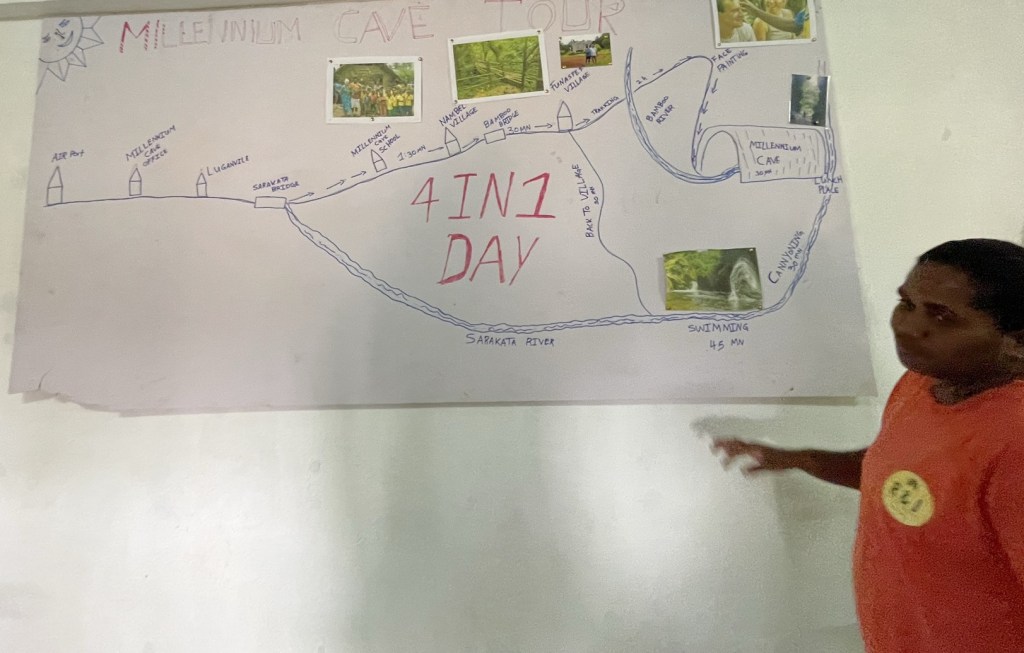
The tour would start with 1.5-hour drive inland to Nambel Village. Along the way we would pass by the Millennium Cave School, a primary school supported in part by the proceeds from the tour. From Nambel, we would hike 30 minutes to Funaspef, another village. We would then hike 2 hours to reach the cave and then another 30 minutes to pass through the cave and out the other side. To be honest, this was the first we’d heard about hiking all the way through cave. I thought the hike would go to the cave, poke around a bit, and then return. I also didn’t know about the next part — about an hour and a half of swimming and canyoning. Then, it would be another hour back to Nambel, and another couple of hours back to Turtlebay. It was going to be a full day!
Meanwhile, back at the lodge, the girls had finally gotten out of bed and made it to breakfast. While we were trying to figure out what exactly was meant by “canyoning,” Lydie was exploring the finer points of banana pancakes.
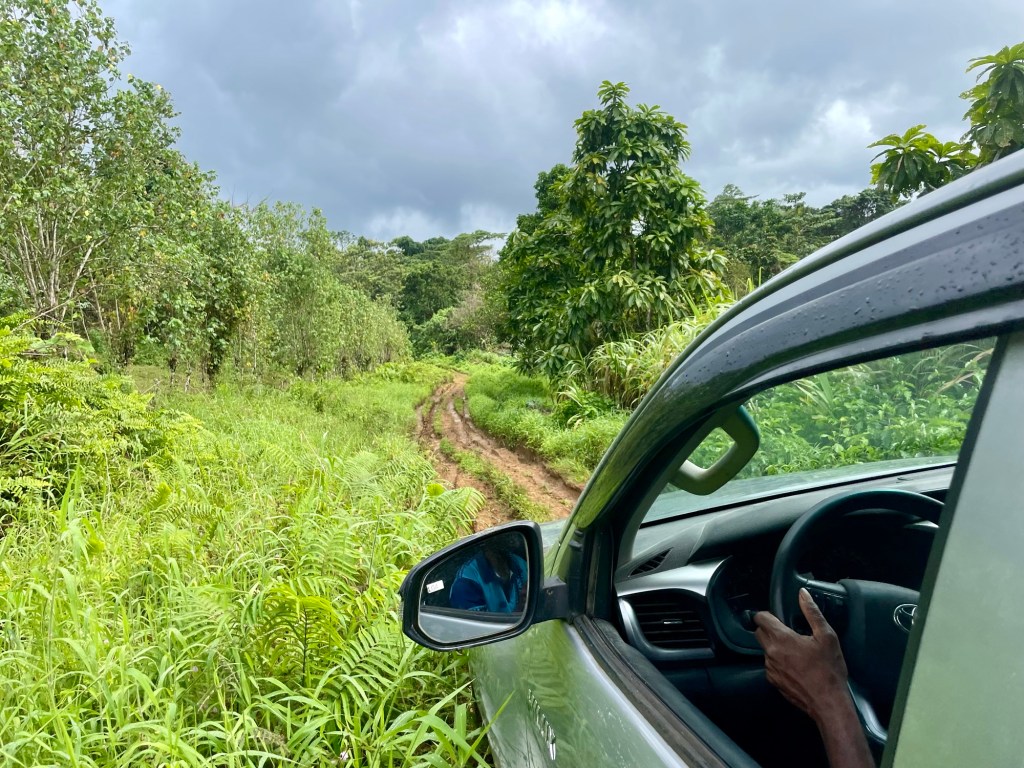
After our briefing, we paid our fares and climbed back in Michele’s truck. A short time later we turned onto a dirt road ascending into the jungled interior of the island. The road was far rougher than anything we’d seen so far, with muddy ruts worn by 4x4s so deep that the undercarriage scraped as we drove.
We soon reached Nambel, where Michele introduced us to our guides — Sydney (who spoke English) and Cherny (who spoke French). Both were in their late teens and were related to Michele. See? Family business. Michele also decided that English-speaking Sydney would work with the Stones, while Cherny would help Les Hubbards. Julie and I quickly ran through as many French phrases as we could conjure up. Bonjour! Merci! Je m’appelle Lafayette!

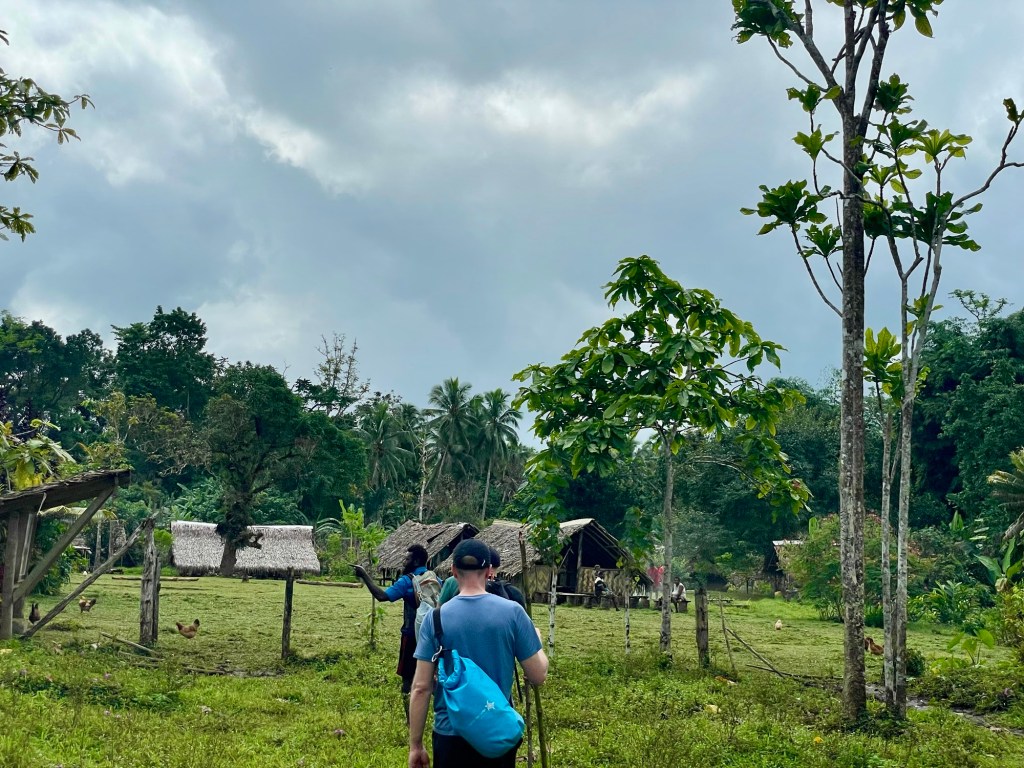
We also had a minute to look around the village, which was small and rustic, with most of the buildings being made entirely from local natural materials. There were some small solar panels on the houses for lighting at night, but otherwise no electricity and certainly no plumbing. Our guides politely made it clear that we had a long way to go and a schedule to keep, so it was time to set off!

You may note that our footwear wasn’t exactly jungle strength. Remember that 10kg limit for our luggage on Air Vanuatu? We were traveling very light, which meant that we didn’t bring hiking boots. Besides, our guides were barefoot, so I certainly wasn’t complaining. That said, as the trail descended, the footing became slippery, and we soon started to miss our boots.
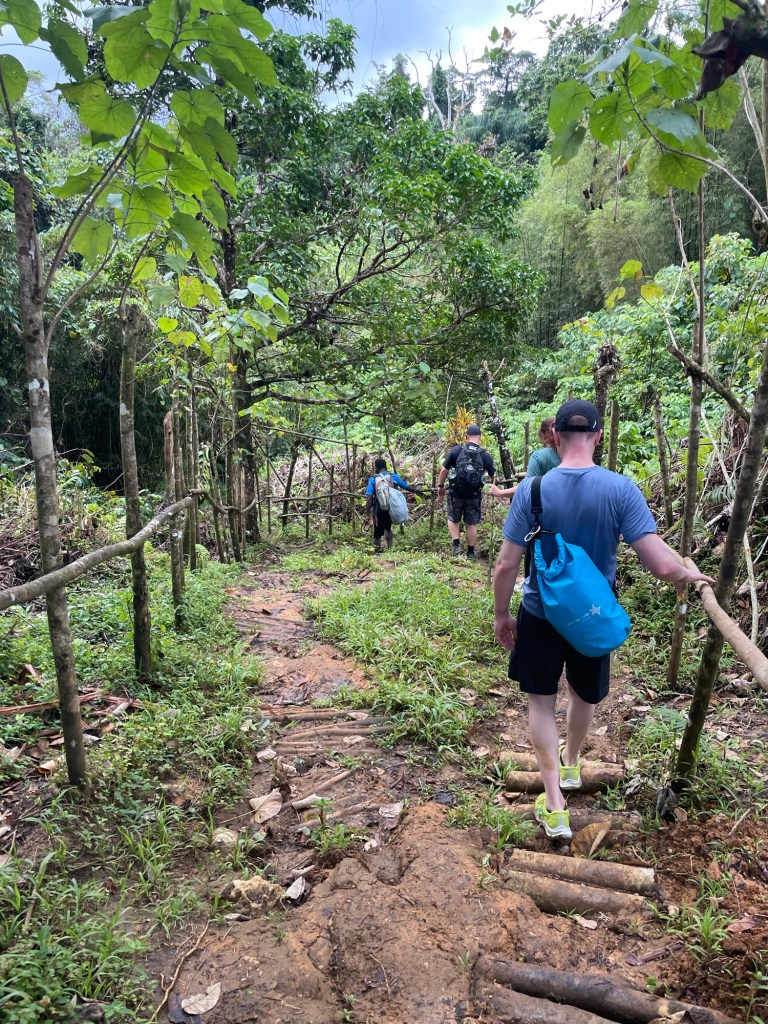
All things considered, the trail was relatively wide and well maintained, which makes sense given that it is the main path to get to Funaspef. Whenever someone from that village wants to head towards Luganville, this is the route they would take. Part of this path includes a rough bamboo bridge.
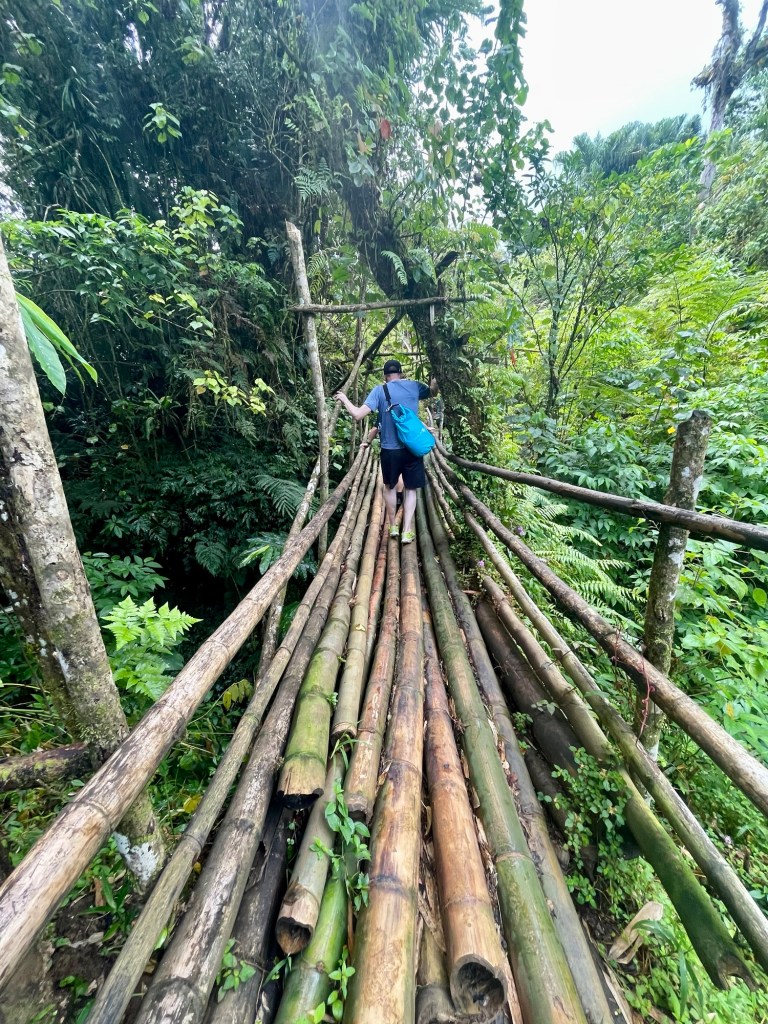
The bamboo isn’t lashed to the bridge. Rather, multiple huge pieces are simply laid flat from bank to bank to create a somewhat shifting walking surface. After about 30 minutes of hiking we reached the next even tinier village.
Meanwhile, while we were beginning our hike, Lydie and Cassie had finished breakfast and watched something on Netflix for a bit. Around the time we reached Funaspef, the girls were on their way to the pool.

In Funaspef we were given life vests, which we would wear as we hiked for the next couple of hours to the cave. Geared up, we set off into the jungle, with the trail becoming markedly smaller.
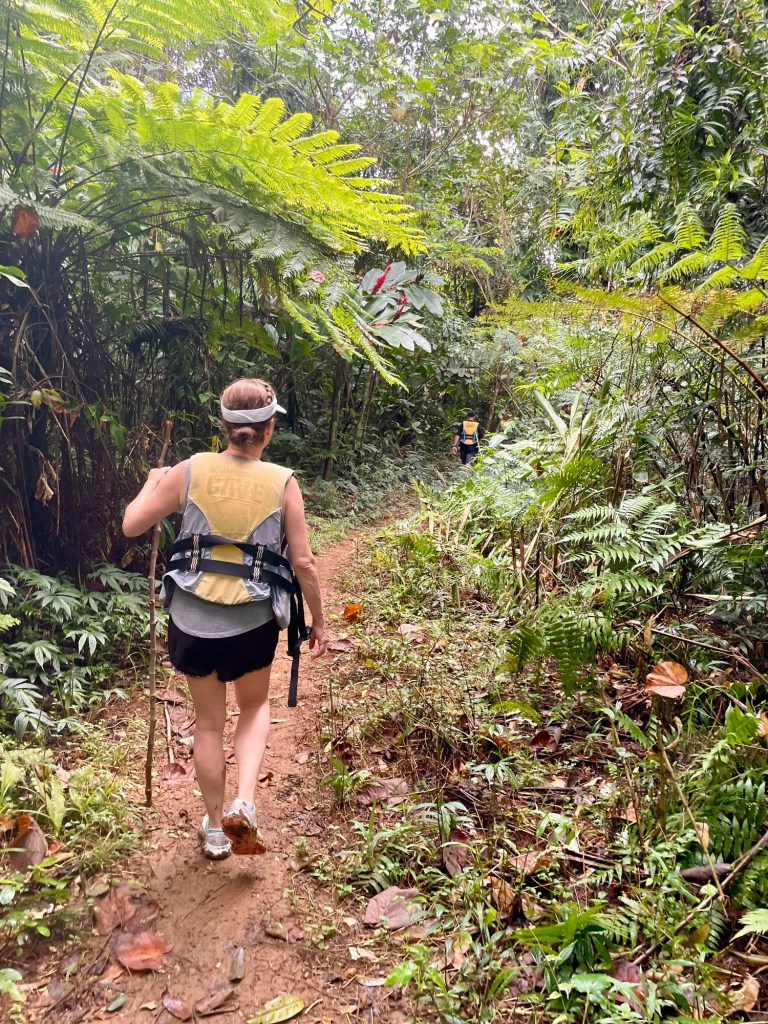
Jason, our new travel companion, had wisely found some hiking sticks for all of us non-ni-Van, and we were soon relying heavily on them for stability. As the jungle grew wilder, we crossed a stream flanked by some huge stalks of bamboo like those used for the bridge.

The trail then followed the water for a bit, with the vegetation growing even more lush.
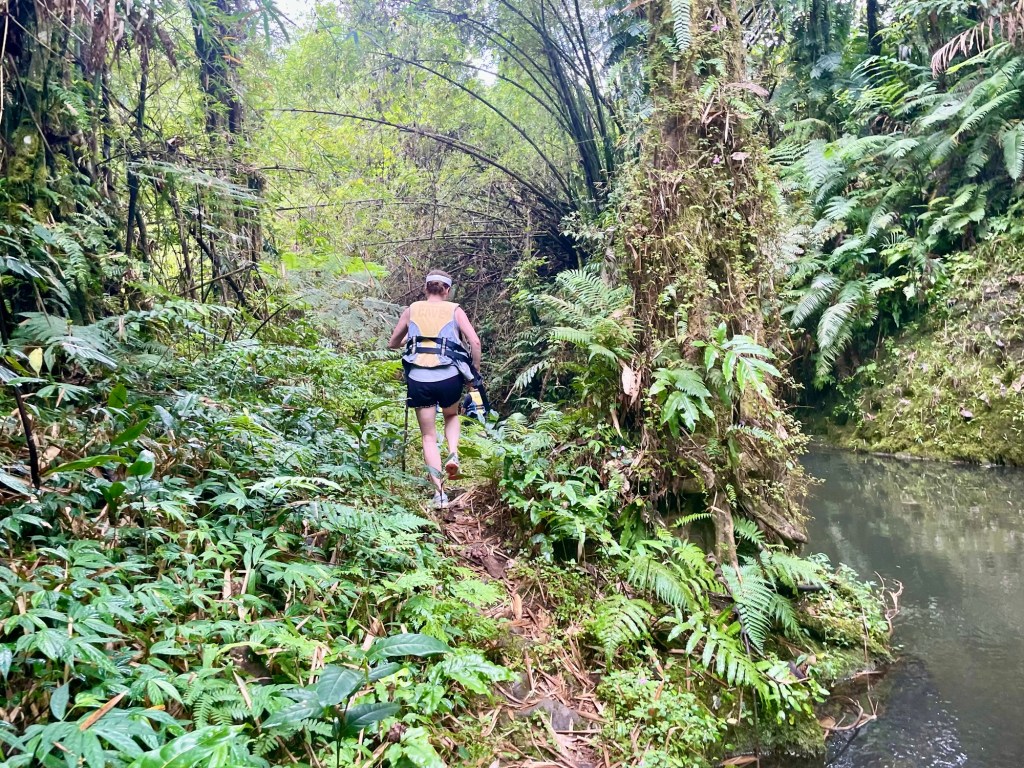
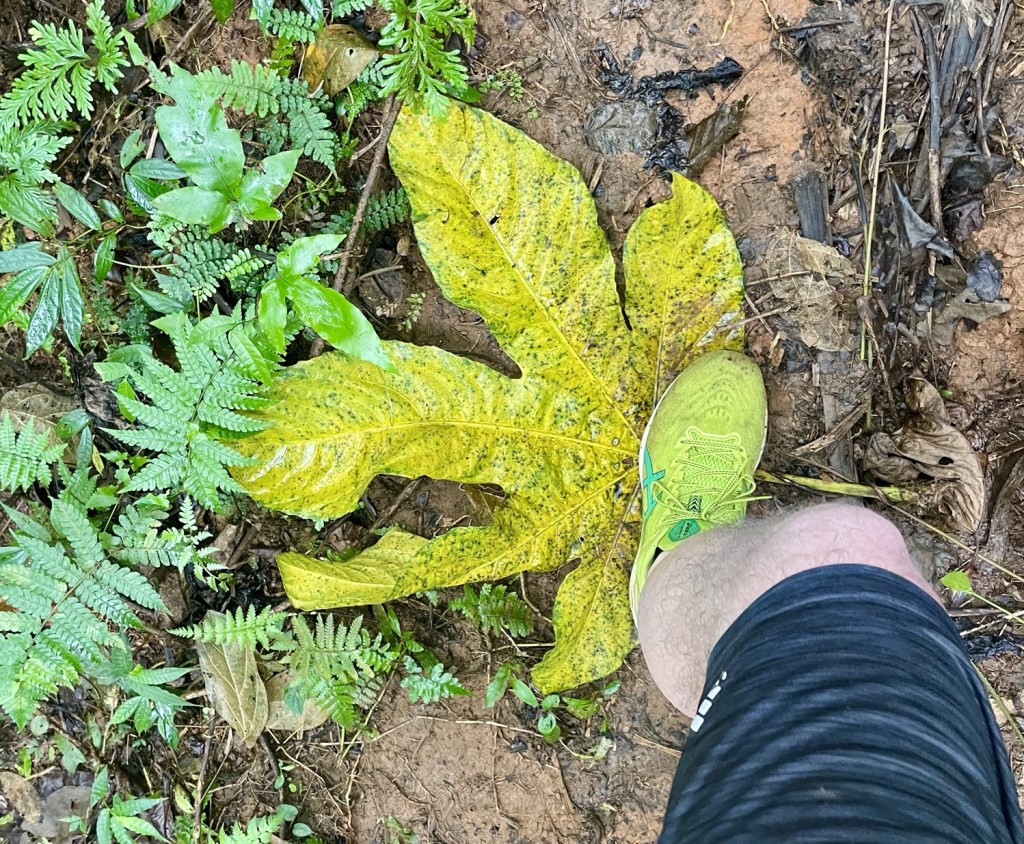
Some of the leaves were Jurassically massive.
From time to time, our guides would stop to tell us a bit about the jungle and to let us catch our breath. At our first such stop, our guides pointed out the giant palms that are used to make the roofs for the huts we’d seen in the villages.

Along the trail our guides also highlighted other interesting plants, including the vines used on Pentecost for their vine-diving tradition. After our break, the trail grew much steeper.
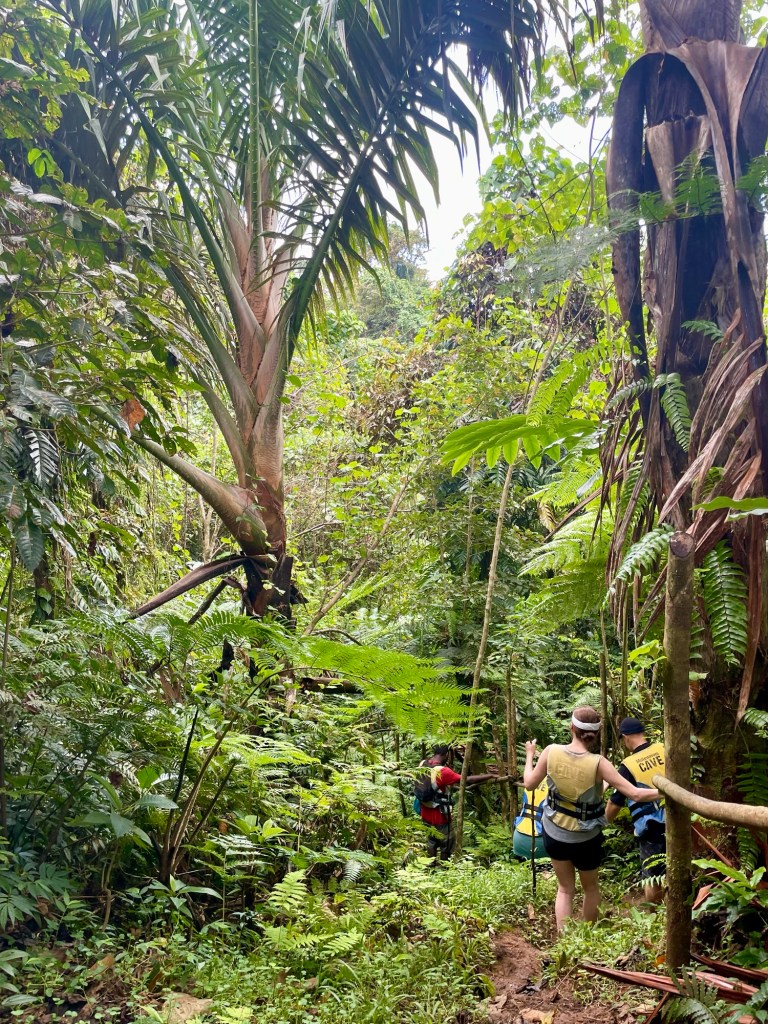
Given the slippery footing, we were glad to have some rough handrails. Without them we’d surely have gone sliding down the hill. But it turned out that this was actually the shallow part of the descent. The next stretch of the trail included sections that may once have been steps, but had washed out to to become an ankle-breaking trap for the unwary.
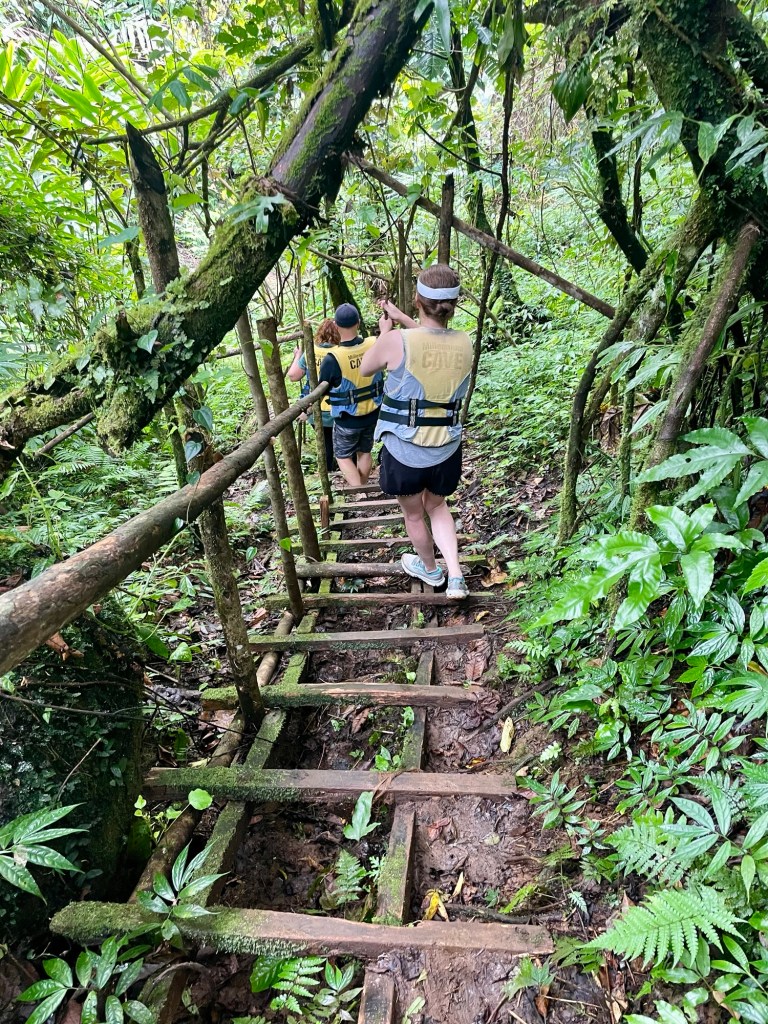
As we hiked, huge ferns lined the trail. Clearly, this place sees a lot of rain from time to time. With some dark clouds in the distance, we kept our fingers crossed that the rain would hold off for our day in the jungle, particularly the part where we would be underground.

Each section of trail seemed steeper than the last, and we soon had to start using angled ladders to descend.
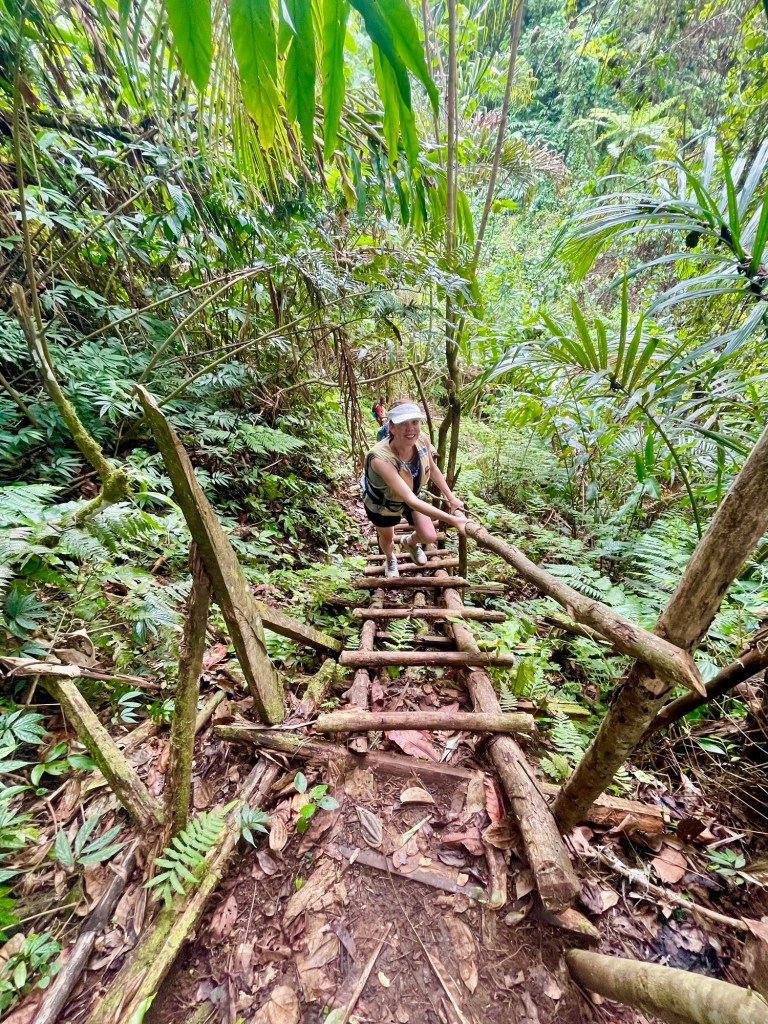
It was actually easier to go down the ladders backwards, which is why Julie is facing me as she climbed down. There were rough railings in some spots, but in other areas the railings were either rotten or otherwise absent. In those stretches, we had to use our hands on rungs, which is why going backwards was easier and safer. But it wasn’t all down. We went up and down as the trail snaked through the jungle (where there are no venomous snakes fortunately).

In fact, there was quite a bit of steep climbing.
After about an hour, our guides stopped us for another break and some face painting. The guides used the wet mud we’d been hiking through to draw various cave-related motifs on our faces.

I wasn’t sure what to make of the face painting. I’m always up for adding to the experience and embracing local traditions, but I couldn’t help but wonder if this might just be a gimmick for the tourists. A conversation a few days later with Mick from Turtlebay made me think twice. He described to me his only trip to the cave. On his tour, there were some other visitors to the island who refused the face painting on religious grounds, as they apparently were Christian missionaries. Mick said that the guides were somewhat upset by the refusal and unsure of what to do, as they took the face painting seriously. Mick also said that after face-paint refusal, when the group entered the cave, the water levels rose so quickly that they had to turn back. Caving karma!
In any event, Julie and I were happy to have our faces painted, as were the Stones. The war paint also helped steel our nerves, as the “path” got much steeper from here.
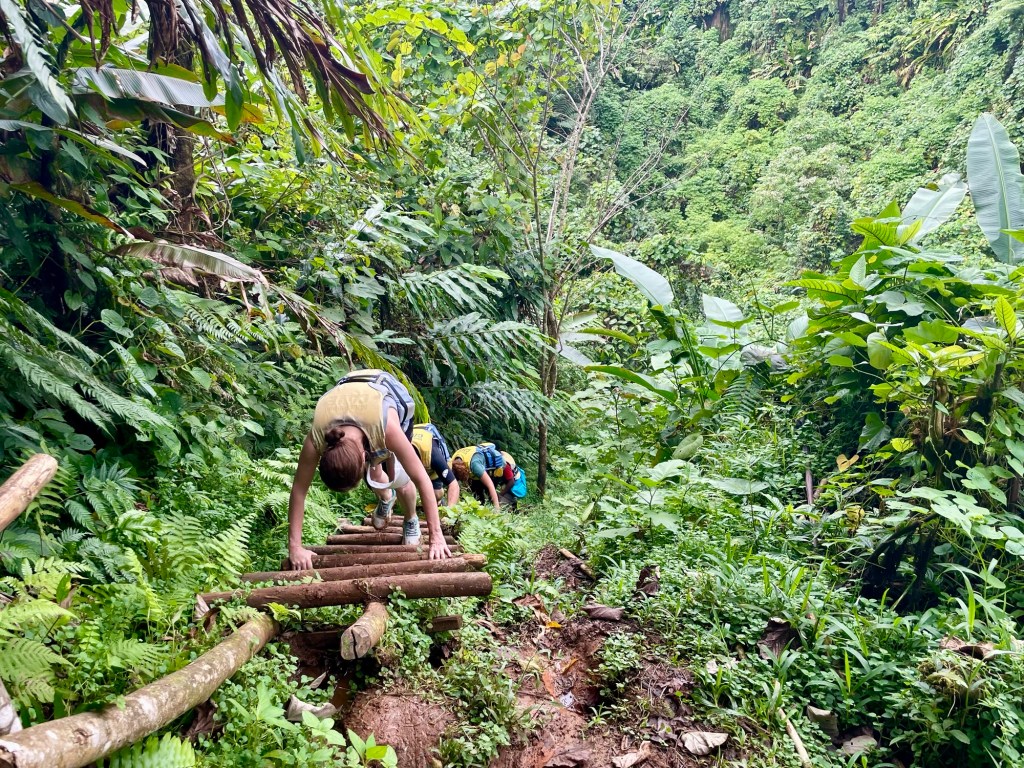
Again, it was easier to go down backwards. How steep was it? Steep. Seriously steep. The-pictures-don’t-do-it-justice steep. Here’s what I saw after I climbed down and looked back.
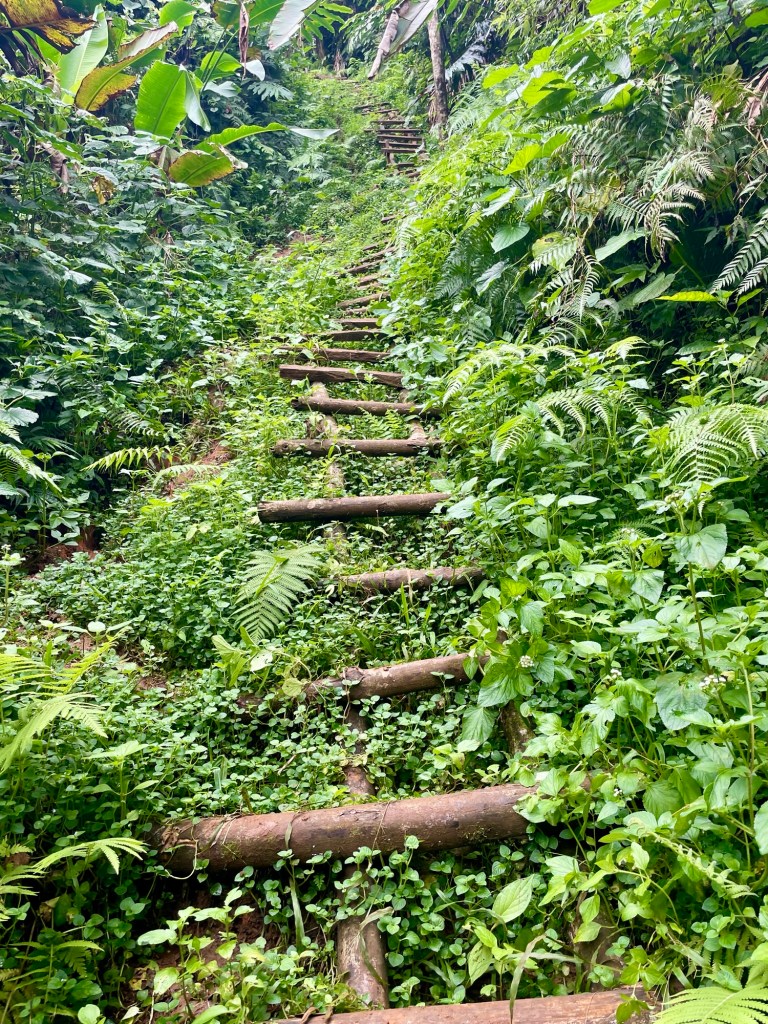
And we weren’t even done yet. The picture above was taken halfway. From here, the trail kept going down.
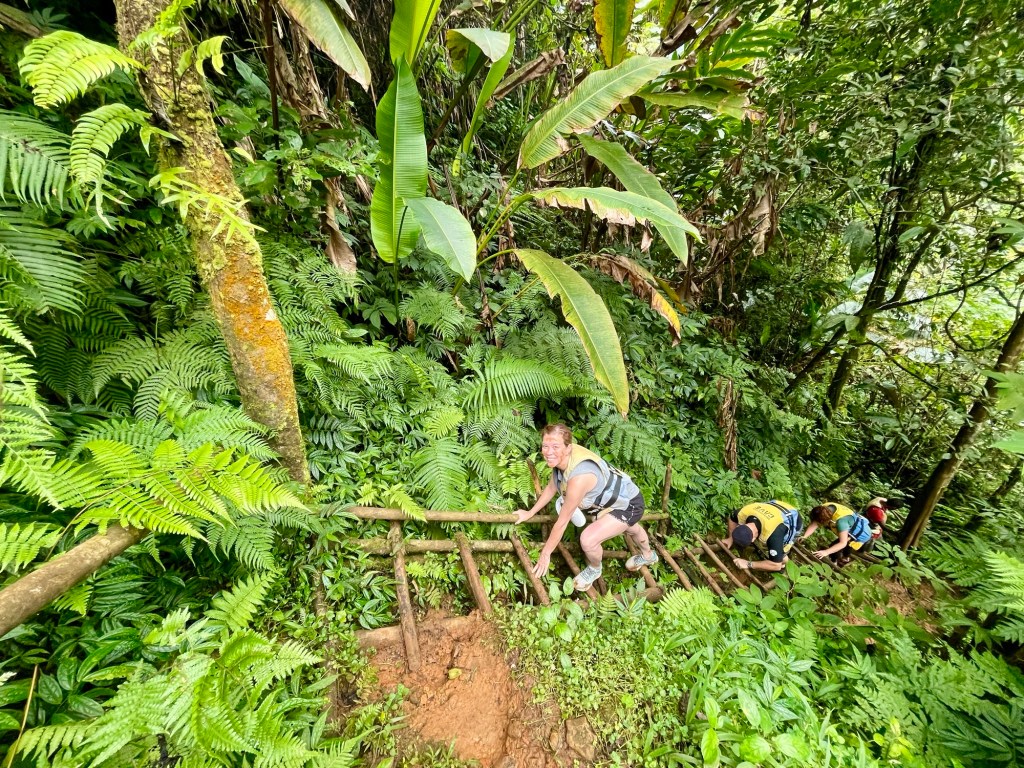
In fact these ladders went straight down into a crevice under some boulders, where we had to crawl underneath to pass out the other side.
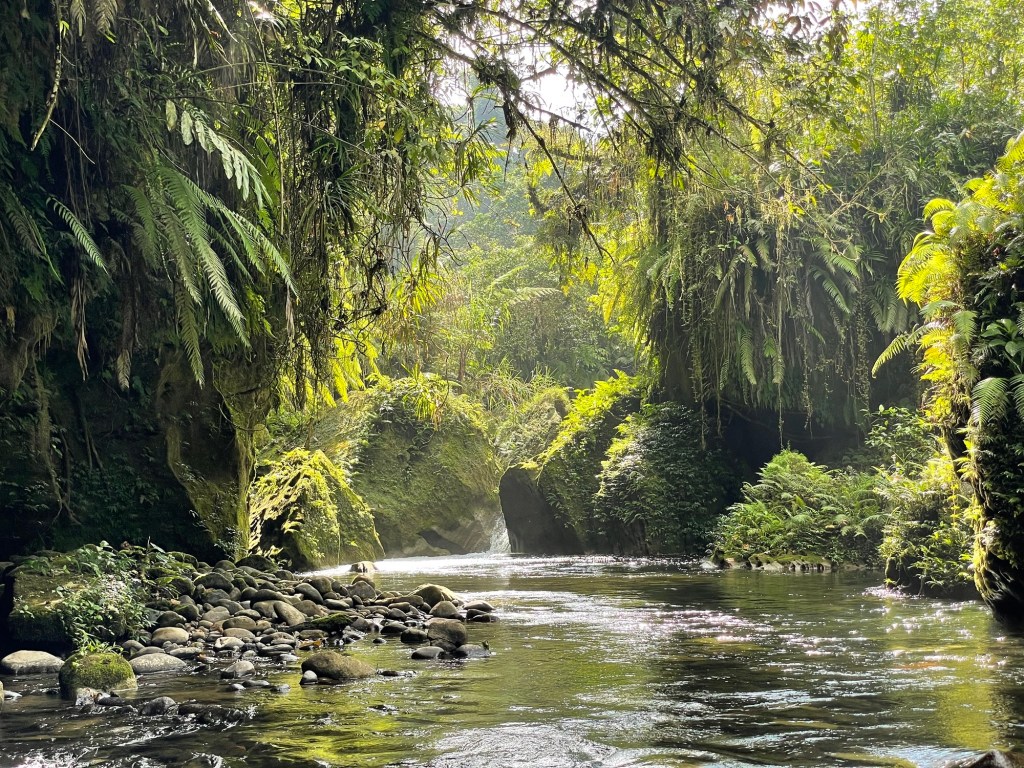
From here, the trail leveled out, following the stream that you could hear in the video above. It’s worth noting just how dense and lush the jungle was in every direction. It was simply spectacular.

As we hiked, we could hear the stream passing over waterfalls, and the cool water was refreshing after all the hiking and climbing.

After a few more minutes, we reached the cave. The whole squad was thrilled!
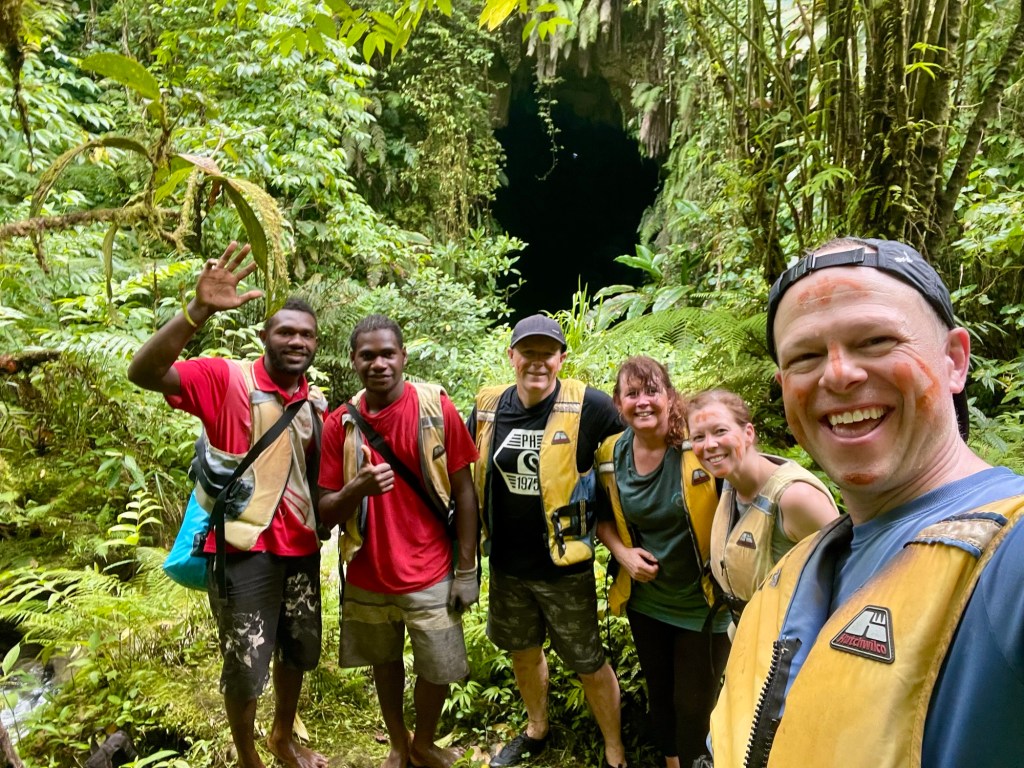
But we weren’t done yet. Not even close. It was time to hike into the cave.
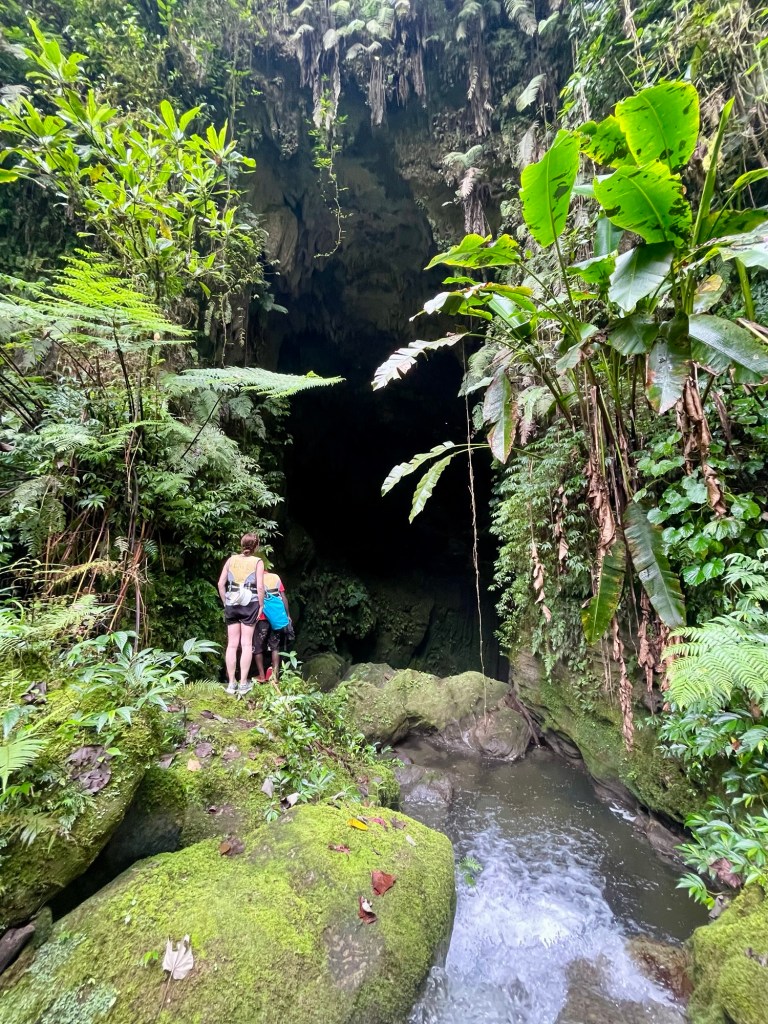
About this time, we started to see some sort of flying creatures going in and out of the cave. We weren’t sure if they were birds or bats. All we knew is that there were lots of them. Julie was feeling understandably trepidatious. I was just excited.
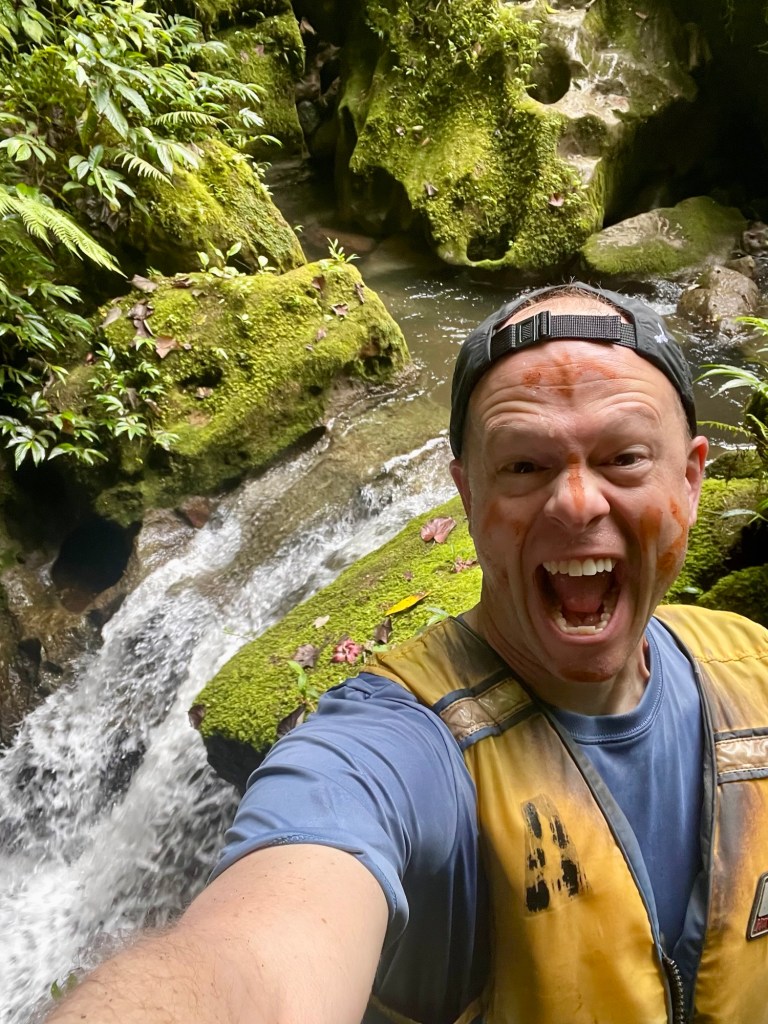
The waterfall behind me plunged down into the cave, so that we had to climb alongside the falls to enter.
From here, we could see the flying creatures were birds, hundreds if not thousands of white-rumped swiftlets (probably – based on my later internet research). As they flew in and out of the cave, they screeched at each other to avoid collisions, though you can’t hear it over the sounds of the waterfall in these videos.
As we ventured further into the cave, our guides passed out small hand-held flashlights for us to navigate. For the next 40 minutes, we hiked down the rapid-filled riverlet in the bottom of the cave, climbing over rocks large and small. This was a challenging part of the adventure. Our small lights helped us find our footing in the rushing water, but it was difficult to see obstacles in the underground whitewater. My flashlight also failed after about five minutes. Our guide Cherny gave me another one, but the batteries were dying in that one, too, so that I still had only a dim light.
And the smell! Swiftlets nested all throughout the long cave, as they can apparently navigate the darkness with echolocation like bats. And those birds have been pooping in the cave for millennia. In the treacherous footing, we frequently had to use the rocks and cave walls for stability, putting our hands in squishy god-knows-what. Julie and I also spied some good-sized spiders in the cave. Good call, Lydie!
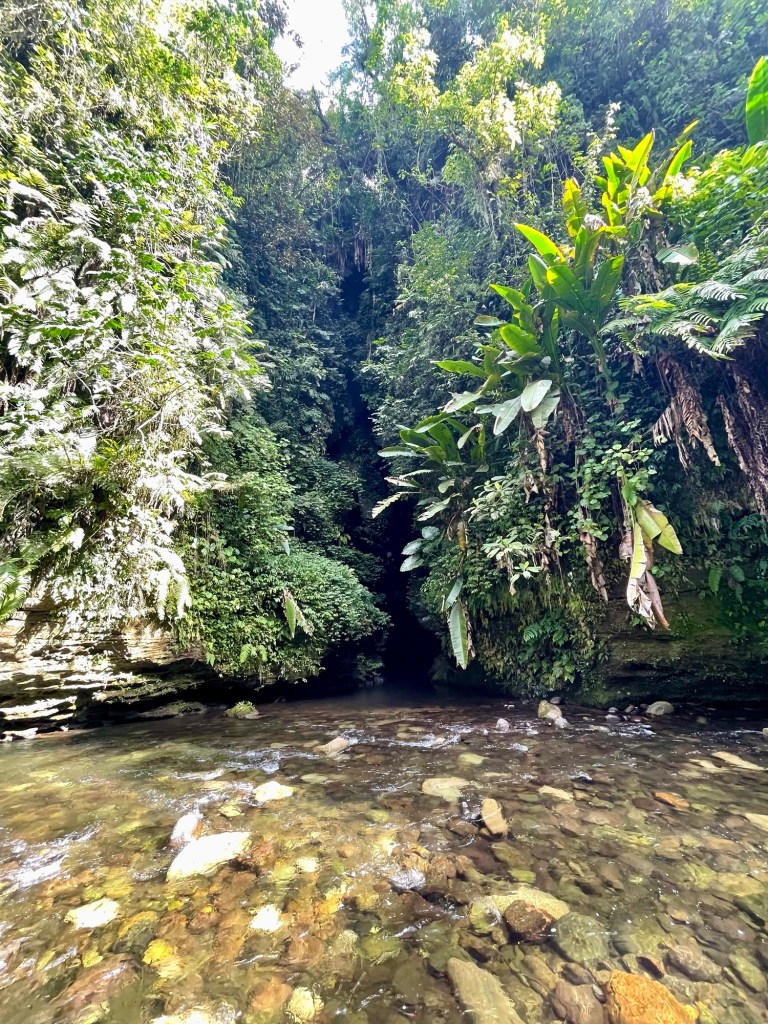
Eventually, we started seeing light in the distance. As we reached the downstream exit, the cave narrowed, and the water deepened, so that we had to swim out of the cave. Julie was not enthused to be swimming in the cave-bird effluent. She *might* have climbed on my back for most of the swim, stopping only when my feet couldn’t touch and she started forcing my head under the water. Around 2pm, we emerged from the cave, where our stream joined with a larger waterway. We climbed onto the far bank feeling exhilarated and looked back towards the cave exit.
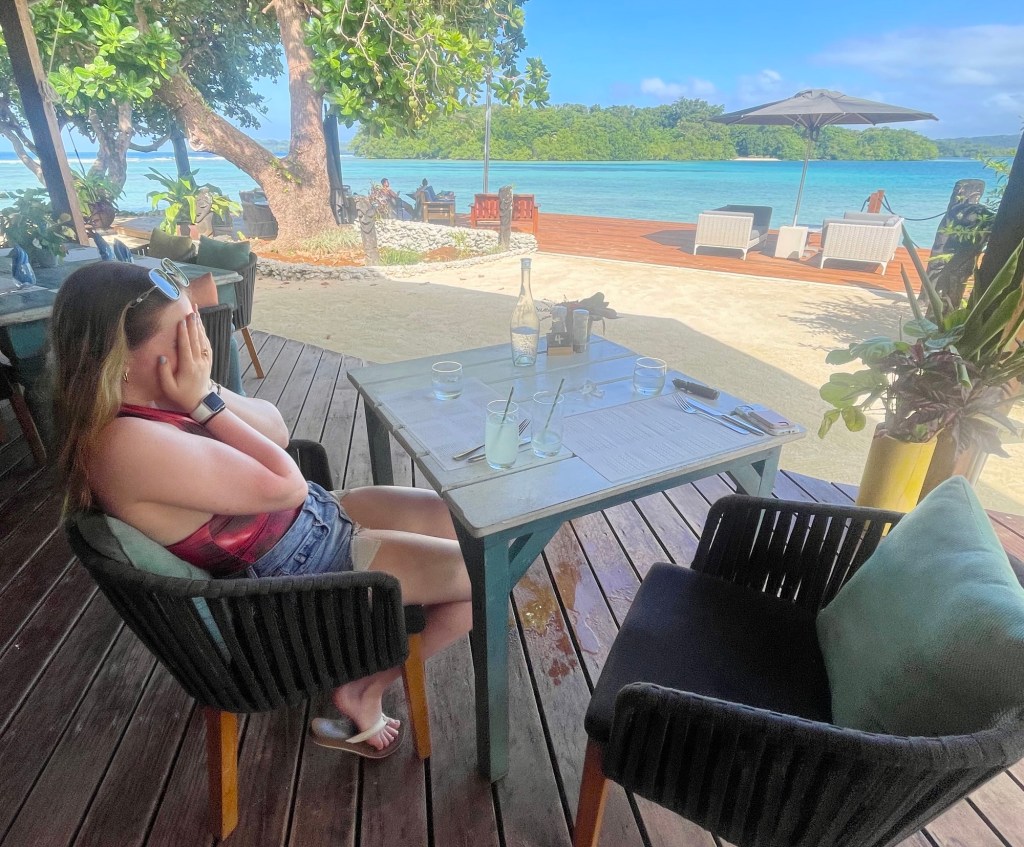
While we were battling our way through the cave, Lydie and Cassie were having a very different day.
The girls were absolutely right. Julie and I were having a great time! While the girls ate at the lodge looking out over the lagoon, Julie and I scarfed down our simple picnic lunch marveling at the cave across from us, the jungle around us, and a waterfall upstream in the distance.
It wasn’t all fun and games at the Turtlebay. Sure, Julie and I were battling our way through cave poop, but Lydie spilled her lime juice. The struggle was real.
Julie and I finished up our lunch, and packed up everything in the dry bags. It was time to continue. This time, there was no trail. We cinched up our life jackets and plunged in the water.
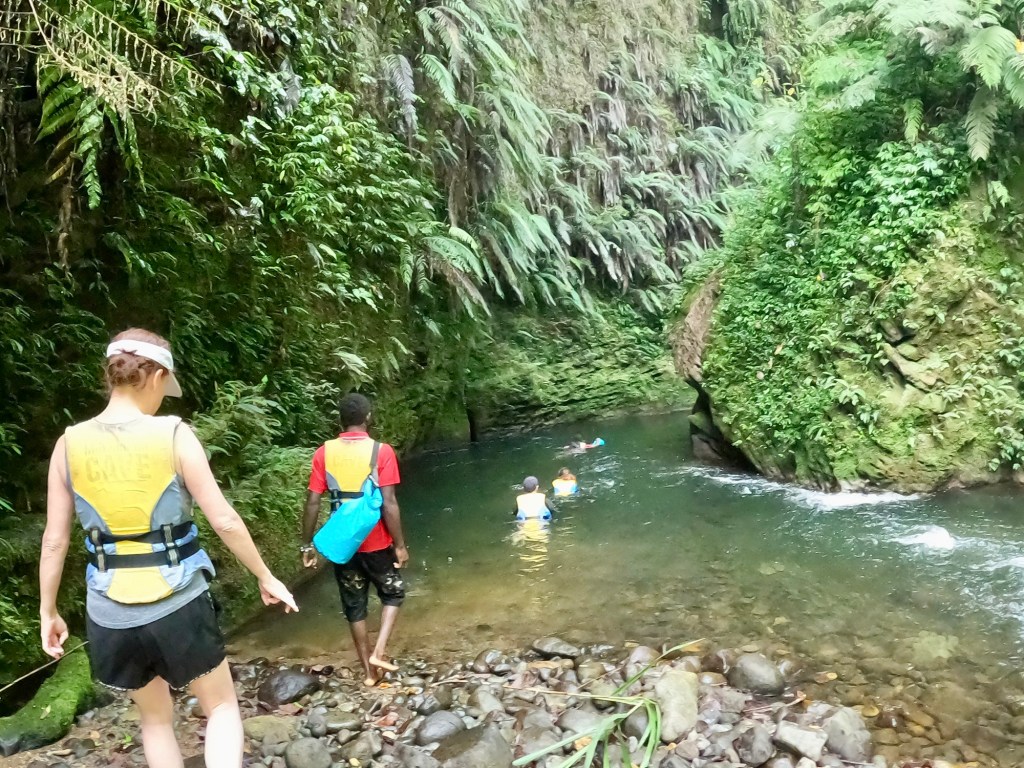
When the stream became too shallow to swim, we scrambled along the rocks to the side, doing our best to find our footing in the rapidly flowing water.
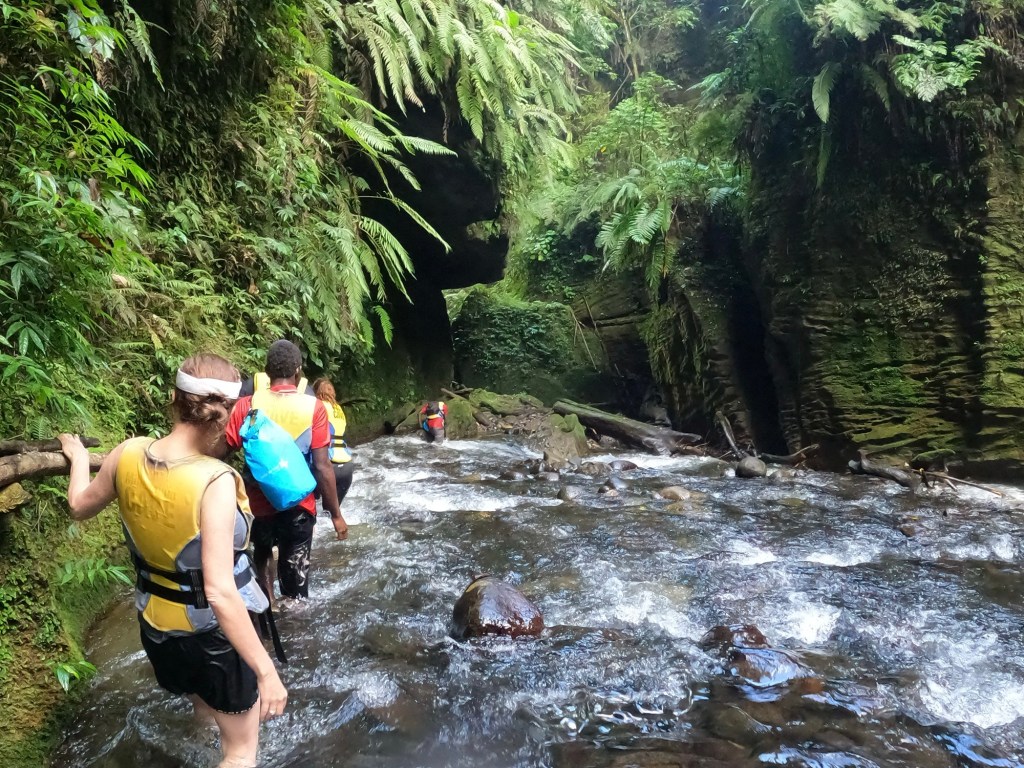
In some stretches, the river passed through dangerous gorges, forcing us to scramble up and over huge boulders.

Lush vegetation covered everything. The picture below shows part of the “path” we were following. You can see Jason’s yellow vest in the center of the picture and our guide in the bottom left. But the trail between the two of them is all but invisible. Without our guides, we never would have made it through.
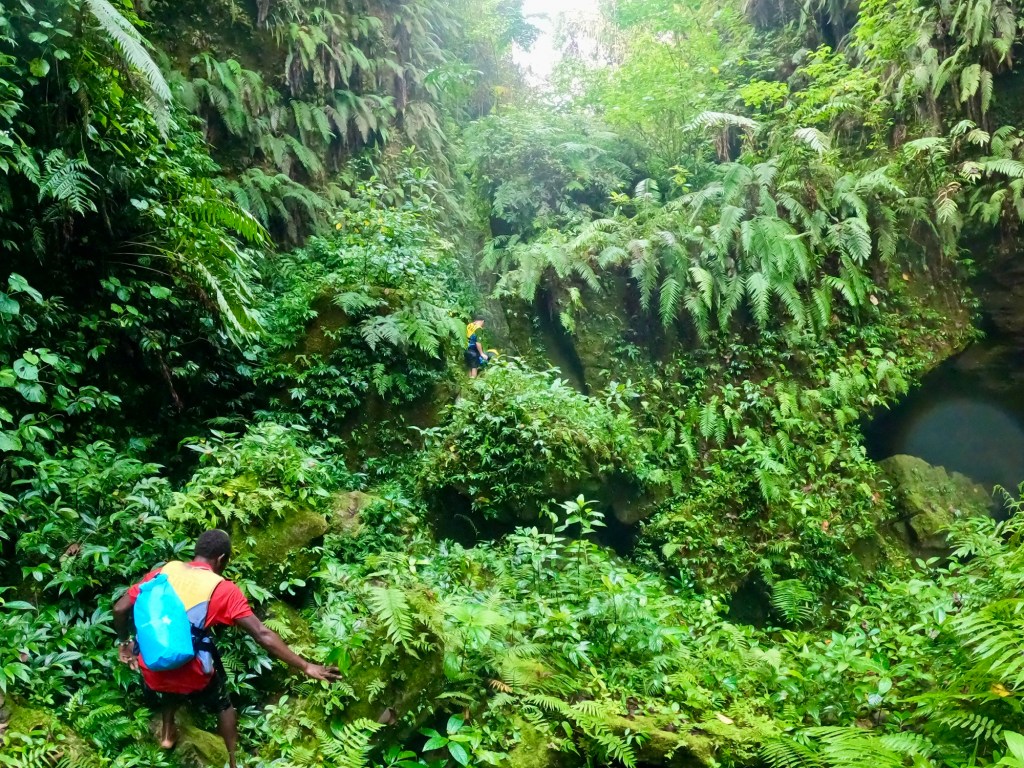
In some places, we had to pass under massive boulders, walking in water and being careful not to twist our ankles or get washed into crevices.
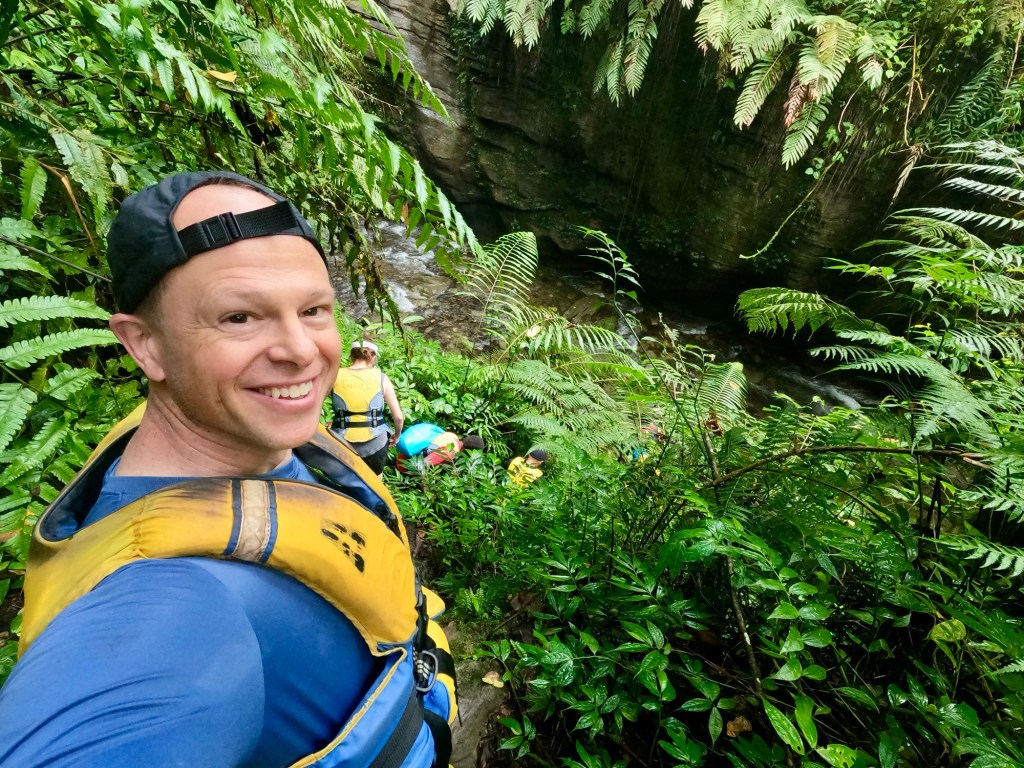
As you can see, we were being extra cautious. There was little margin for error here. If anything went wrong, it would be hard to get any help. We were hours away from Luganville, which was hours and a flight away from Vila, which was hours and even more flights away from any major city. So, a little caution was in order. But we didn’t feel unsafe at any point on our adventure. Our guides were wonderful help, pointing out handholds and safe spots to step, holding Julie’s hand in tougher sections, and frequently checking in with me to make sure I didn’t need more help.
In some stretches much-needed metal rungs were anchored in the stones to help us climb on the slippery moss-covered rocks.

Ropes also gave us something to grab from time to time. We climbed up, we climbed over, and we climbed down, always following the river. It was exhilarating.
Back at the Turtlebay, Lydie and Cassie continued their hardcore, extreme day of relaxation.
Around this time, Julie and I reached a new stretch of the river, where it wound through a deep ravine, requiring us to swim.
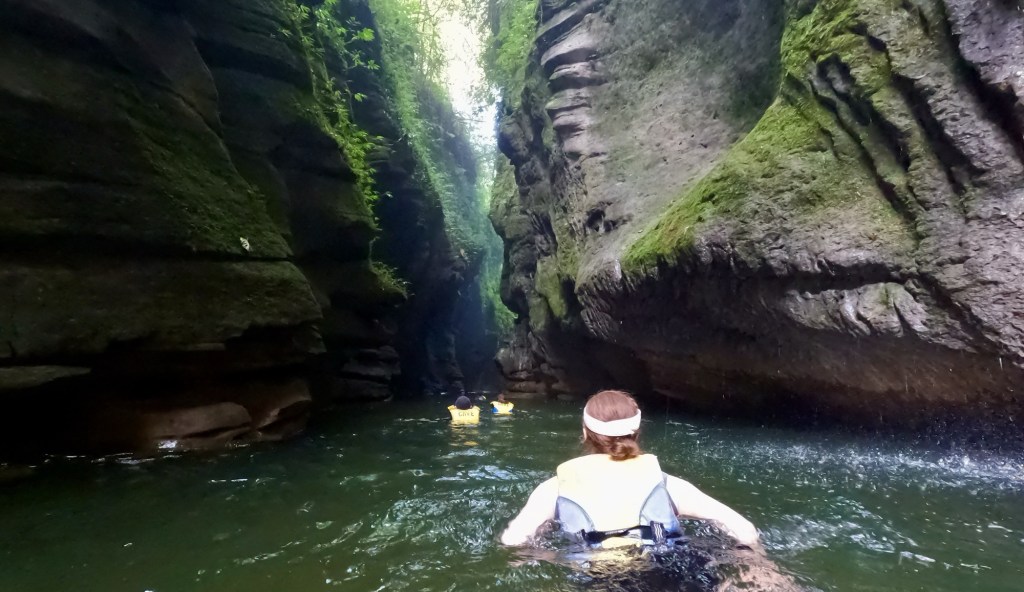
Behind us, light filtered through the canyon, and we enjoyed looking back as much as looking forward.
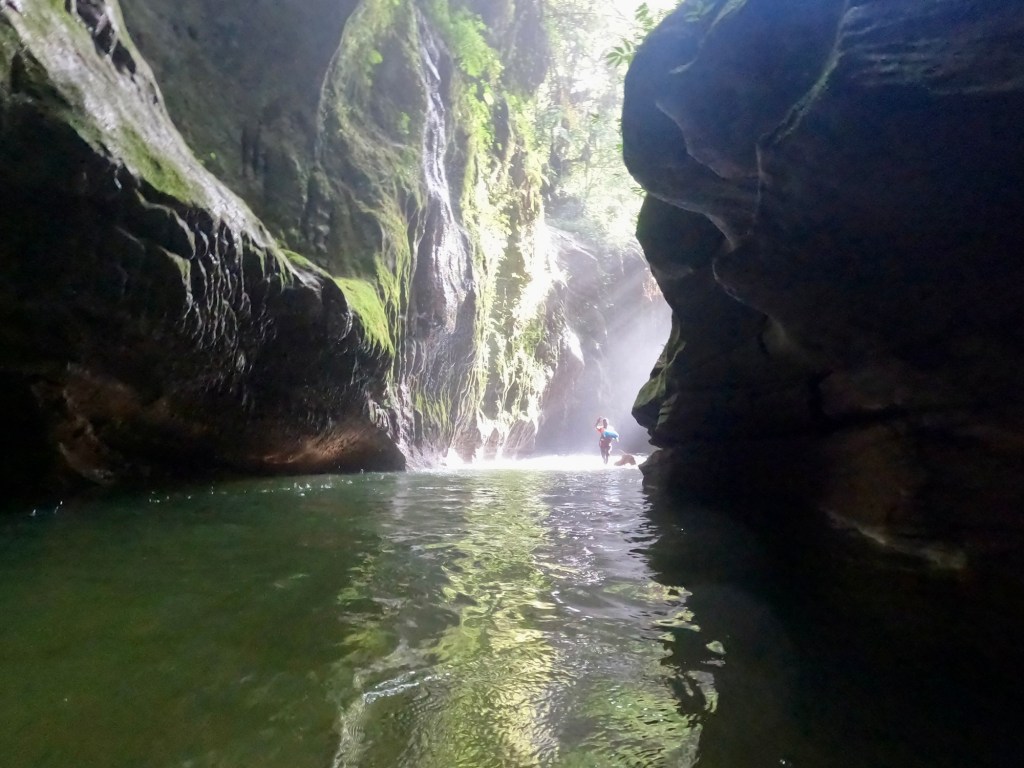
We floated on, with towering cliffs on both sides. In one spot we saw a huge tree that had fallen across the chasm up above. Other than this natural bridge, the rift would have been quite a barrier for ni-Vanuatu long ago.
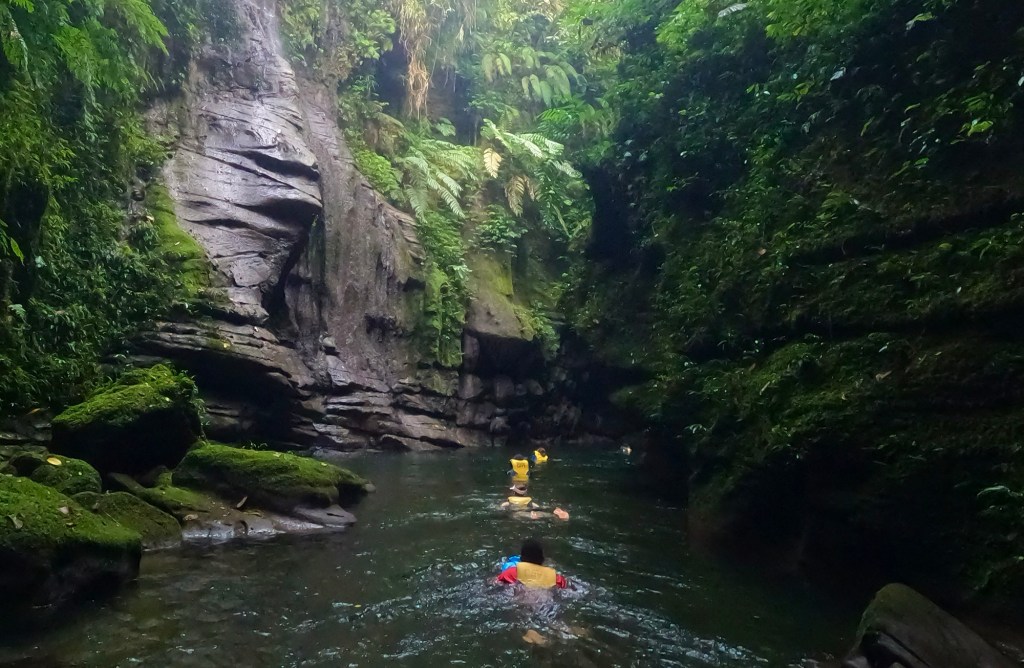
We floated along in this other-worldly place, swimming forward and then turning around backwards to see the stone walls from other angles, with the sunlight catching the moist air.
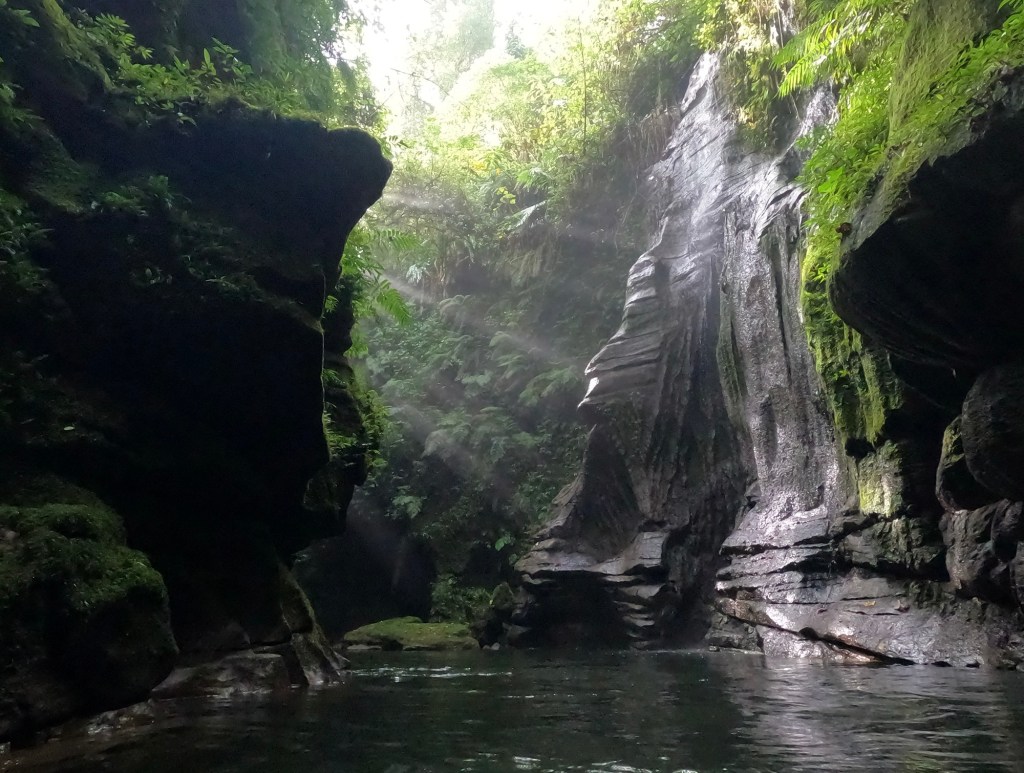
Ahead in the distance, we could hear and soon see a waterfall.
As we approached, the water became shallower, so that we could walk under the waterfall. Everyone in the group took a turn under the shower, even our guides. It was too enticing to pass up.
A short time later, the cliffs grew shorter, and the chasm started to open up, indicating that we were nearing the end of our river adventure.
Soon, we were starting to climb out of the water on the banks along the side.
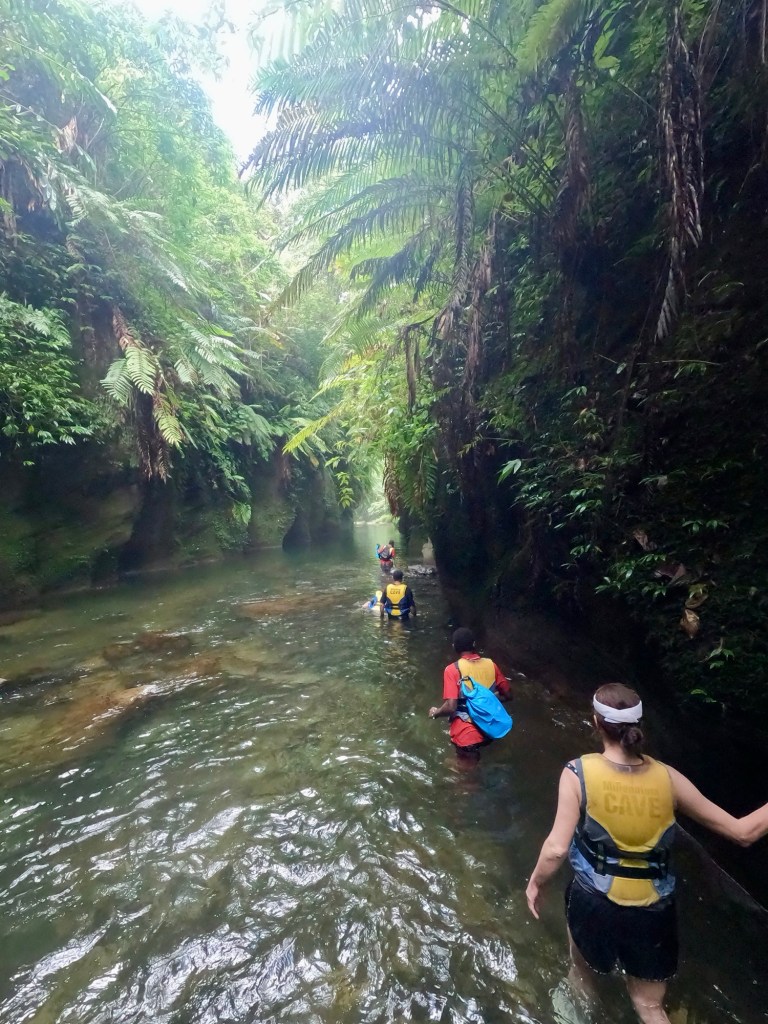
We cast a final look back at the canyon, which was still just as breathtaking.
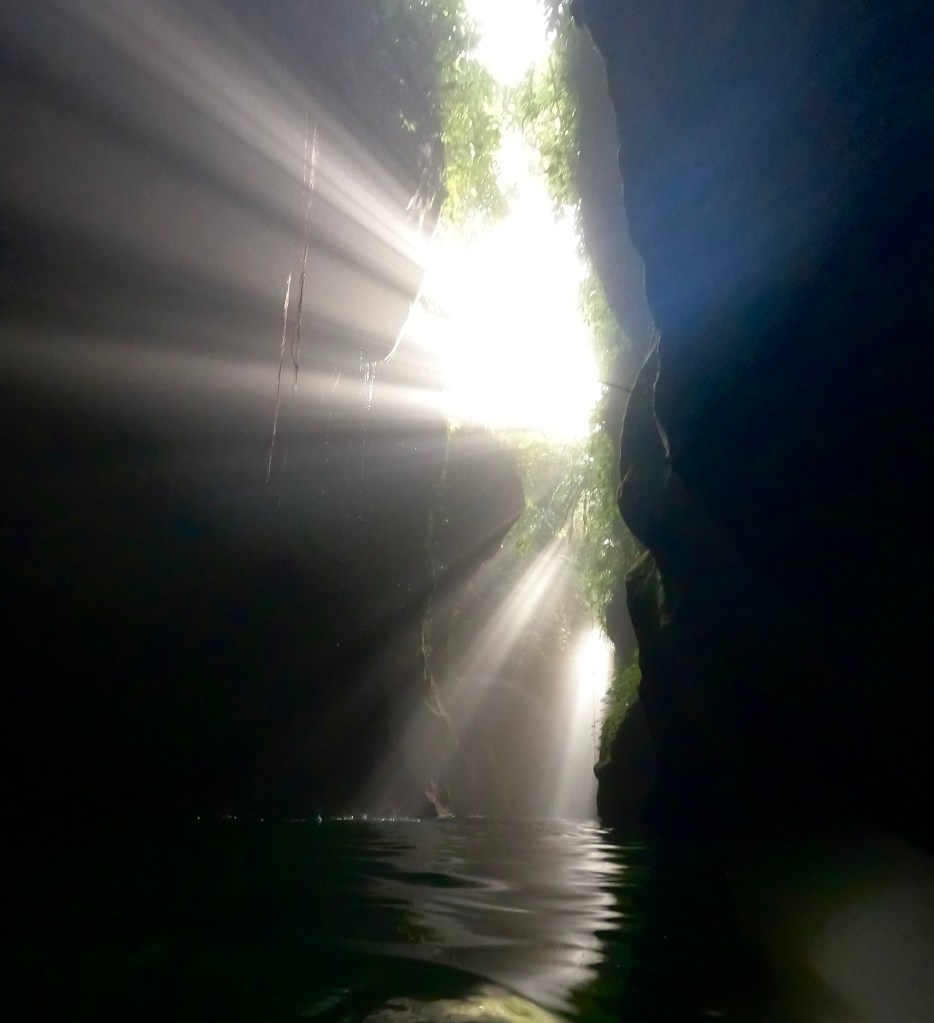
Now it was time to hike back out. We’d been heading down for quite some time, since before we reached the cave. The climb out was going to be a beast.
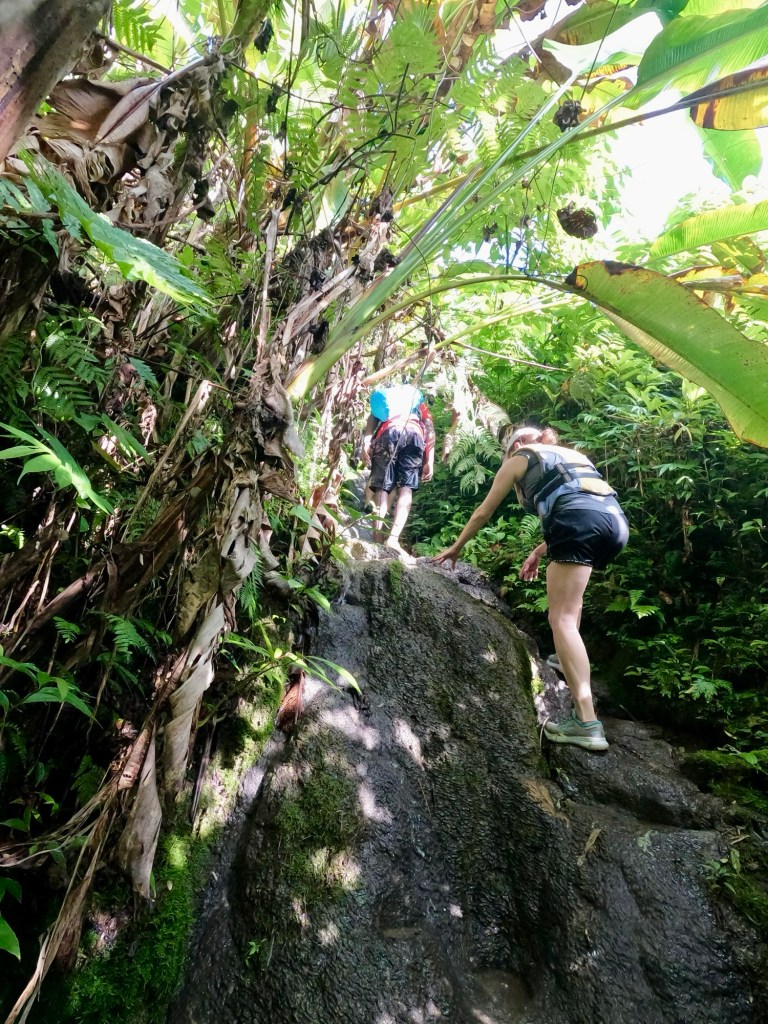
But the climb was also fun. The rock in this area created a great climbing surface — at least if you have a rope to pull yourself along.
And then we reached more rough ladders, which were so long that I sped up the video to make it a bit easier to watch.
Looking back, the jungle was so thick that there really wasn’t any sign of the river or the ravine.

From here, the trail largely leveled out, as we hiked the last stretch back to Funaspef.
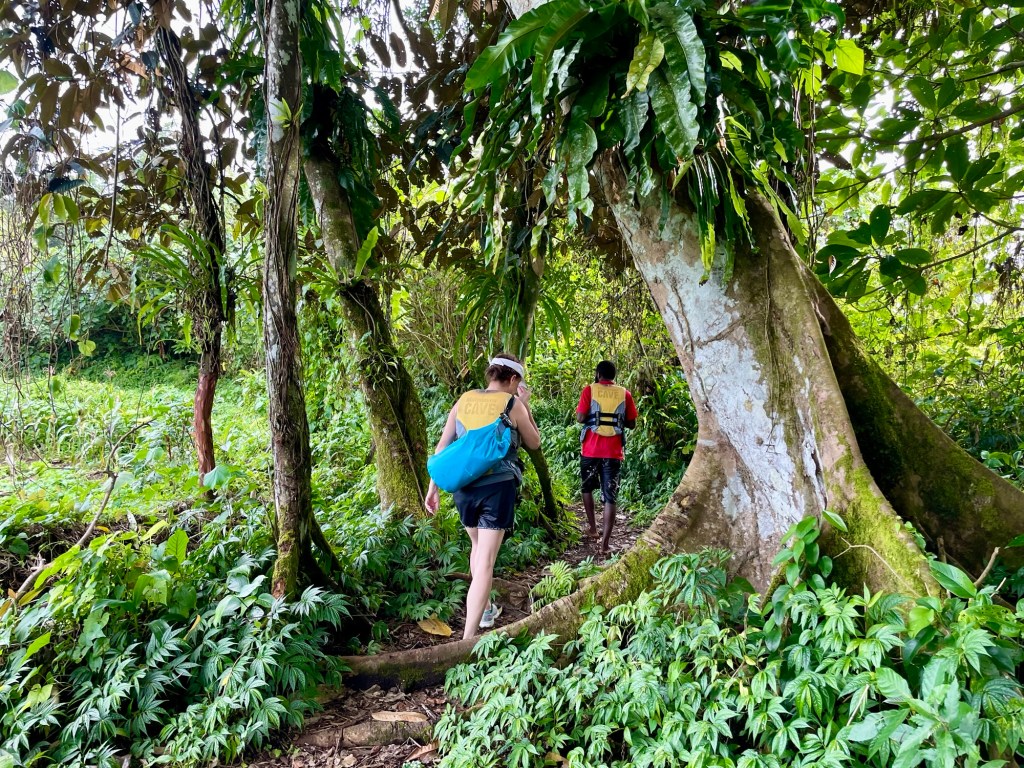
We crossed a small field, where horses and cattle grazed. As we walked, I marveled at our guide’s feet. He’d done this whole thing barefoot.

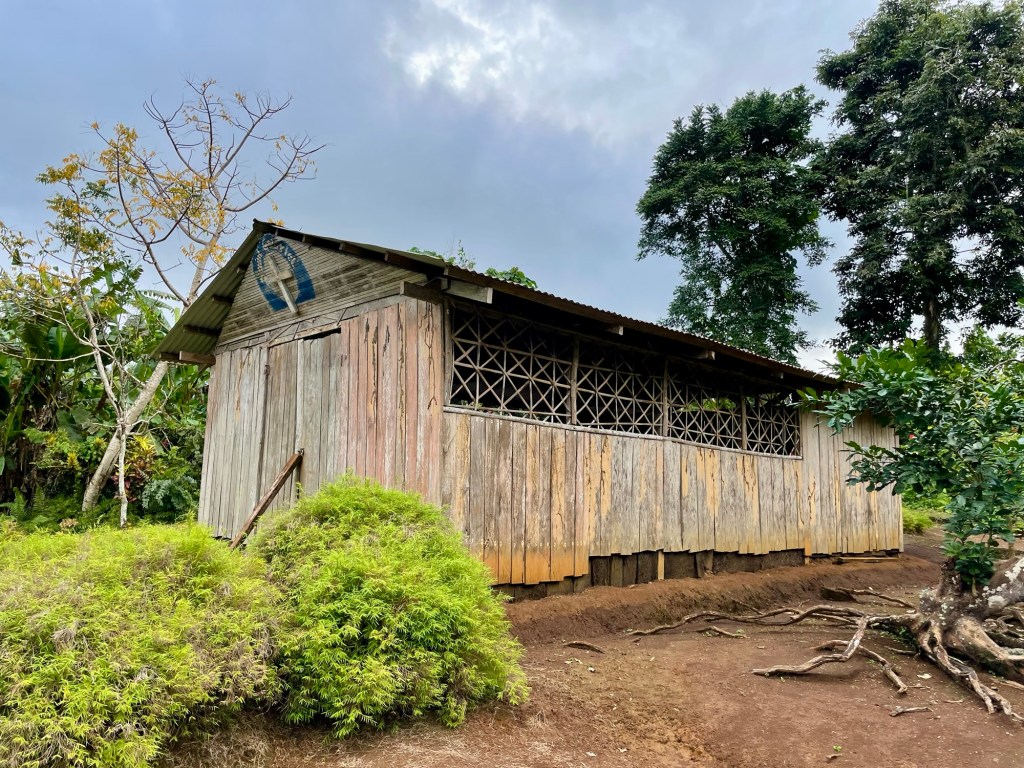
We entered the village from a different part of the jungle than before, passing alongside the village’s tiny church.
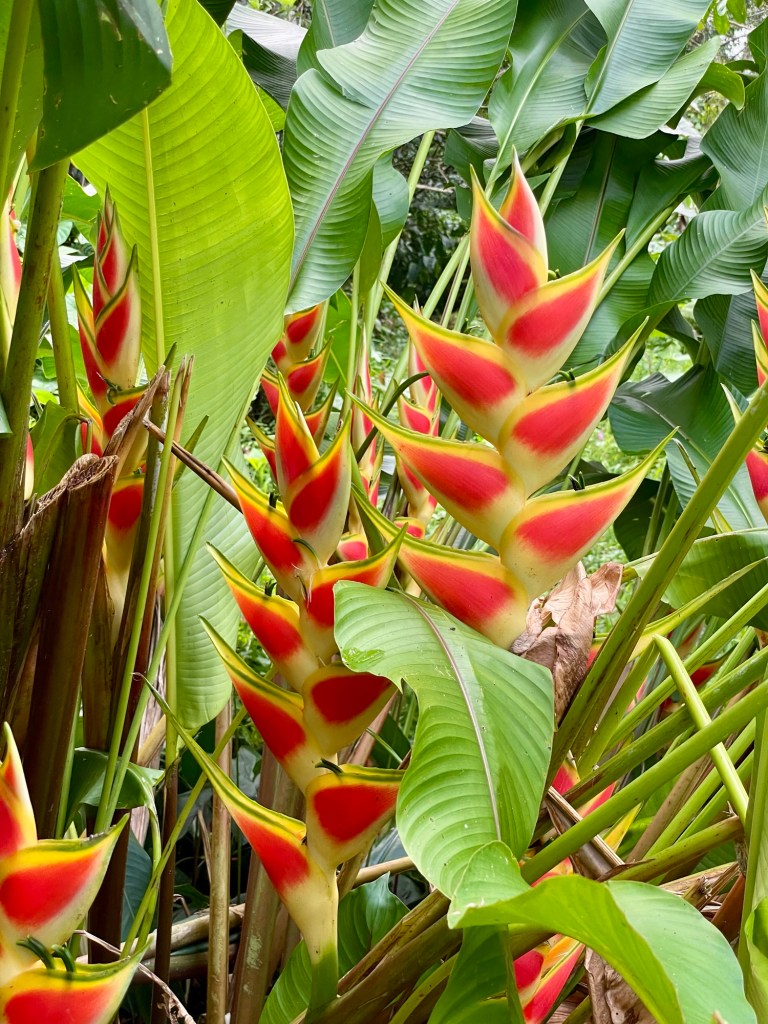
Around the church, there were blooming heliconia, though we couldn’t tell if they’d been planted or simply grown there naturally.
We walked on to the center of Funaspef, with Julie petting some puppies along the way (of course).

Inside one of the buildings we met a mother and her young child. They offered us some oranges and grapefruit, which were delicious. We were almost done — but not quite. We still had to hike back to Nambel to meet up with Michele for the ride home. But we’d basically made it! I mean what could go wrong now?
I probably shouldn’t have been filming myself, but I really wanted the girls to see how crazy the path was. Fortunately, the same mud that made me slip was incredibly soft, so that I landed without injury. Less fortunately, there was a group of about a dozen ni-Van waiting to carry a gigantic water cistern to Funaspef. They had a great view of my tumble, and we all had a good laugh. We crossed the bamboo bridge once again and made it to the truck without further incident. The day had been amazing, and our quiet, French-speaking guide was wonderful. A 10 out of 10 on all fronts!
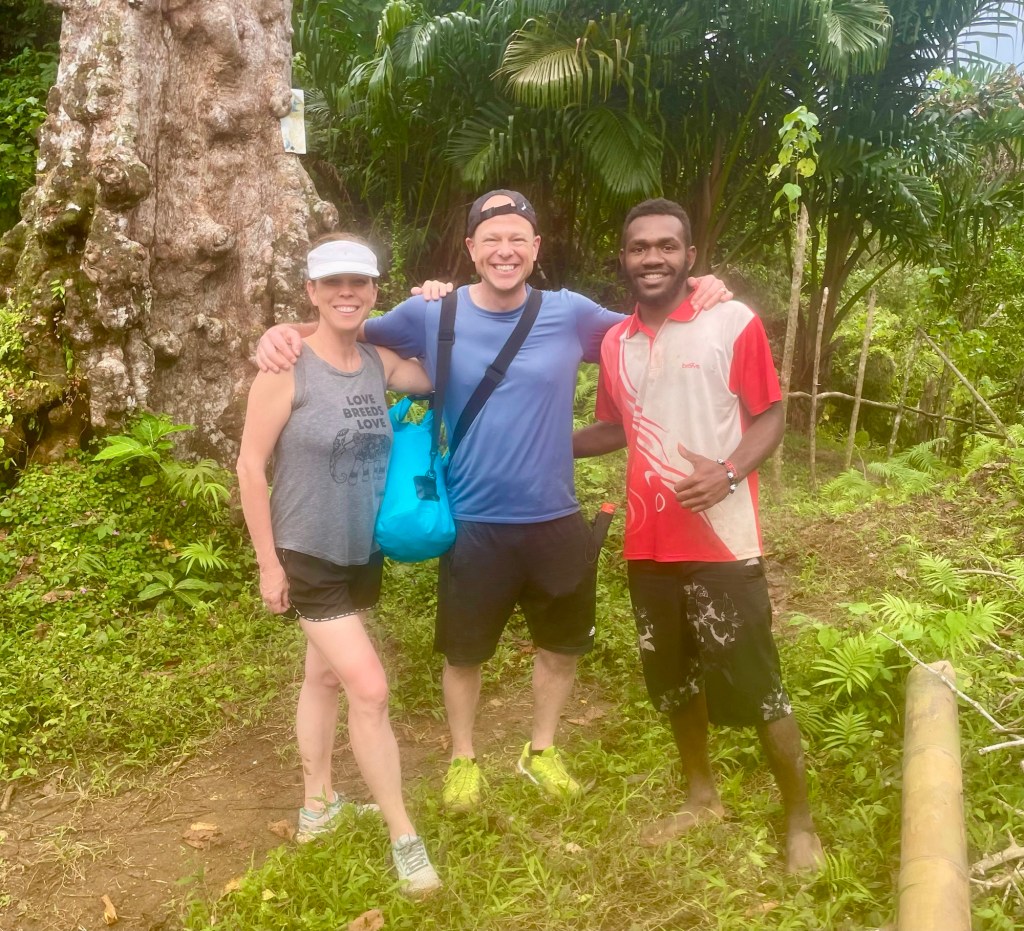
We got back in the truck and drove the muddy, steep, twisting road back to Luganville and then dropped off the Stones. As we headed towards the Turtlebay, we chatted with Michele, who played some local music for us and told us about his life. He dropped us off around 6:30 pm, but before he left, we made a donation to the school that the Millennium Cave Tour supports. We’d budgeted our trip for four people to go on the excursion, so we had a little extra to give. It wasn’t much, but Michele wasn’t expecting it. In response, he hugged us. We hugged him back.
We showered and had another great meal in our open-air restaurant. Over well-deserved Tusker beers, we swapped tales of our days with the girls. Everyone particularly enjoyed the video I took of myself slipping in the mud.
The day was unforgettable. This island of Santo is simply special.
-Will
 The Hubbards' Travel Blog
I’m impressed! By comparison, our Milford Trek was a walk in the park1
LikeLike
Blown away! What an adventure! And the descriptions were the best part…I just wish you had shared with the dear readers what Cassie ate for breakfast. What had the girls watched on Netflix? What had they read while enjoying that spectacular view on the beach? Oh…and your little hike, cave jaunt sounded fun too.
LikeLike