We started Day 58 at our AirBNB in Whitianga. We packed up, drove 2.5 hours to the Auckland airport, and dropped Connor off for his flight back to the US. Team Hubbard+ was now back to just Team Hubbard.
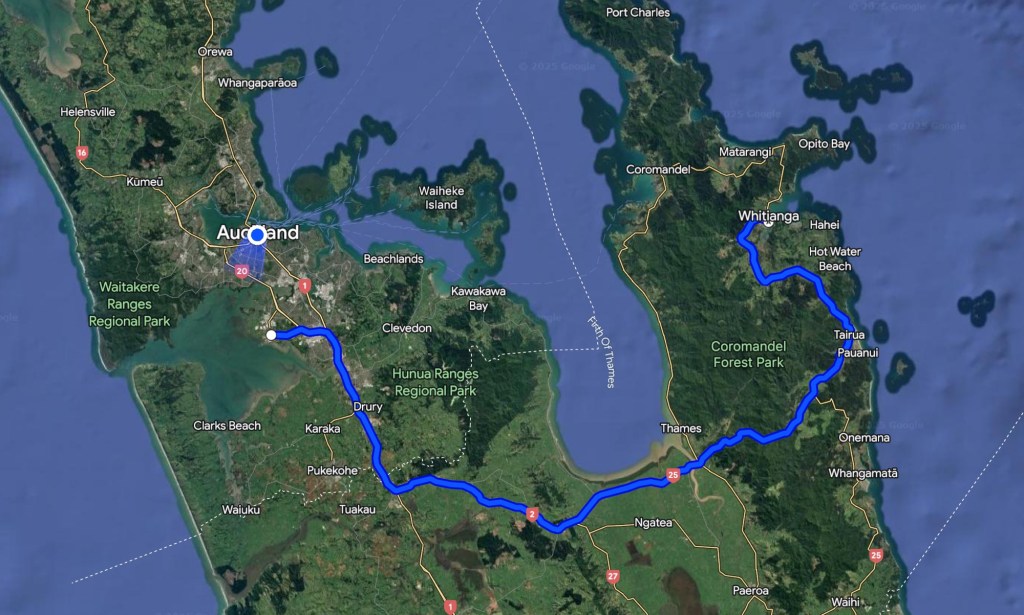
We spent the rest of the day in the orbit of the Auckland airport, where we sorted out some logistics, including a rain-soaked physics-defying effort to pack some of our luggage and sundries into a storage locker at the airport. We dropped off our rental cars and headed to our hotel near the airport, where we cobbled together the last of our food as a makeshift dinner. This was the 15th place we’ve laid our heads on our adventure.
We woke early to catch a 6:30 shuttle to the airport for our 3-hour flight to Fiji, where we had a layover for a few hours. We spent our time sampling the local cuisine.
We soon boarded our 2.5-hour Air Fiji flight to Vanuatu, flying on a medium sized smaller ATR-72, a medium-sized turbo-prop plane. By mid afternoon, we landed at the Port Vila airport in Vanuatu.

Team Hubbard was excited!
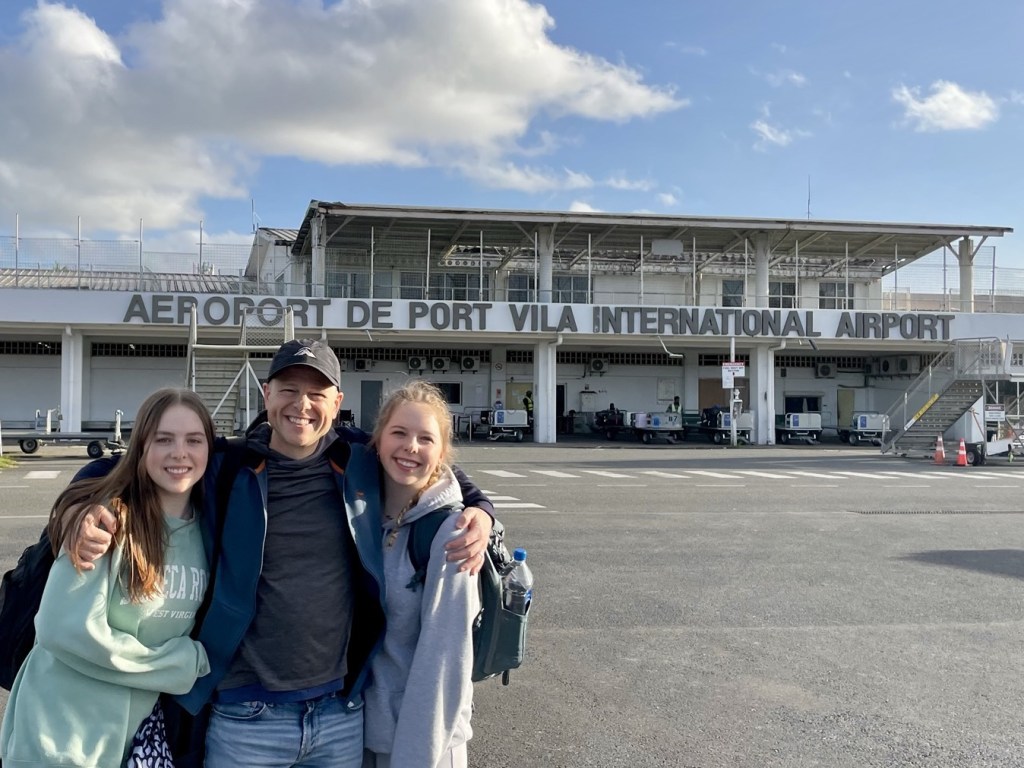
In the small airport, it didn’t take long to get our bags and clear customs. I also picked up a prepaid SIM card so that we’d have a local number and some internet access for navigation. We also got some Vatu (local cash) out of an ATM. Unlike our travels in NZ, where just about everything can be done electronically, cash is king in much of Vanuatu. The exchange rate is a little bonkers, with 1,000 Vatu equaling USD $8.31. We then met up with the shuttle to our hotel (the Fatumaru Lodge) and headed off towards Port Vila, which the locals shorten to just Vila.
As we drove on the bumpy but paved 2-lane road, we learned a couple of things about Vanuatu from our driver (Willy) and his partner (Julie). To start, there are no stoplights or other electronic signals in the entire country. Indeed, Willy claimed that there are no traffic laws at all, and he sure drove like it, frequently veering into the opposing lane to pass slower cars. But Willy and everyone else drove slowly enough that it didn’t cause a problem. More importantly, we just happened to have arrived on the 45th anniversary of Vanuatu’s independence. Up until 1980, the country had been a joint colony of the UK and France, and English and French are still official languages in Vanuatu. As we drove, we saw people out celebrating on the sidewalks and in the backs of pickup trucks. The men wore brightly colored shirts emblazoned with the number 45 and designs in red, green, yellow, and black, the colors of Vanuatu flag. The women wore full-lengths dresses with white fringe at the neck, arms, and legs. Flags were everywhere, small ones held in hands and larger ones strapped to cars and trucks. Vila is a small city, with just under 50,000 people, but in the midst of the Independence party it was bustling.
After about 30 minutes we reached our lodge and checked in. This makes our sixteenth place to sleep!

Well, sort of. Shortly after checking in, we discovered a bit of a plumbing problem. Something was causing water to come up through the floor of our shower. This wasn’t going to work. We talked to reception and discovered that all the rooms were fully booked. The small lodge only had about a dozen units. But the good people at Fatumaru assured us that they’d work something out, so we decided to walk to the town center to get some dinner.
As we walked, we were delighted to discover that the people of Vanuatu — the ni-Vanuatu — are incredible friendly. People passing the other direction greeted us in French or English. Team Hubbard loves this kind of stuff. We soon reached the Banyan Beach Cafe, an open-air beach-front cafe/bar that was packed with ni-Van celebrating under the branches of a big banyan tree. Sure we didn’t have a place to sleep yet, but listening to the celebrations and watching the sun, Team Hubbard was enjoying the moment too much to worry.
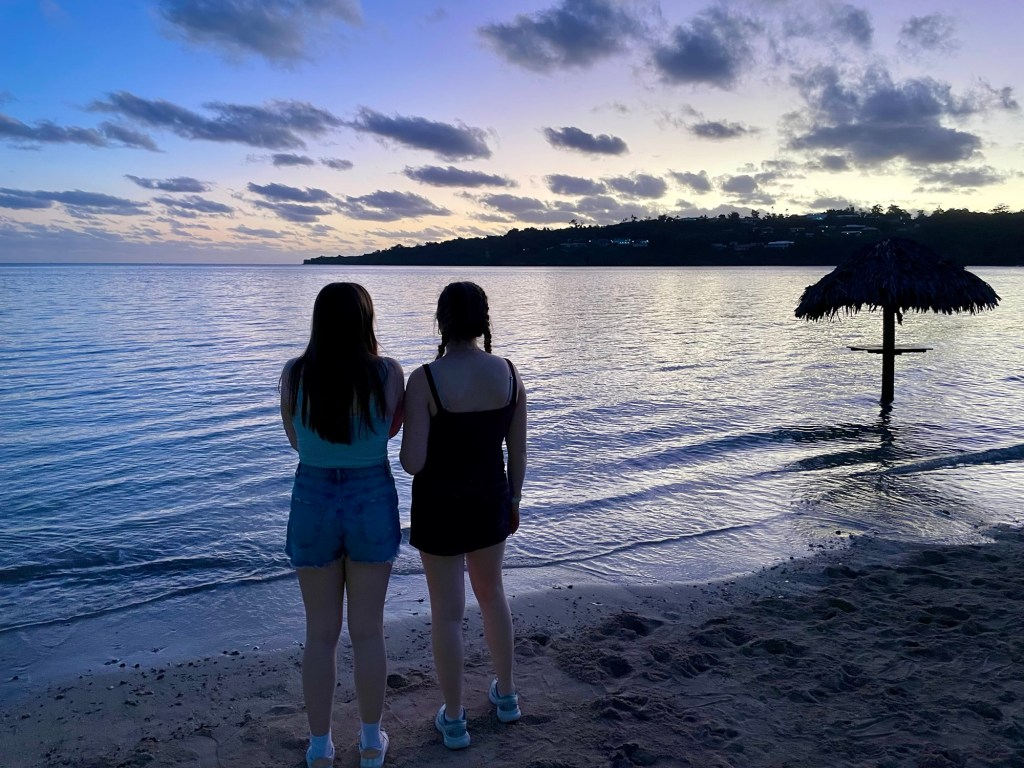
Then we got the news that a massive earthquake in Russia might have sent a tsunami racing towards the South Pacific.
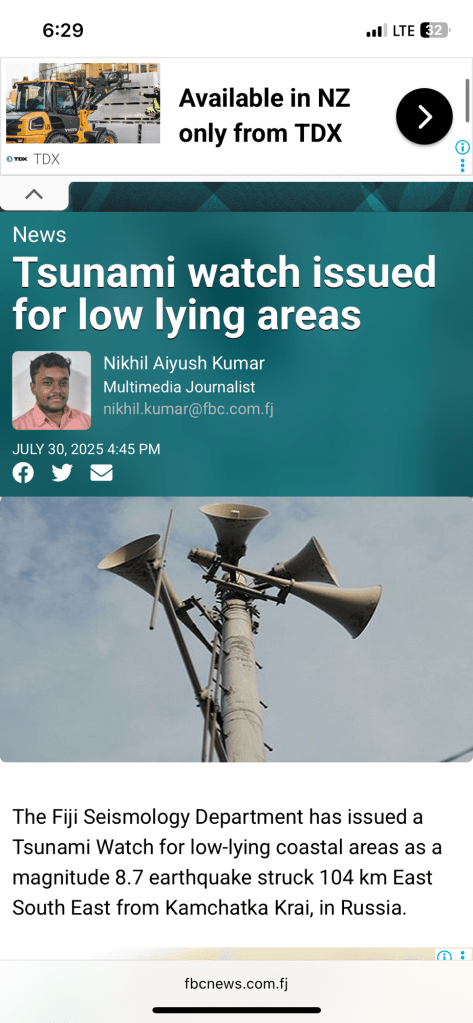
This made us worry a bit. We tried to find more info on my phone but had trouble getting information specific to Vanuatu. It’s a tiny country with relatively few resources. About 330,000 people live here, but they are spread over more than 80 islands. The per-capita GDP is only about USD $3,500. We decided to watch the news for nearby Fiji, which has a population of close to 1 million and far more money. We did verify that Vila has a tsunami warning system, so there’d be some signal if we needed to head for the hills. Julie and I also took the precaution of drinking a couple of Tuskers — the local beer named for the tusks of wild pigs, which roam the islands in Vanuatu.
Towards the end of dinner, the Fatumaru Lodge called to tell us that they’d found a room for us, but that it would be at another lodge. We walked back to Fatumaru, grabbed our stuff, and hopped in another small bus. We didn’t quite catch the name of the new lodge or understand where it was. Hoping for the best, we rode through the dying celebrations of the capital city. The ride ended about 30 minutes later in the dark outskirts of town. Our first night in Vanuatu was a clear win. We’d lucked into a nation-wide celebration, hadn’t been a tsunami, and we had a place to stay.
The next morning the girls and I set off try to find some breakfast. We were more than a hour’s walk from town, but there was a cafe about 15 minutes away.
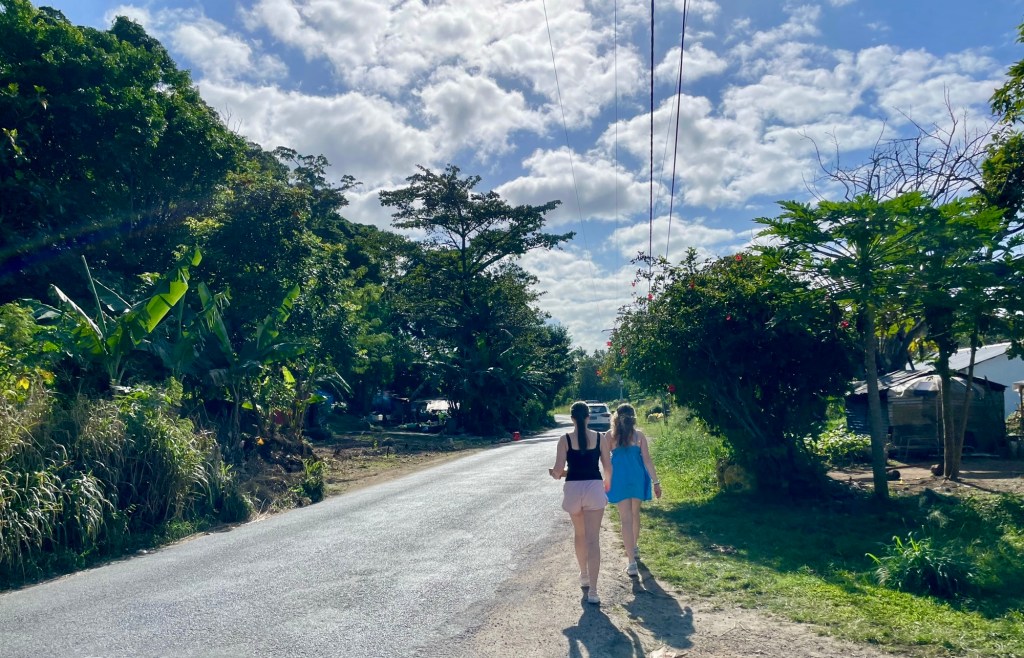
As we walked down the dusty path on the side of the road, we smelled woodsmoke and saw more of the small vans that operate as private busses, which were all elements that reminded me of my time in Botswana 20 years ago. We succeeded in getting some breakfast and some coffee, which we took back to Julie. We then packed up again and headed back to the Fatumaru lodge, where we’d be spending our second night in Vila. We dropped our stuff off and walked back into town. Here, Team Hubbard split up for a short while.
I had an informal coffee meeting planned with the Senior Patents & Designs Officer for the Vanuatu Intellectual Property Officer. I had reached out to him months ago in the hopes of learning more about Vanuatu’s views on IP protection. I later took a photo of the place where we met, as I’d like all of my future business meetings to be in sand-floored places like this.
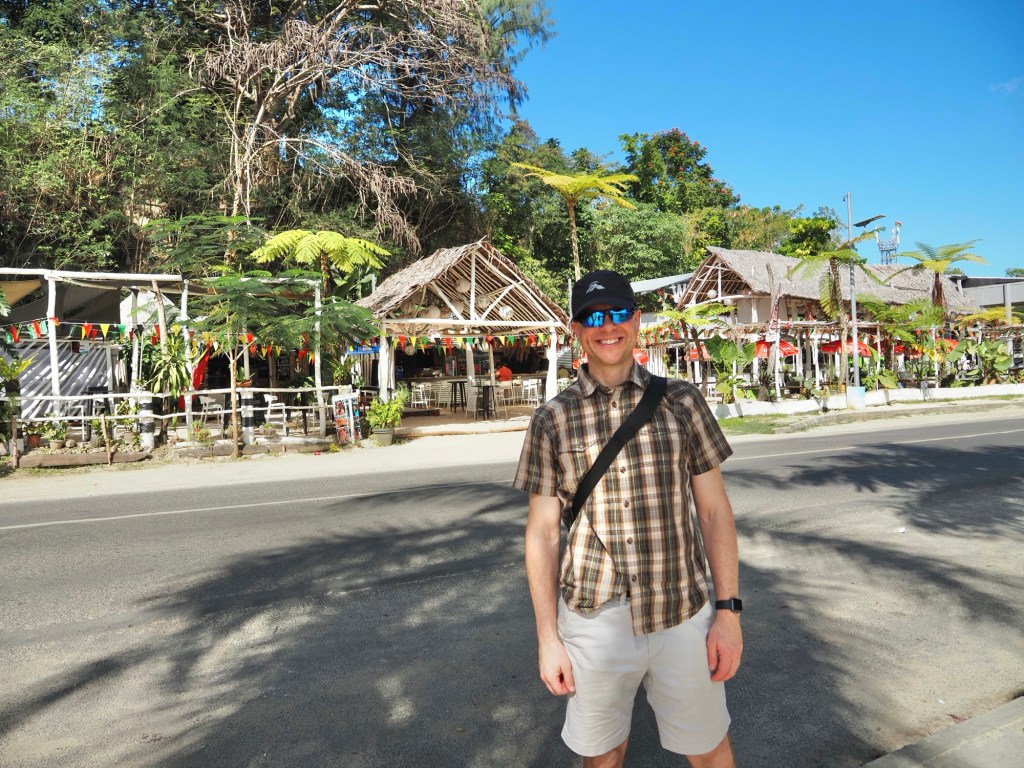
Meanwhile, the girls went to the local market to check out the local handmade crafts. After my meeting I joined them in the market for a bit.
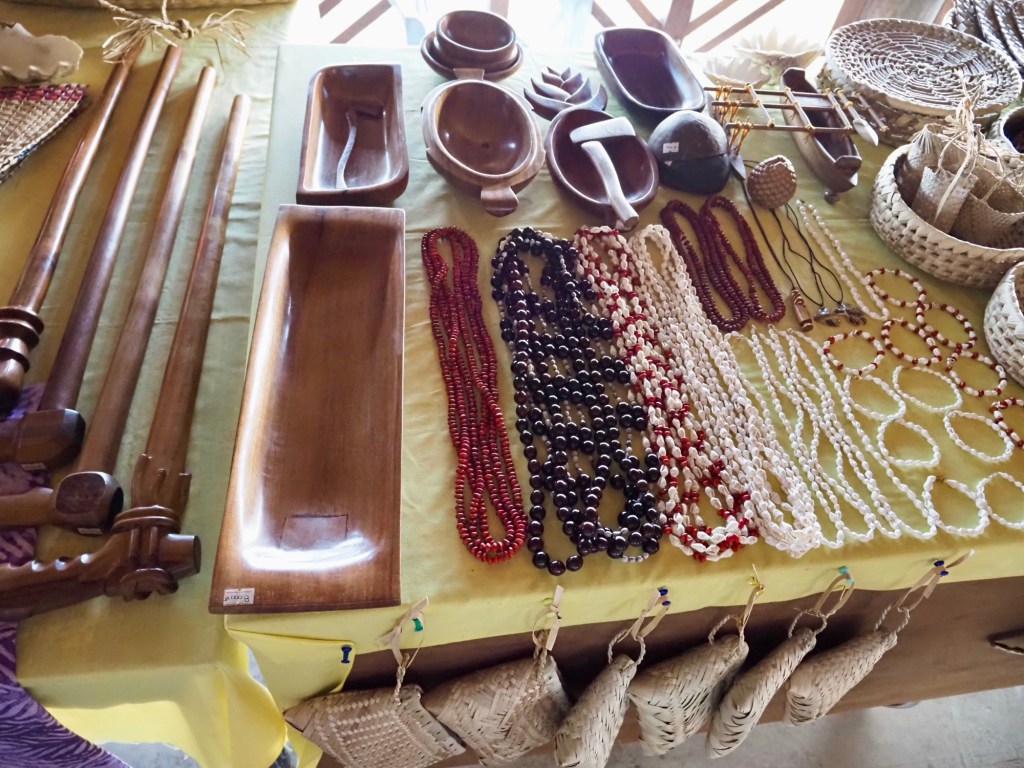
The women who run the market are called “the Mamas,” and they were delightful. Like all the other ni-Van we’d encountered, they were friendly and warm. They taught us a few words in Bislama, the local common tongue.
Bislama has a fascinating, dark history. By some counts, Vanuatu is the most language-dense country in the world. With a population of about 300,000 the country has more than 130 languages. This complicates communication between the peoples of Vanuatu. For much of their history, those barriers may not have mattered, as tribes were on different islands or isolated from each other by mountains and rivers. However, in the 1870s and 1880s, thousands of people from Vanuatu were effectively taken as slaves to work on plantations in Fiji and Australia. There, the ni-Vanuatu needed to communicate with each other, so they developed a new language based on English words and Polynesian grammar—Bislama. The result is that Bislama makes some sense to an English speaker, but only if you think about it for a bit. For example, the Mamas in the market taught us how to say “Thank you very much” in Bislama — “Tangkyu tumas,” which I suppose has roots in a phrase like “Thank you too much.”
And we found many uses for this phrase! The girls bought some tropical cloth wraps.
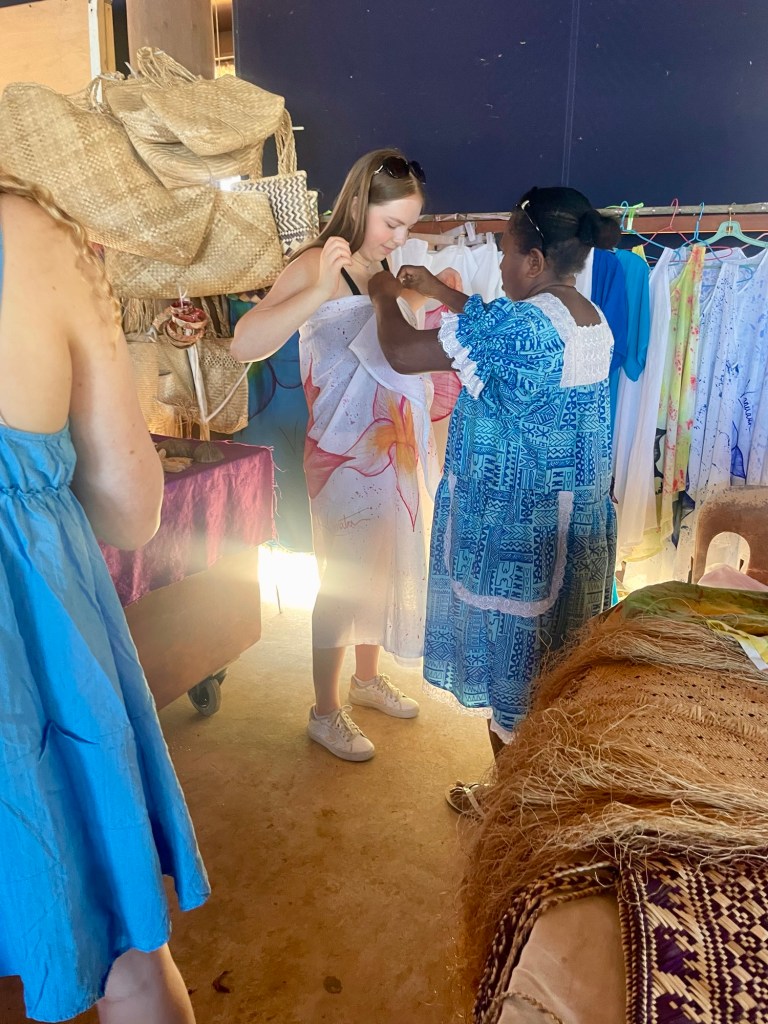
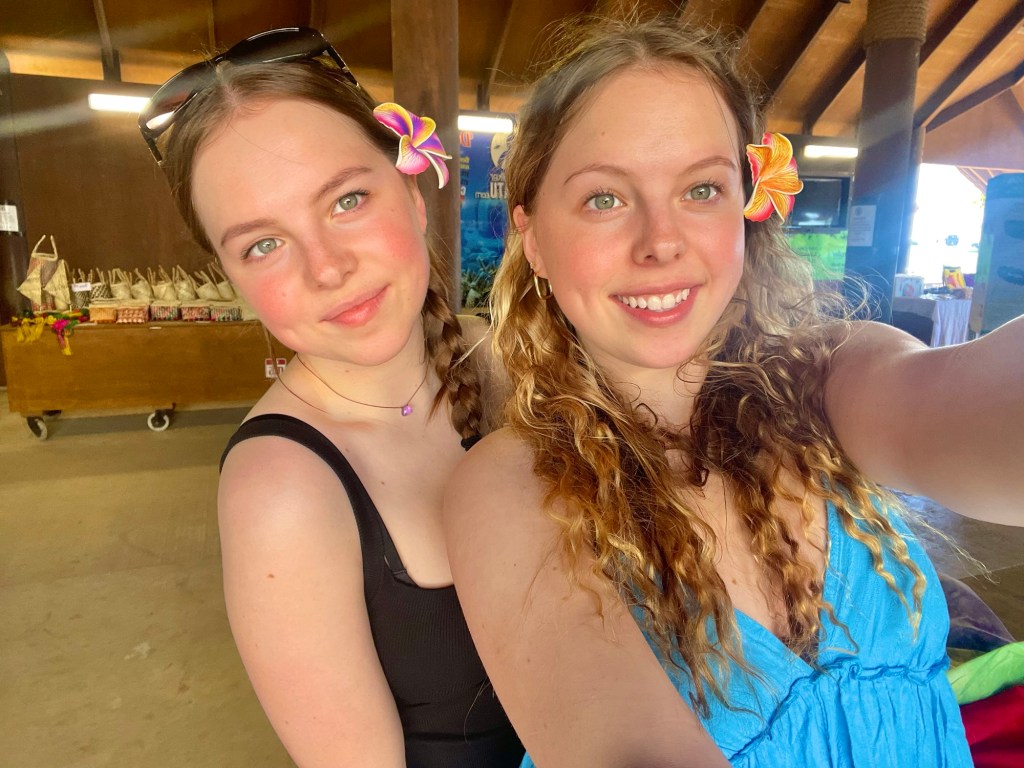
And some cute cloth flowers as accessories. Tangkyu tumas, Mamas!
After the market, we found a cafe on the water for lunch — the Nambawan Cafe (the Number One Cafe).
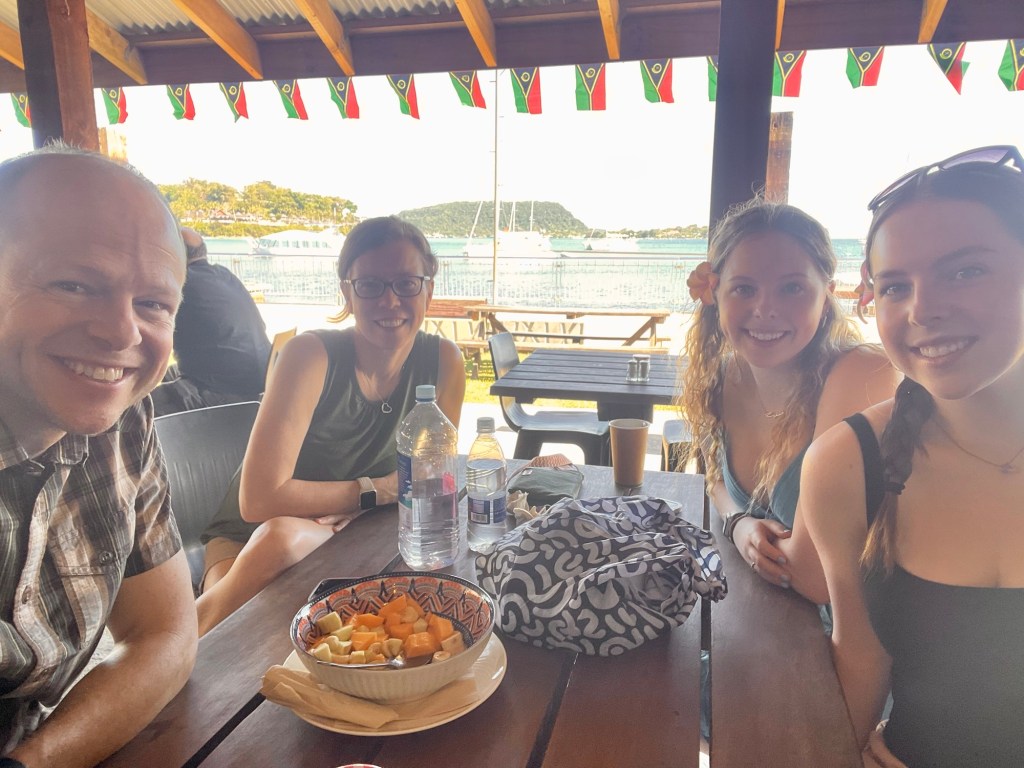
I enjoyed my first good hit of tropical fruit, which was delicious. From here we walked along the waterfront.

Our destination was a small mall, where the girls could get some bathing suits for our time in Vanuatu. We then decided to check out the national museum. To get there we took Vila’s version of public transit – the mini-van busses we’d seen zipping around the island. It’s an informal system. The van pulls up, and you tell them where you’d like to go. If they’re headed that way, they agree. If not, they tell you to try the next van. Our first van worked for us, so we paid 150 Vatu each (USD $1.25f) and were off.
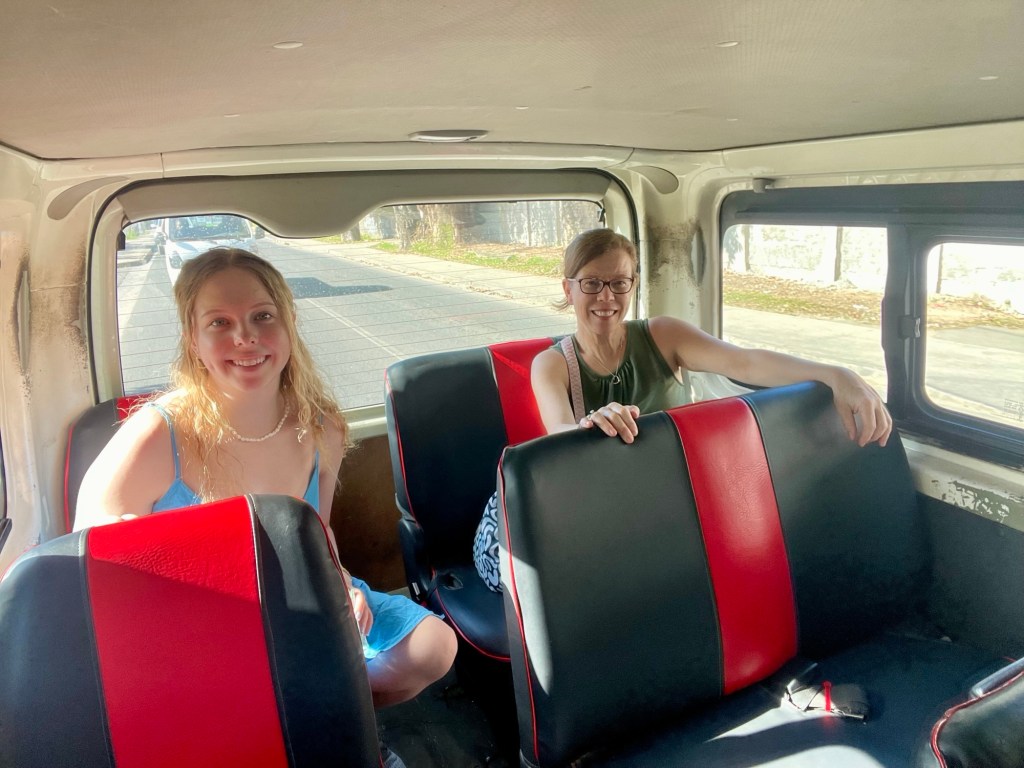
As we drove, we got a better sense of Vila. The city is still recovering from a massive 7.3 magnitude earthquake in December 2025, just 9 months ago. Fifteen people died, but for a country this small that’s a significant number. Numerous buildings were destroyed, with many others rendered unusable. The tourism sector has been hit particularly hard, with many hotels shutting down. The result is that the central business district looks a bit scarred. Rebuilding will be slow, as Vanuatu’s resources are modest. Indeed, we learned from locals that many of the existing infrastructure projects have been aid projects funded from other countries, including Australia, China, France, and the US.
We soon arrived at the national museum, where the sign is in Bislama. Any guesses, dear reader, as to what “blong” means?
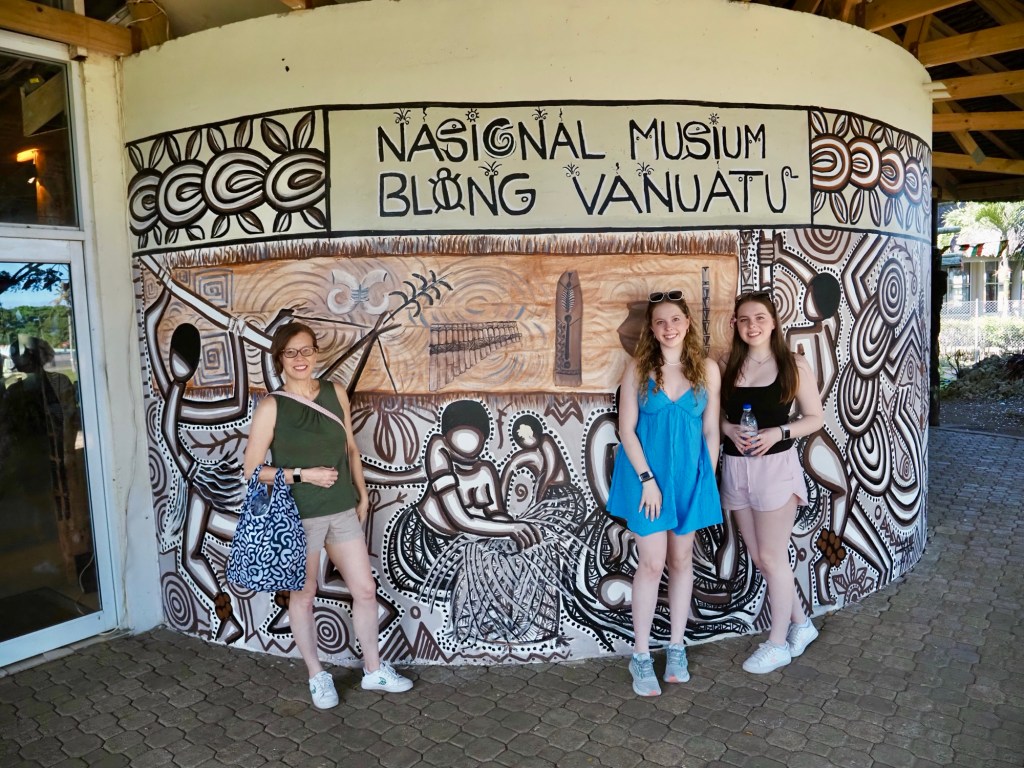
It means “of,” in the sense that the “National Museum of Vanuatu” belongs to Vanuatu. During our entire trip in Vanuatu, I had fun trying to figure out Bislama. I found the Bislama word for “we” somehow cute—“yumi,” i.e., “you me.”
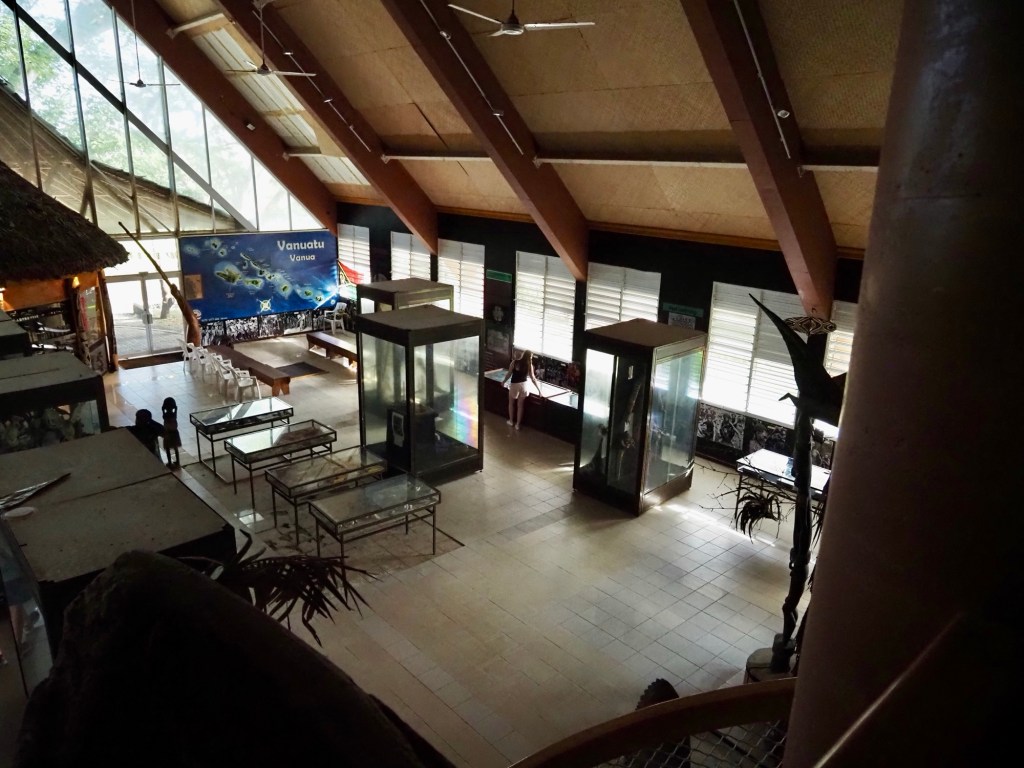
In the small museum we learned more about the country, including the expansion of Polynesian people to Vanuatu (well before any Māori reached New Zealand), early visits by the famous Captain Cook, and ongoing cultural traditions like sand drawing.
After the museum, we returned to the Fatumaru lodge and checked into our new rooms —number 17!

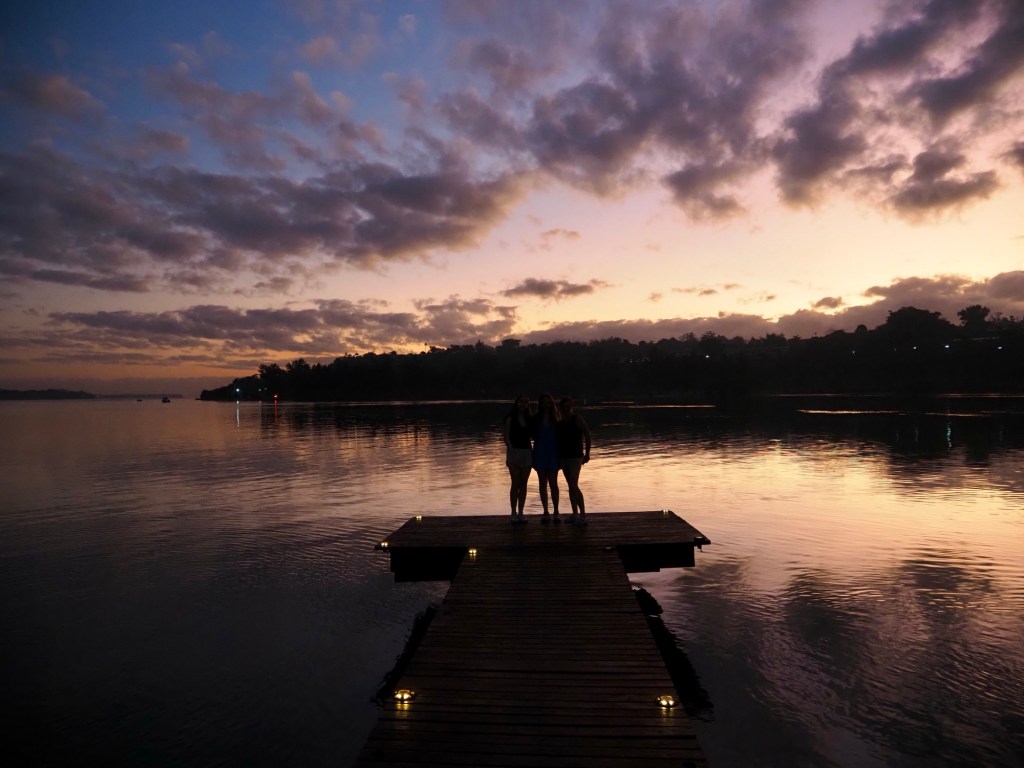
Even better, the plumbing problems were all sorted! We cleaned up and enjoyed the sunset.
For dinner, we headed to a lovely French-inspired restaurant on the water.
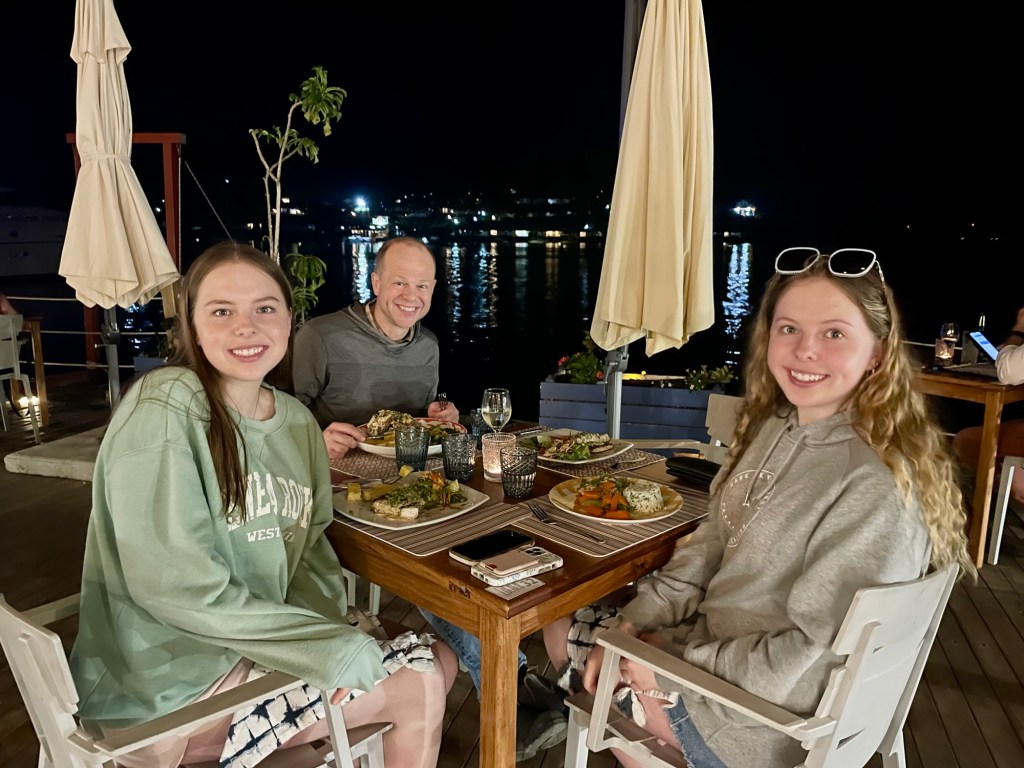
We decided to try the coconut crab, a local massive crustacean that Julie and I last had on our honeymoon in French Polynesia.
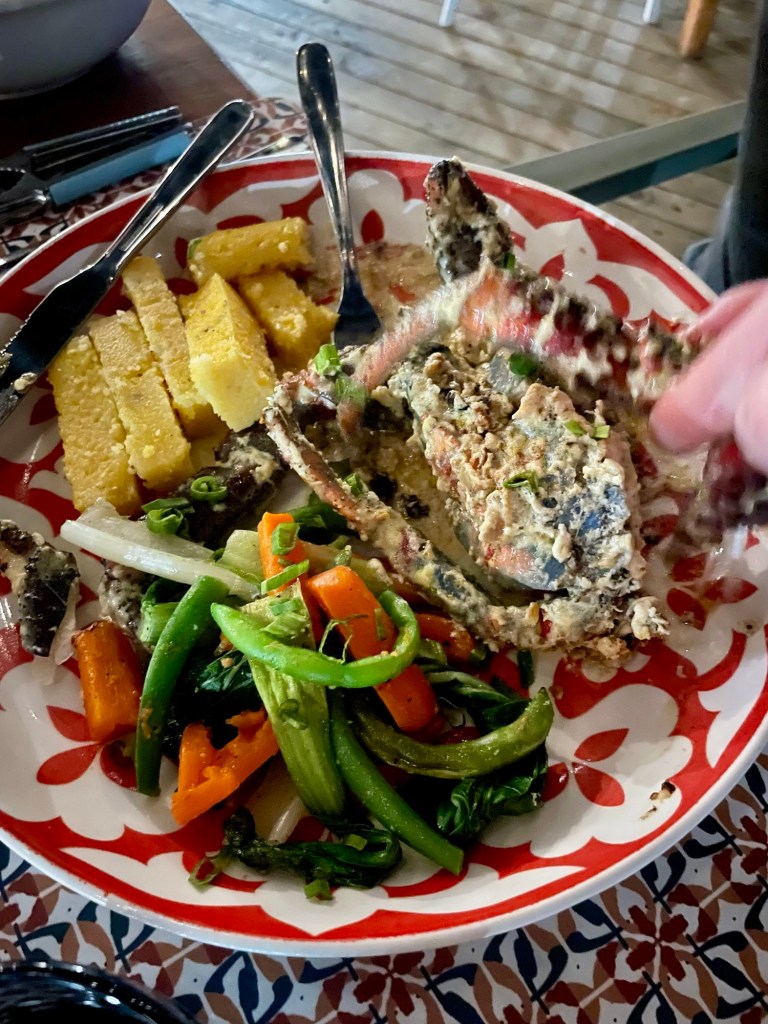
It was delicious, but it was also a mess! We probably were doing it wrong, but trying to crack the thick shell when it was covered in a slippery cream sauce seemed like a prank. We all enjoyed it anyway.
We had a wonderful day in Vila. It helped us to begin to understand a little bit about this country. Coming from the US, we don’t know much about Vanuatu. So far, everything we’ve learned and encountered has delighted us. This tiny country is something special.
-Will
 The Hubbards' Travel Blog