Our plan for June 30 was to explore Christchurch a bit more, starting with a tour on one of the hop-on-hop-off trollies we had seen cruising on rails around the city. On the way to walking to the main trolly station, we walked by the Christchurch Cathedral, a large stone building dating to the 1860s. The church was still being repaired after a 6.3 magnitude earthquake struck the city in 2011. Portions of the building were still in pieces on the ground, and huge metal structures had been erected to support the destabilized walls. We thought it odd, however, that nobody was working on the church. But we’re just tourists, so what do we know? Maybe it was a holiday. We shrugged and walked on.
We soon reached the trolly station, got our tickets, and set off.
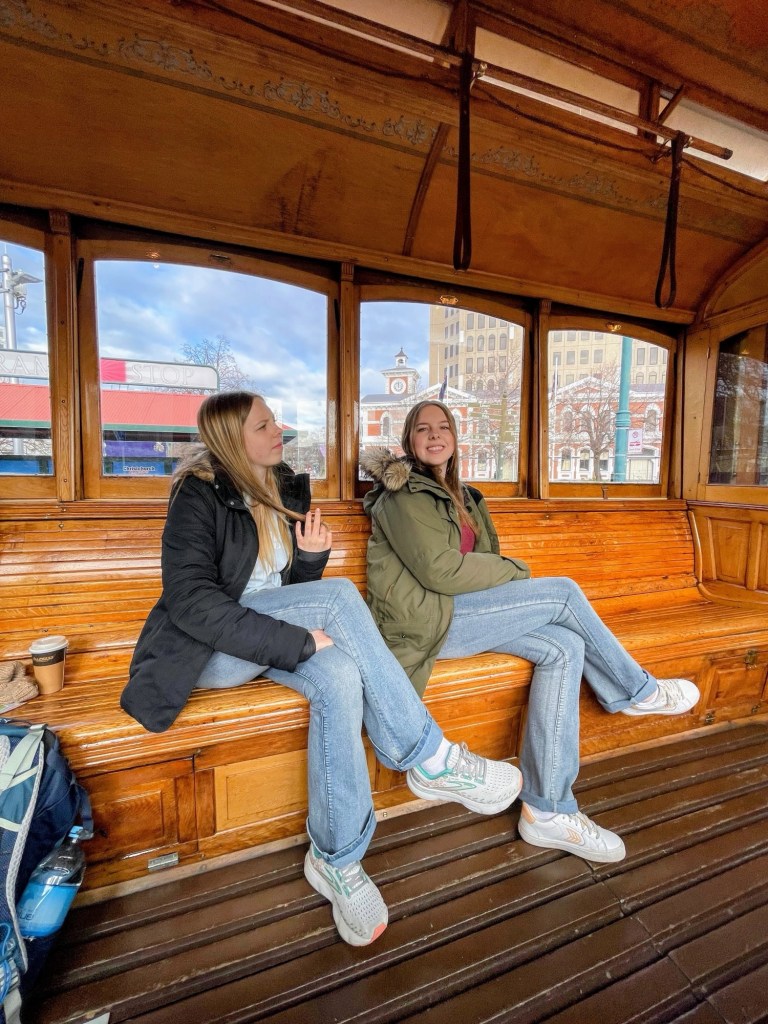
We happened to be riding on Tram 11, which is the oldest in the fleet. It was made in 1903 and operated in Dunedin for decades during an era when many people used trams for general transportation needs. The tram retired from active duty in 1953, and now is mostly used for tourism. We had a charming guide who did a great job of helping us understand how the quake affected the city.
I remember the quake being in the news, but it didn’t make much of an impact in the US. Here, it was a major tragedy. The quake killed 185 people, a substantial number for a city of only 375,000 people. More than 70% of the buildings in the city were so damaged that they had to be razed following the quake. Between 2010 and 2021, the population in Christchurch dropped by 21,000.
This context helped to bring a few things into focus for us. We had been struck for the past few days about all the construction in Christchurch. Our apartment was just around the corner from the site of a fancy newstadium being built. We’d also been talking about how clean and new the central business district felt. The city appears vibrant, and in a way it is. But rather than merely stemming from prosperity, it is a reflection of more than 10 years of work to rebuild from the earthquake.
Sadly, some of the repair efforts haven’t gone well. The project to repair the cathedral we’d walked by spiraled out of control, spending far beyond its budget. Without funds, repairs are at a standstill. The next steps are unclear. The workers at the cathedral weren’t on holiday. There are no workers anymore, leaving an architectural corpse in the center of the city.
Yet other reconstruction efforts are humming along nicely. The stadium is expected to finish on time and under budget. And the many new buildings in Christchurch have been constructed with earthquakes in mind. Building heights have been capped. Larger foundations now include base isolators, which allow buildings to wobble a bit rather than break. Small gaps have been left between buildings for that shimmy.
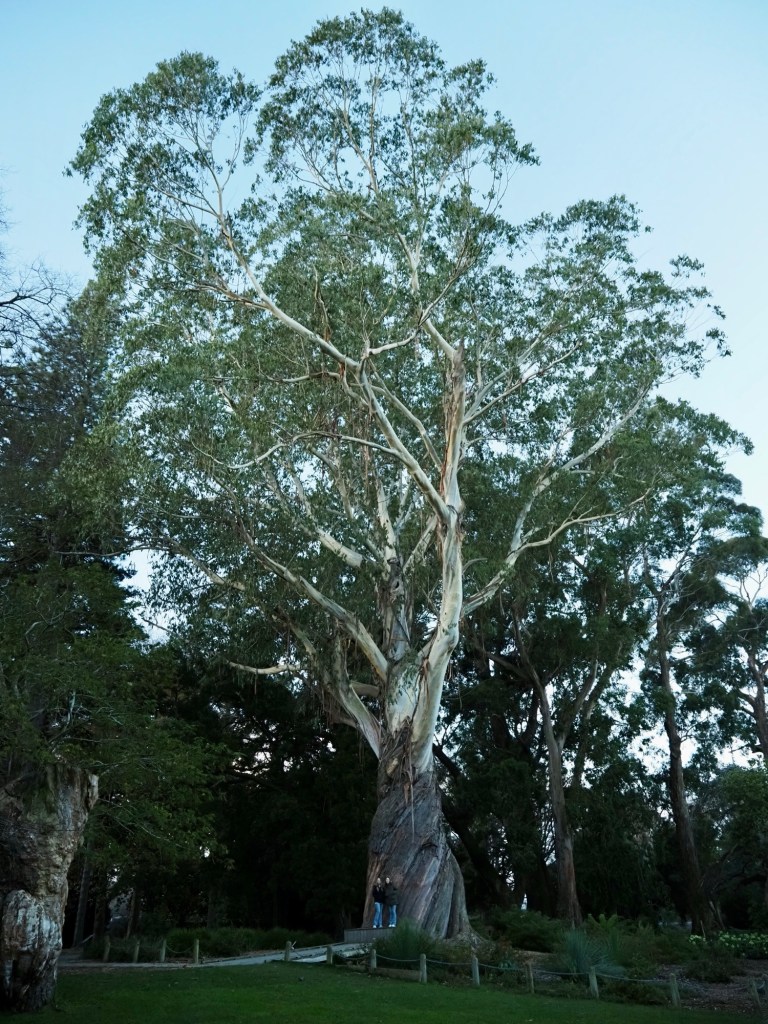
We rode the tram for a bit and got off near the botanical garden. We walked around the garden for a while and admired some of the impressive local specimens. This eucalyptus tree was particularly impressive.
We left the garden and started to walk back to our flat. Along the way, we passed through the Christ Church Art Center, which is housed in stone buildings that were once part of Canterbury College. We saw some interesting art installations, but were mostly just passing through.
As we were leaving, Julie started chatting with a woman who looked about our age. She said that she was in charge of fundraising for the Art Center. She told us that in years since the quake fundraising has been tough. Donors are overtaxed by the many worthy needs, like the repair of the cathedral. She also told us that her children were looking outside of Christchurch and outside of New Zealand for better opportunities. Even her son with a degree in electrical engineering was struggling. We’d read about this problem, but talking with this Cantabrian (evidently that’s what you call someone from Christchurch) brought it home in a personal way, particularly with Lydie and Cassie studying engineering.
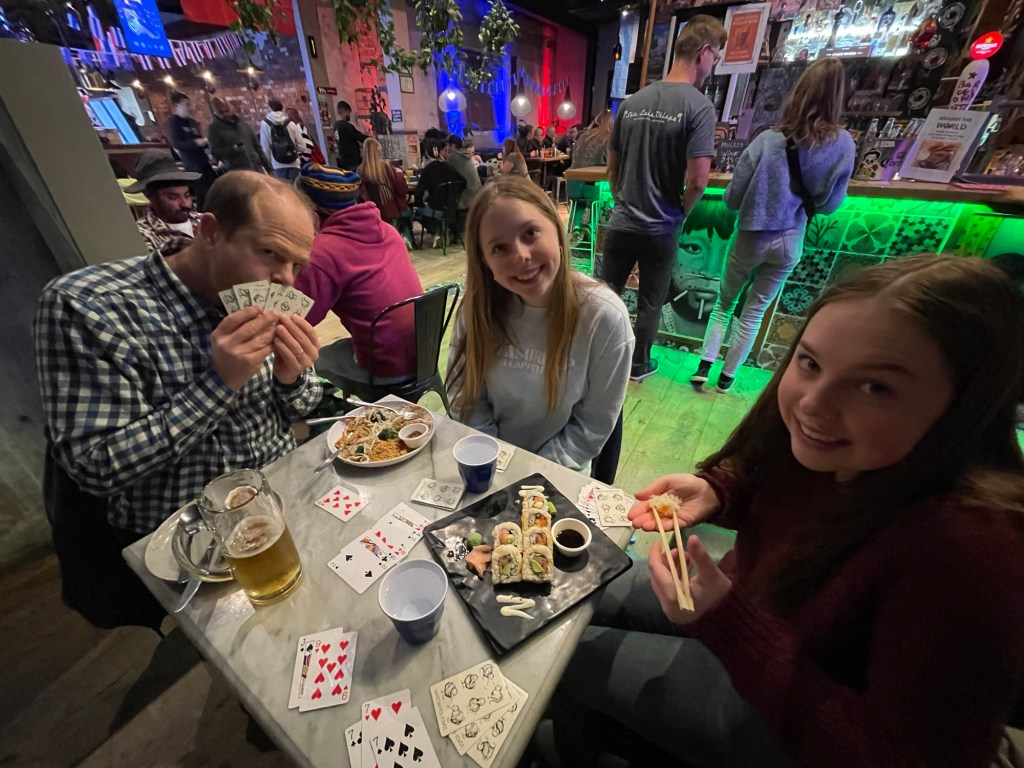
For dinner we found another local food hall, where we played cards as we waited for our food.
Our time in Christchurch felt like a full arc. This is a wonderful city, bustling with new construction, energy, and possibility. It’s charming, livable, and set in a beautiful locations. But it’s clearly still in the midst of a painful recovery. We hope it will fully bounce back, cathedral and all.
We think it will. The big eucalyptus tree we saw at the botanical garden has thrived for a long time despite earthquakes, economic cycles, and the general isolation of New Zealand. Our fingers are crossed that Christchurch will likewise grow, but this time with earthquake-proof roots.
-Will
 The Hubbards' Travel Blog